

We Are Past the “One-Trigger” Moment
What the cycle of insurrection looks like in America.

Another life has been extinguished — this time on a Minneapolis street — and once again federal immigration agents stand at the center of it. On January 24, 2026, a man was fatally shot during an ICE/DHS enforcement operation; video circulating online shows agents grappling with him moments before agents discharge their firearms against a man on the ground.
Authorities insist he was armed within seconds after the incident.
Political leaders immediately began disputing narrative and culpability, as if the argument itself were the substance.
This followed the January 7 killing of Renee Good, a 37-year-old American citizen shot by an ICE agent in south Minneapolis — an incident that catalyzed mass protest almost overnight. Together with a third fatal encounter, these deaths form a pattern the federal government appears determined not to recognize.
Predictably, the official apparatus performed its well-rehearsed routine. Federal spokespeople insisted the actions were lawful. Allied commentators rushed to justify the violence. Republican officials inflated threat narratives. Democratic officials offered condolences, condemned the optics, and demanded accountability they lack the power — or will — to impose. This is the choreography of contemporary American crisis: defend the agents, denounce the unrest, disclaim responsibility, and escalate rhetoric in place of policy.
The streets, equally predictably, have responded. Over fifty thousand people participated in mass demonstrations in Minneapolis on Friday, including a coordinated economic shutdown branded the “Day of Truth and Freedom,” closing businesses, universities, and workplaces across the state.
This was not a riot. It was organization.
From that organization, a simple inference follows: the social contract is unravelling. When federal law-enforcement actions reliably catalyze mass civil resistance — and when political elites either sanctify violence or offer procedural regret — institutional legitimacy erodes. This is not rhetoric. It is a historical regularity.
A Crisis of Legitimacy, Not Temper
Two people have now been shot dead by federal immigration agents in Minneapolis in a matter of weeks — both of them U.S. citizens. The federal response has been notable not for alarm, but for bureaucratic serenity.
Everything was lawful.
Everyone deserved it.
Case closed.
The machinery hums on.
The Department of Homeland Security responded to public outrage not with restraint but with escalation. Protests were met with expanded deployments and conspicuous shows of force. There have now been at least six recorded incidents of ICE agents threatening or presenting deadly force against unarmed individuals to enter homes, effect arrests, or conduct routine operations.
ICE now claims authority to conduct traffic stops, enter private residences without judicial warrants, and perform so-called Terry stops without probable cause against citizens and non-citizens alike.
This posture has not been disavowed. It has been celebrated. The Secretary of Homeland Security has advised the public to be prepared to “show their papers.” The Vice President of the United States has publicly, and erroneously, asserted that ICE agents have “absolute immunity” in their actions and operations.
What followed was not hysteria but coordination. One killing produced outrage; outrage produced organization. A statewide shutdown followed. A third killing did not shock the public into silence — it clarified the pattern. When violence repeats without consequence, it ceases to resemble misfortune and begins to look like method.
Labor unions, clergy, community organizations, and ordinary citizens now confront armed agents directly, asking — not rhetorically — whether they are next. You’re going to have to kill me. That is not protest language. It is the language people use when they no longer believe authority is constrained by law.
This is not “people being mad.” It is legitimacy collapse — the point at which repeated lethal force, dismissed with official shrugs, convinces the governed that power answers only to itself.
In American history, this is the necessary precondition for insurrection: not rage, but resignation — the quiet conclusion that obedience has become irrational.
The Government Is Accelerating the Spiral
The government’s official framing is not calming the situation; it is accelerating it. Each time federal officials line up to insist the shootings were “legitimate enforcement,” that agents “feared for their lives,” and that protesters are irrational or dangerous, they are not restoring order.
They are advertising indifference to murder.
To people on the ground, this language does not read as reassurance. It reads as a dismissal of the value of their lives. It signals that whatever occurred is irrelevant — that the verdict has already been rendered and no institutional process will meaningfully interrogate it. From the President downward, the message is remarkably consistent: we do not care, you cannot stop us, and there will be no reckoning.
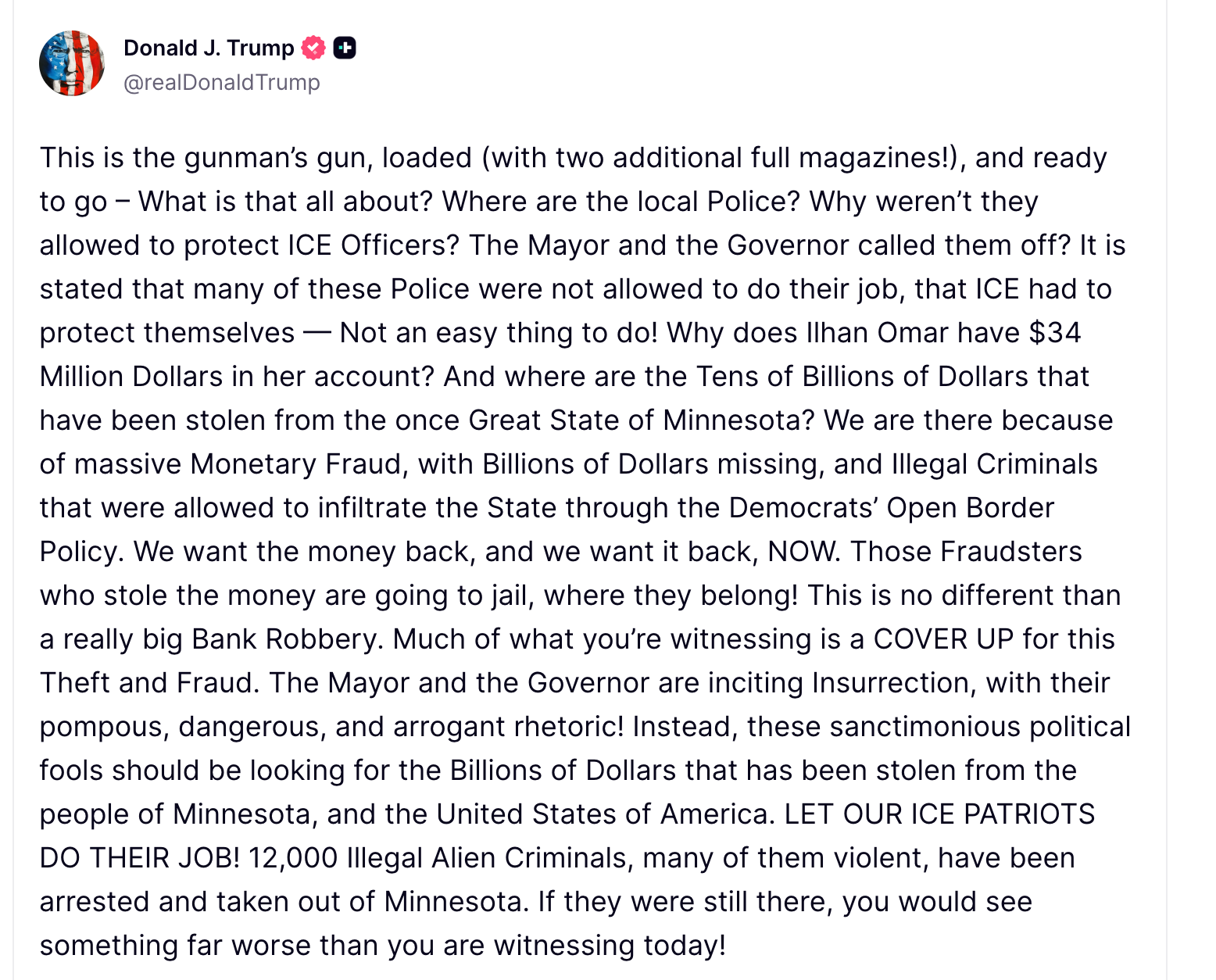
President Donald Trump, January 24th, 2026, at about 1PM Central.
About roughly four hours after the incident.
This posture feeds escalation in two predictable ways. First, it validates the protesters’ central conclusion: that official channels are decorative rather than corrective. When repeated killings are waved away as proper, accountability stops looking delayed and starts looking impossible. Petition gives way to confrontation.
Second, it destroys the signaling value of restraint. If the government insists everything is fine, moderation accomplishes nothing — while escalation carries no additional political penalty. Once that calculus sets in, restraint stops being virtuous and starts being foolish.
Thus, it is the federal government — not the mayor of Minneapolis or the governor of Minnesota — that is accelerating toward rupture.1
Past the One-Trigger Moment
Every regime in trouble insists unrest is an overreaction to a single incident — a bad arrest, a tragic mistake, an isolated abuse. This is not analysis. It is self-exculpation. The “one-trigger” narrative exists to preserve the fiction that the system is otherwise sound.
That fiction has failed before.
In the late nineteenth and early twentieth centuries, labor unrest followed this exact arc. Individual strikes were dismissed as criminality. Killings by private or state forces were justified as necessary. Courts and executives closed ranks. What followed were general strikes, pitched street battles, and eventually federal intervention — not because workers were “mad,” but because institutions refused correction until confrontation became inevitable.
The pattern repeated itself in the civil rights era. Early police violence was rationalized as crowd control. Federal authorities urged calm while declining to intervene meaningfully. Only after violence escalated — after Birmingham, Selma, and urban uprisings — did legitimacy collapse force federal action. Until then, restraint was rewarded with indifference.
It repeated again in the late 1960s and early 1970s. Campus protests were dismissed as radical theater. National Guard deployments were framed as efforts to restore order. When force finally spilled into bloodshed, the state discovered — too late — that its authority had already decayed.
The lesson is consistent: the trigger never matters as much as the refusal to adapt once the pattern is visible.
Why Minneapolis Is More Dangerous
What distinguishes Minneapolis is not the intensity of anger, but the coherence of mobilization and the explicit collapse of trust in institutional correction.
People are not waiting to see how investigations turn out. They have concluded that the outcome is pre-written. They are not arguing about policy. They are arguing about legitimacy.
That is a far more dangerous dispute.
When people believe the system is biased, they protest within it. When they believe the system is fake, they begin operating around it. This is why rhetoric has hardened. This is why economic disruption has entered the picture. This is why enforcement escalation is backfiring.
The public has already updated its priors.
What Comes Next
History does not guarantee insurrection. It guarantees probability.
If current dynamics persist, several outcomes become more likely: protests become more frequent rather than larger; enforcement grows more aggressive rather than more effective; political rhetoric intensifies while control diminishes; accidents and miscalculations multiply. None of this requires conspiracy. It requires only inertia.
Insurrection does not begin with slogans or weapons.
It begins when obedience stops making sense.
Minneapolis has not reached that endpoint. But it has crossed the threshold where old explanations no longer work — where calls for calm sound like mockery, and assurances that everything is fine read as provocation.
That is not noise.
That is a system entering a legitimacy crisis — and history is unforgiving to governments that mistake that moment for mood.
DHS officials (including statements attributed to Bovino and others), in the immediate aftermath of today’s incident, asserted that the individual shot presented deadly force to officers. The difficulty with that claim — and one I expect anyone trained in use-of-force doctrine will immediately recognize — is that it does not align with either the available video evidence or, arguendo, the agents’ own conduct.
If an individual had, in fact, approached ICE agents while actively brandishing a firearm and threatening imminent deadly force, the lawful response at that moment would have been the immediate use of deadly force by the agents. That outcome would have been tragic, but it likely would have been legally justified. Under settled law, when an officer reasonably believes an individual presents an imminent threat of death or serious bodily harm to the officer, other officers, or the public, the officer is entitled to use deadly force to neutralize that threat. Officers are not legally required to attempt de-escalation in such circumstances, even if de-escalation is often trained and encouraged.
That is the law.
The problem is that DHS’s narrative does not comport with what the video appears to show. The footage depicts a group of protestors being approached by ICE Agents. The footage depicts one of those agents being manhandled by those agents. The footage depicts multiple ICE agents attempting to wrestle the man to the ground and effect an arrest — conduct inconsistent with an assessment of an immediate deadly-force threat. One agent, who does not appear to be physically engaged in the struggle, then draws his sidearm and fires at least two shots while other agents have their hands on the individual. The agents subsequently disengage, and additional shots appear to be fired while the individual is on the ground.
That fact pattern is inconsistent with lawful use of deadly force.
Why? Those facts, as they presently appear, are difficult to reconcile with the claim that the individual was actively presenting an imminent deadly threat at the time lethal force was employed. If he did, then attempting arrest would have been doctrinally incorrect. Manhandling him would have been incorrect. Pushing those around him would have been incorrect. The agent’s actions, prior to the use of deadly force, seemingly sua sponte don’t line up with an argument that deadly force was reasonable.
To be clear, the video record is not necessarily complete, and additional facts may emerge. If DHS’s factual account were accurate — that the individual was actively brandishing a weapon and threatening deadly force — the use of deadly force could well have been lawful.
But that is not what the available footage appears to depict.
Against that backdrop, federal officials declaring the shooting “fully justified” within minutes of the incident — and only later attempting to assemble a factual narrative to support that conclusion — raises serious credibility concerns.
It has the appearance not of investigation followed by judgment, but of judgment followed by narrative construction. That sequence erodes public trust precisely because it suggests outcome-driven justification rather than lawful, good-faith review.
"From that organization, a simple inference follows: the social contract is unravelling. When federal law-enforcement actions reliably catalyze mass civil resistance — and when political elites either sanctify violence or offer procedural regret — institutional legitimacy erodes. This is not rhetoric. It is a historical regularity." My first lesson every year as a US history/government/law instructor was to teach the social contract. WE THE PEOPLE agree to obey the laws enacted by the federal government and the federal government in return promises to TREAT US FAIRLY AND JUSTLY. If either side reneges on their part, the contract, in accordance with law, is broken---What does that mean for us now? As my political science prof taught us during the Vietnam War, civil disobedience.
"Every good thing you have in your life is a product of someone else's struggle."
- Josh Johnson 2026, speaking on general civil rights and norms (social contract), and why it is important to stand against immoral and unconstitutional actions