

The Sermon and the Starter’s Pistol
How One Strike Rewrote the Nuclear Incentives of the World

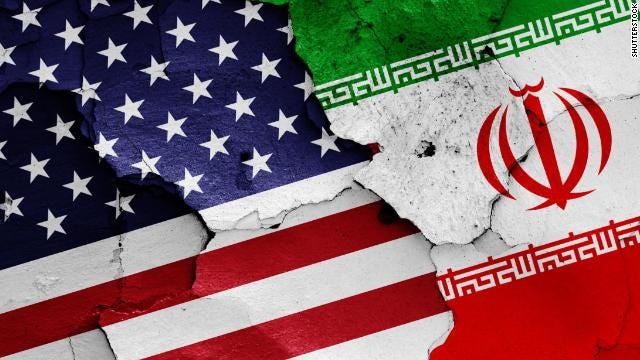
The masses love a war the way parishioners love a sermon — especially when it promises redemption without repentance.
Strike the wicked.
Cleanse the evil.
Restore the moral order.
The Ayatollah has been dispatched, and the television preachers of geopolitics are practically speaking in tongues. The Republic has flexed. Decisive action. Somewhere, a producer is booking the same retired generals for the fifteenth time this month.
And of course, the scribblers are already at work. By tonight, you’ll have received nine hundred Substack homilies — extolling it, condemning it, “contextualizing” it — each one longer than the last, each one more certain than the next. Endless moral laundering. Endless introspection. An orgy of adjectives pretending to be strategy.
What you will not get — what we almost never do — is the only question that matters:
What incentives did we just rewrite for the rest of the planet?
I have no affection for the Ayatollah.
If the Islamic Republic sank tomorrow into the geological record, I would sleep like the dead. The regime has strangled eighty-eight million people for nearly half a century. The Revolutionary Guard is not a misunderstood civic club. I remember 444 days. I remember Beirut. I remember IEDs stamped in Farsi and folded into American convoys like death notes.
I am not arguing for Iran.
I am arguing that we have detonated our own strategic leverage in a fit of moral theater.
And the consequences are not philosophical.
They are structural.
The Fatal Incentive Shift
Here is the part that should terrify anyone who understands how states actually behave:
We have just demonstrated — again — that negotiating away your nuclear program is a prelude to being bombed, and possessing a nuclear weapon is the only durable guarantee of regime survival.
This is not rhetoric. It is pattern recognition.
Gaddafi surrendered his nuclear program. He died in a drainage ditch.
Ukraine surrendered its arsenal under security guarantees. It was invaded.
Iran signed the JCPOA, complied with intrusive inspections, and was rewarded with sanctions and strikes.
North Korea built the bomb. It gets summits and containment.
Every foreign ministry on earth understands this. The lesson is not subtle.
If you disarm, you are vulnerable.
If you deter, you survive.
And today, we converted that lesson from inference to doctrine.
“But They Were Cheating.”
Let’s deal with the obvious counterargument.
Perhaps Iran was buying time. Perhaps they were negotiating in bad faith. Perhaps breakout was closer than advertised.
Fine. Then explain the timeline.
On Thursday — forty-eight hours before the first American sortie — the latest round of US-Iran talks concluded in Geneva. Iran agreed, on the record, never to stockpile enriched uranium. Oman’s Foreign Minister, who brokered the negotiations, told the world that peace was “within reach” and that the talks had advanced “substantially.” Both sides agreed to continue engagement.
On Friday, the President said he’d “love not to” attack Iran, “but sometimes you have to.”
On Saturday morning, we attacked.
This was not a case of diplomacy collapsing (at least not obviously as of yet). Negotiations were active. Concessions were being discussed. The process was alive.1
We bombed a country that was sitting at the table.
If you believe Iran was negotiating in bad faith, show the intelligence. Demonstrate imminent irreversibility. Because if breakout was not days away — if diplomacy was even partially functional — then we traded a constrained threshold state for a sprinting, cornered one.
Killing the Supreme Leader does not dissolve the Revolutionary Guard.
It does not dissolve uranium stockpiles.
It does not dissolve physics.
We already proved this nine months ago. The June 2025 strikes targeted Iran’s nuclear facilities directly. The administration claimed they had “significantly degraded” the program. Iran resumed enrichment. We are now doing the same thing twice and calling it strategy.
What a strike does is alter incentives.
And the incentive inside Tehran now reads as follows:
Finish the bomb as fast as humanly possible.
A strike meant to stop a weapon can accelerate its necessity.
That is not ideology.
That is survival logic.
Regime Change as Ritual
We are told this is liberation.
The same liturgy was recited in Baghdad. The same hymnal was opened in Tripoli. We have now replaced strategy with incantation.
“Take your country back,” America declares, while cruise missiles redraw the skyline.
Iran is not a hollowed-out tribal shell. It is a dense, industrial, eighty-eight-million-person state with a deeply embedded coercive apparatus and a population that remembers 1953 as vividly as we remember 1979. The Revolutionary Guard controls vast sectors of the economy. It controls the guns. It controls the prisons. In January, it crushed mass protests with lethal force and the regime did not flinch.
A decapitation strike does not produce Jeffersonian town halls.
It produces succession struggles.
And succession struggles inside nuclear-threshold states are not liberation movements.
They are volatility generators.
If this is regime change, it is regime change without architecture — a demolition crew without blueprints.
The Proliferation Cascade
Here is the real catastrophe.
We have fired the starter’s pistol on a global nuclear recalibration.
Saudi Arabia is watching.
Turkey is watching.
Egypt is watching.
South Korea and Japan are watching.
All of them now face a simple question:
Can we afford to rely on American guarantees?
Or do we build our own?
You do not need rogue states for proliferation. You need rational ones observing broken incentives.
The Non-Proliferation Treaty was always a bargain: you forego the bomb; the nuclear powers restrain themselves and provide stability.
If that bargain is perceived as void, the treaty becomes a piece of paper.
I am sure there are already calls in Tehran to leave the NPT following this event. Once that exit happens, it is not an isolated event. It is a proof of concept for every signatory running the same arithmetic.
And once proliferation begins in earnest, it does not politely reverse itself.
Empires do not end when they lose battles.
They end when their guarantees stop structuring behavior.
The Gulf Is Not a Thought Experiment
Retaliation has already begun.
Iran has struck US military installations in Bahrain, Kuwait, Qatar, the United Arab Emirates, and Jordan. The Strait of Hormuz — twenty percent of global oil, every single day — has been declared closed. Air raid sirens have sounded in Manama. Explosions have been reported in Dubai and Doha.
The only Gulf Cooperation Council state Iran has not hit is Oman.
Oman — the country that brokered the peace talks we abandoned two days ago.
These are not hypothetical costs I am warning about from comfortable distance. These are allied nations under missile fire inside an active war zone they did not vote for, did not authorize, and could not prevent.
If you believe they will absorb that quietly, you have not been paying attention to regional politics for the past thirty years.
Hormuz is not a metaphor.
Even partial disruption is economic artillery aimed at every industrialized economy on earth. China and India power their economies on Gulf oil. The knock-on effects do not stay regional.
They go global, and they go fast.
The Credibility Problem
The American century was not built on raw force. It was built on predictable force.
Predictability creates order.
Order creates alignment.
Alignment creates power.
When diplomacy is perceived as a tactical pause before bombardment, diplomacy ceases to function as leverage. No adversary will negotiate seriously with a country that bombs you forty-eight hours after your mediator calls the talks a breakthrough.
When security guarantees appear selective or reversible, hedging begins.
When regime change becomes a reflex rather than a last resort, adversaries harden and allies diversify.
This is not about morality.
It is about trust architecture.
And trust architecture, once degraded, is extraordinarily expensive to rebuild.
The Uncomfortable Question
If you were sitting in Riyadh tonight, what would you be funding?
If you were in Ankara?
In Seoul?
In Tokyo?
Would you invest in speeches about international norms?
Or in centrifuges?
That is the question this operation has forced onto the world.
And if the answer tilts toward centrifuges — and it will — then the damage is not symbolic.
It is structural. It is generational.
And it will be extraordinarily difficult to unwind.
The world just changed. Not in the direction of freedom, not in the direction of security, and not in a direction that any rational actor can afford to ignore.
America has lost the plot.
There is a version of events in which intelligence showed imminent weaponization, in which diplomacy was a smokescreen, and in which this strike prevented a nuclear Iran by days or weeks. If that intelligence exists and is made public, this argument changes.
Spheres of influence today.. It's a mafia run world. The norms we had prior, sone of which you disclose here, are no more, being replaced by making offers you can't refuse, acting as friends, a friend of mine, a friend of ours, and whacking people (its the person you trust most that does the hit). Thus we are dealing with a new (even though very old) system where mafia codes rule, and others who just don't grasp that the mob took over and is now running the show can't quite grasp those realities. Money, greed, power is all they know, and they will run the world based on codes they designed. This is not a government that cares for peoples opinions or even their votes. This is a mob grabbing, defending or obtaining territory, and saying who gets what, who runs the rackets in those areas, and making sure that money flows upward to the bosses running it. The soldiers get a piece, but the bosses get the lions share of the pie.
Thank you for saying what needed to be published and for us to share with our communities.