

The Seriousness Test: We get an F-
Invoking the 25th Amendment instead of impeachment is how Congress admits it is no longer governing

Today, Trump goes to Switzerland and embarrasses himself.
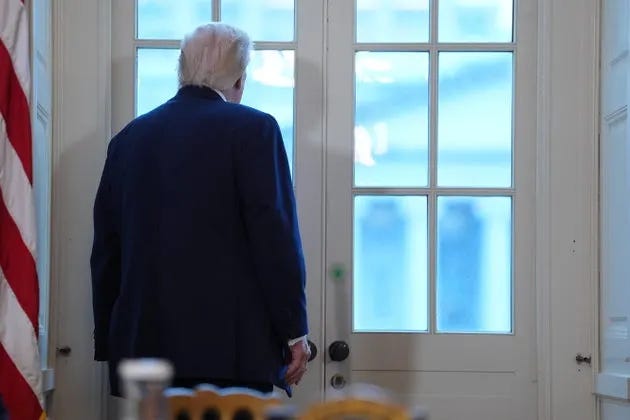
This follows yesterday, when he spoke for nearly two and a half hours in the press room—rambling, incoherent, unmoored. It follows last week, when he stood up in the middle of a meeting with petroleum executives, wandered to a window, and began musing aloud about a building that does not exist. He writes, in the middle of the night, to the Prime Minister of Norway, apparently confusing it with Denmark, and says, in effect, “since you didn’t give me the Peace Prize, now I’m going to engage in war over Greenland.”
The pattern is not subtle.
And so, predictably, the press wheel turns. Members of Congress begin floating the idea—again—of invoking the 25th Amendment. Cable news panels nod gravely. Former aides and minor figures leak “concern.” Serious faces discuss a mechanism they do not understand.
I’m out of outrage at this point. As an Italian, all my *oah!*s have been used up.
What disgusts me more than the President’s behavior is the ritualized stupidity surrounding it. The press courts the spectacle, then feigns shock. Congress performs helplessness. And the 25th Amendment is wheeled out like a constitutional Ouija board—something to gesture at so no one has to do anything.
Let’s be clear.
The 25th Amendment does not apply here.
It is not a political removal mechanism.
It is not a remedy for authoritarian behavior.
It is not a substitute for congressional courage.
The 25th Amendment is a cabinet-driven incapacity clause. It presumes a functioning executive branch acting in good faith to address physical or cognitive incapacity. It presumes independent actors. It presumes sanity upstream. It presumes that every person on the Cabinet isn’t a sycophantic stooge who appears as mentally incapacitated as the President himself.
None of those conditions exist.
Invoking the 25th in this context is not naïve—it is evasive. It externalizes responsibility. It allows Congress to pretend removal is someone else’s job. It reframes a constitutional crisis as a medical one.
There is only one mechanism for removing a president who is abusing power, destabilizing the state, or acting in ways that endanger the republic:
Impeachment and removal.
That’s it.
No workaround.
No shortcut.
No comforting fiction.
Every time a member of Congress talks about the 25th Amendment instead of impeachment, what they are really saying is this: we don’t want ownership. Impeachment requires recorded votes. It forces alignment. It creates a historical record. It assigns responsibility that cannot later be laundered through concern-trolling and hindsight regret.
The 25th Amendment, by contrast, is risk-free theater. All they need is to troll out Thomas Massie and Ro Khanna, pass a joint resolution saying “25th Amendment by the end of the month,” and the formula for Congress to do absolutely nothing of consequence is complete.
At some point, constitutional systems face a “seriousness test.”
Not a legal test. Not a rhetorical one. A practical one.
The question is simple: when the tools designed to stop abuse of power carry real political cost, are they used — or are they talked around?
Invoking the 25th Amendment is what institutions do when they want to appear alarmed without acting. Impeachment is what they do when they are willing to accept consequences.
This is the line between governance and theater. And once it is crossed, it does not quietly uncross itself.
Now consider a counterfactual—not a moral comparison, but a structural one.
Imagine a legislature facing an increasingly unstable executive. Imagine that executive preparing actions with irreversible consequences. Imagine further that the legislature possesses a lawful, explicit mechanism to remove him—not through intrigue or violence, but through its own constitutional authority.
And imagine that the legislature chooses not to use it.
Not because the tool is unclear.
Not because the threshold is unreachable.
But because doing so would be politically uncomfortable, career-ending, or electorally risky.
Instead, they gesture. They express concern. They discuss alternatives that conveniently place responsibility elsewhere. They wait.
History would not say, “At least they were worried.”
It would say: they had the authority—and refused to exercise it.
This is the part modern commentary avoids. Catastrophes are rarely caused by madmen alone. They are enabled by institutions that decide, collectively, that action is someone else’s job.
The lesson here is not that unstable leaders are dangerous. Everyone knows that.
The lesson is that when a legislature with removal authority refuses to use it, it becomes part of the causal chain.
The question is not whether Trump is unfit.
He is.
The past two weeks alone make that clear. He gestures toward open conflict with historic allies—Greenland today, Canada tomorrow, who knows next. He stares out windows talking about buildings that do not exist. He flips through printed PowerPoint slides at press conferences like a man paging through a photo album no one else recognizes.
Whether the president is diminished is not the question. I believe he is.
But even if he’s not, then the situation is even more dire. The President is deliberately placing all the systems that America has relied on for its safety, security, and prosperity at risk. And if he’s not insane, then it is a deliberate act of malice, not stupidity, and not incapacity.
So, whether you think the President is insane or a malicious actor, the question becomes why the people empowered to stop him from harming the United States keep pretending they aren’t.
The Cabinet is not going to remove him.
There is no alternative mechanism.
Congress either acts—or Trump remains.
That is the reality.
We should all stop pretending otherwise.
Shorter version: Congress doesn't act, trump remains — same as it ever was.
I'm not putting a penny on Congress doing anything!