



You’ve probably seen it by now.
“He’s going to use nukes.”
It’s everywhere—group chats, cable panels, Substack comments. In about 12 hours, the conversation jumped from “this is getting serious” to “we’re about to cross the line.”
I understand why.
When you hear language like “a whole civilization will die tonight,” your brain doesn’t file that under normal escalation. It jumps to the worst-case scenario—because that’s what the words imply.
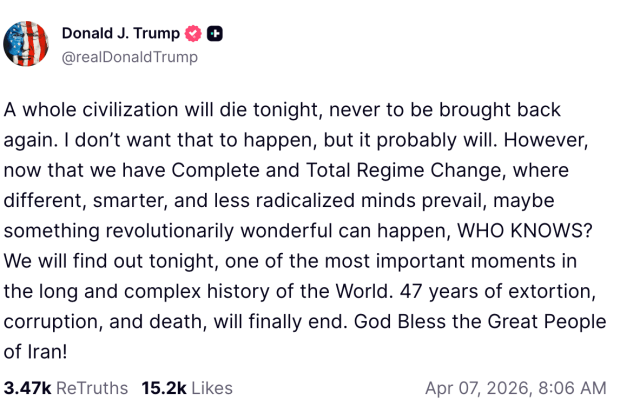
Two days ago, I said something similar. I did exactly what everyone is doing today. That I was increasingly concerned we might be positioning to do something reckless. That the rhetoric we were hearing was not normal. And that we should not comfort ourselves with the idea that “the system” would simply refuse an order if one were given.
That concern wasn’t irrational. I still have it.
But there’s a difference between rhetoric and posture. And if you want to understand what is actually likely to happen next, you have to look at the system—not just the words.
So I did.
How to Read a Crisis
First, let’s be clear about something.
This is not a reaction scenario. This isn’t “Madam Secretary” where someone bursts into the room and says, “900 warheads are inbound.”
This would be first use.
That means we control the timeline. We control the escalation ladder.
That matters.
When governments prepare to cross a line like nuclear use, they don’t just say it.
The system shifts.
And those shifts leave patterns. They cannot be fully hidden, even if they are classified.
You see them in:
force posture
readiness levels
personnel movement
command and control behavior
allied reactions
These are not subtle if you know what to look for. They don’t show up as press releases—but they show up as alignment.
Multiple parts of the system begin moving in the same direction simultaneously.
That’s the signal.
And given what was said this morning, I started looking to see whether anything actually aligned with the rhetoric.
It isn’t.
A Note on “Madman” Signaling
One thing that isn’t widely understood outside of policy circles is what the so-called “madman doctrine” actually requires.
It requires credibility.
Not just words—observable behavior.
During the Nixon era, U.S. signaling didn’t just consist of rhetoric. It included bomber dispersals, troop movements, and posture changes that other nuclear powers—especially the Soviets—could see.
The Vietnamese largely ignored it.
The Soviets didn’t.
Because they could observe the system.
That’s the point:
Systems align before they move.
That’s not to say the worst couldn’t happen, but it does say that right now we don’t seem to be planning for it.
What That Signal Looks Like
If the United States were seriously preparing for nuclear use, you would expect to see a different world than the one I observe.
Not theatrics. Not headlines.
Behavior.
Things like:
Force generation and dispersal — aircraft repositioning, naval surge patterns
Personnel posture changes — leave cancellations, recalls, activation signals
Sustained survivability measures — not a single airborne command platform, but persistent redundancy
Broader readiness alignment — multiple commands shifting posture in concert
Government-wide reaction — not concern, but visible preparation
These things leave traces.
They always do.
And right now, that pattern is not consistent with the idea of imminent nuclear use.
What Is Present
That doesn’t mean nothing is happening.
Quite the opposite.
The United States appears to be positioned for expanded conventional strikes—potentially large ones, potentially including infrastructure, and potentially with consequences we will regret.
We have assembled a significant force in the region. We have activated supporting elements. We have positioned ourselves for escalation.
The rhetoric, meanwhile, has escalated to a level that suggests system-level pressure—not just tactical objectives.
And that combination matters.
Because it creates a different kind of risk.
The Mismatch
Right now, we have a mismatch between:
Language — totalizing, civilizational, absolute
Posture — still bounded within a conventional framework
That gap is unstable.
Not because it means we are about to go nuclear.
But because it means:
The constraints that normally shape decision-making are being rhetorically eroded, even as the system itself has not crossed the threshold.
That is how countries drift into outcomes they did not explicitly plan.
Some of you have noted that the E-4 was moved to Andrews.
Under normal circumstances, when rhetoric and posture align, that wouldn’t stand out. But here, the concern is being driven by a mismatch—people hear “end of civilization” and then see survivability assets move.
That leads to a false conclusion.
E-4 does not mean “end of the world.”
The disconnect is this:
The rhetoric sounds apocalyptic. The system does not.
The Real Risk
There’s a tendency, especially online, to collapse everything into a single fear:
Nuclear war.
But that’s not the most likely failure mode here.
The more immediate danger is more familiar—and, in its own way, more likely:
expanded strikes
broader target sets
increased tolerance for civilian impact
decisions made under compressed timelines and maximalist language
In other words:
A conventional escalation executed under conditions where restraint is weakening.
You don’t need nuclear weapons to create catastrophic, irreversible consequences.
What This Means
Let me be precise.
I cannot tell you that nuclear use is impossible.
No one can.
But I can tell you this:
If the United States were seriously positioning for it, the system would look different from what it does right now.
What it looks like instead is something else:
A system preparing to hit hard—and potentially push further than it should.
If I were observing this from the outside, that would be my conclusion—with a medium-to-high degree of confidence, based on observable signals in intelligence channels.
Final Thought
The danger isn’t that we suddenly jump to the worst-case scenario.
It’s that we convince ourselves we’re still operating within limits—
right up until the moment we’re not.
That’s the real risk.
And let me be clear about something:
If the United States does “unleash hell” and begins systematically striking power plants, water systems, bridges, and civilian infrastructure, the human consequences will be enormous.
We don’t need nuclear weapons for that.
We just need to stop exercising restraint and good judgment.
I think that’s what people are really afraid of.
P.S. If I’m reading the tea leaves incorrectly, well, the Borderless Living Q&A will, regrettably, be canceled due to incineration.
The good news is: I suspect I’ll still be doing a briefing this weekend.
But again, in the off chance I’m wrong, thanks for subscribing. I’ll see those who survive in the mineshafts. (Mein Führer! I CAN WALK!)
I'd like to think Trump is smart enough to realize that stealing Iran's oil will be a bit more challenging in the midst of nuclear fallout. But then again Trump went ahead and bombed Iran without making any plans for the safety of the Americans in harm's way, so he likely doesn't give a fig if oil workers get radiation poisoning.
I lived on Air Force bases as a child in the Cold War era. No one had to tell me if a 3 day alert was real or a drill. The tension in the air, or lack of, was unmistakable. You can move personnel and equipment around, but you can’t fake when someone is running on adrenaline.