

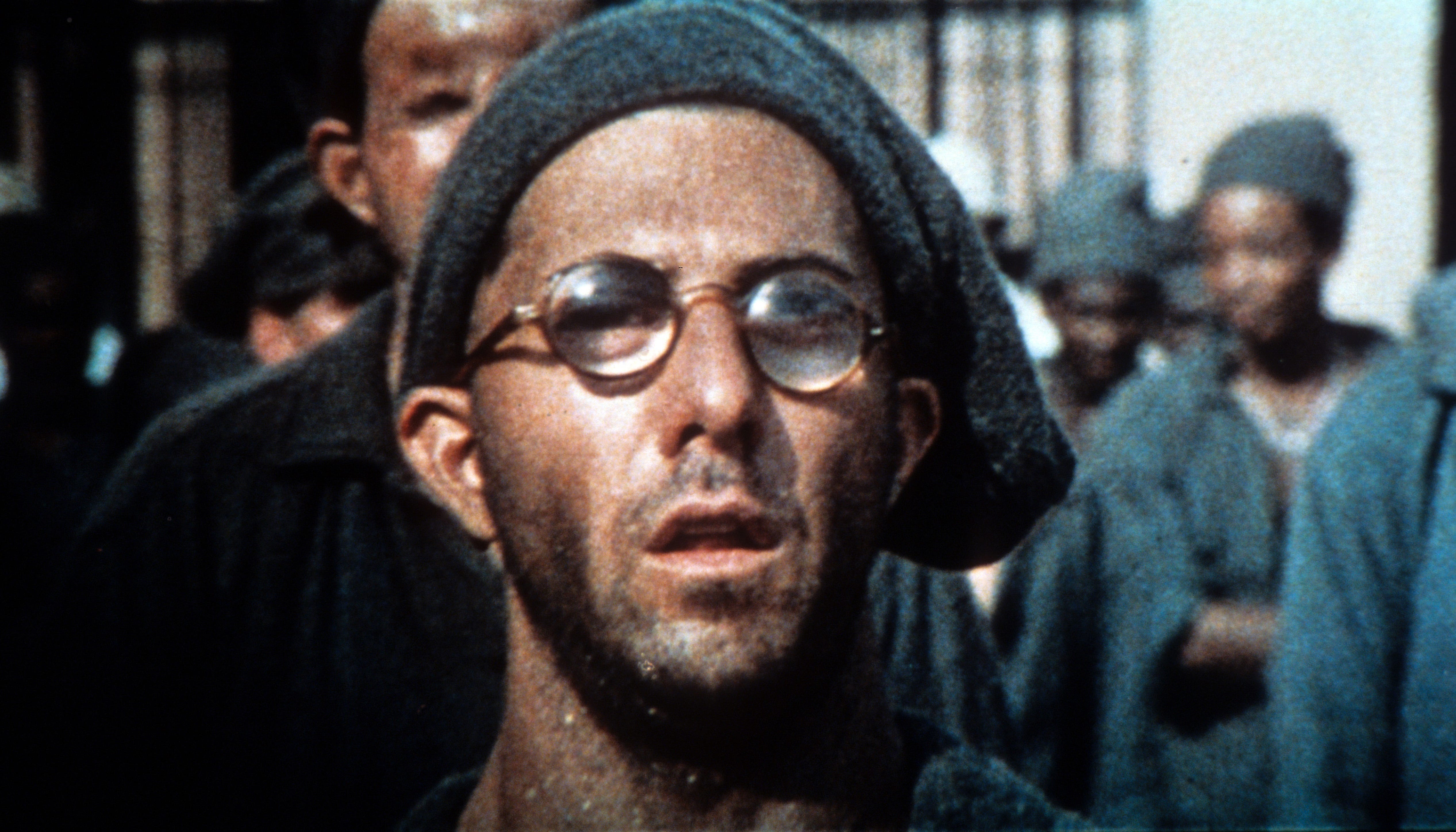
American Papillon.
It's déjà vu all over again - but this time, it's so so much worse.

We interrupt Pete Hegseth committing crimes to bring you this special bulletin…
DHS is torturing people.
Once again, we are confronted with credible reports that the United States is engaged in the systemic torture of individuals in its custody. And when you set these allegations beside what we now know about the unlawful use of deadly force ordered or enabled by senior leadership at the Department of Defense, the picture is no longer ambiguous.
These are not isolated scandals. These are not “mistakes.” This is the Executive Branch abandoning the rule of law. The wheels aren’t coming off the wagon — the wheels are off the wagon.
I want to be clear about why this matters, and why my perspective on this is not that of a pundit idly speculating about “detention.” I was the original and primary author of the U.S. military annex to the first report the United States submitted to the United Nations Committee Against Torture. I coordinated the contributing departments. I edited the submissions. I analyzed the case law, the operations, the disciplinary records, and the internal investigative materials. And I was part of the team that delivered and defended that report before the UN in Geneva.
For that work, I received the Department of State’s Superior Honor Award—an honor reserved for individuals who perform “a special act or service or sustained extraordinary performance covering a period of one year or longer” in support of U.S. foreign policy and diplomatic objectives. It is one of the few high-tier commendations that non–Foreign Service personnel can receive, and it is awarded only when the U.S. Government concludes the contribution is uniquely exceptional.
I say this not to aggrandize myself, but to make a point about competence and experience: I have sat in the rooms where the legal boundaries of detention, interrogation, and state authority were defined, debated, and defended. I know exactly what the United States has told the world about its obligations under the Convention Against Torture. I know the standards we claimed to uphold. I know how the U.S. government distinguishes abuse from torture, and which acts cross the line under American law, treaty law, and military doctrine.
So when I say that what Amnesty International has described—if true—is not misconduct, and not negligence, but torture, I am not making a rhetorical judgment. I am making a legal one.
And the context in which this torture is allegedly being carried out—civil detention, where punishment is explicitly forbidden at every level of U.S. law—makes it even more egregious.
And I want to stress something else: this statement from Amnesty is unprecedented. Believe whatever you want about Abu Ghraib, Guantanamo, or the CIA black sites — the UN, Human Rights Watch, and Amnesty International all condemned those programs in the strongest possible terms. They excoriated waterboarding, stress positions, sensory deprivation, and the rest. They called them cruel, inhuman, degrading, abusive, and potentially tantamount to torture.
But none of them — not the UN, not HRW, not Amnesty — ever accused the United States, point-blank, of torture.
Not during Iraq.
Not during Afghanistan.
Not at Guantanamo.
Not even during the height of the black site program.
They always hedged, because accusing a state of torture outright is a diplomatic and legal nuclear strike. That Amnesty is doing it now — and doing it toward an immigration facility on U.S. soil — is without precedent or peer.
Immigration detention is administrative. No punitive measures are permitted. None. Not as a matter of policy. Not as a matter of statute. Not as a matter of Supreme Court precedent. The reason detainees are not afforded the protections of criminal defendants is that the system is not supposed to punish them at all.
And yet here we are, reading allegations that point to systemic, top-down-directed abuse of people held inside the United States. Abuse that triggers the Convention Against Torture — which is incorporated into the federal code — and the federal criminal statute that implements it. There are no exceptions. No exigencies. No defenses. Torture is a crime.
But none of it seems to matter to the Secretary of Homeland Security or to the President.
Just as the administration appears unbothered by unlawful uses of lethal force at sea, it appears equally unconcerned about unlawful cruelty on U.S. soil. Agencies are operating like autonomous fiefdoms, violating the law as a matter of daily practice, confident that no criminal accountability will ever touch them. Meanwhile, Congress sits, inert and useless.
The result is a picture of governance that should alarm every American. There are no safeguards. There is no internal discipline. There is no functioning chain of lawful authority. A federal government that tortures in administrative custody is a government that has discarded the very idea of legal constraint.
We are not “approaching” authoritarianism.
We are living in its early stage. And while that does not mean you will feel a rifle butt against your forehead tomorrow morning, it does mean the probability of state violence — arbitrary, impulsive, and unreviewable — is no longer theoretical. It is non-zero for everyone, no matter your status, wealth, or citizenship.
The government’s behavior makes one thing unmistakably clear:
It does not care about your liberty, the rule of law, or any principle higher than its own convenience.
So let’s talk about why this is so abhorrent — and what it means for a republic that is no longer operating by its own rules.
Again, Abu Ghraib wasn’t even close to what we’re seeing now (and that’s terrifying)
As terrible as one might contemplate the abuses that occurred during the Global War on Terrorism, no human rights NGO or IGO — not the UN, not HRW, not Amnesty — ever accused the United States point-blank of systematic, national policy, torture.
Not during Iraq.
Not during Afghanistan.
Not during the worst moments of Guantanamo.
Not even with respect to the black sites.
They hedged.
They said the acts could constitute torture.
They said the conduct might amount to torture.
They said the treatment raised serious concerns regarding torture.
They could describe individual acts as potentially torturous, but that is a very different thing from accusing a state of running a torture regime.
No organization ever crossed the line into declaring:
“The United States is committing torture.”
Why?
Because accusing a sovereign state of systematic torture is not rhetorical embellishment. It is a legal and diplomatic nuclear detonation.
Doing so triggers treaty obligations.
It raises jurisdictional issues about international courts.
It obligates other states to respond in some fashion.
It exposes the accusing NGO to catastrophic reputational and legal risk if it cannot substantiate its claims.
And during the post-9/11 era, NGOs recognized that although the U.S. was deeply engaged in abusive conduct, they lacked any clear evidence that the United States had adopted torture as policy.
Let me underline that:
Even at the lowest moral point in recent U.S. history, NGOs believed the situation was ambiguous.
Here’s why:
The U.S. government maintained that torture was illegal.
The U.S. maintained that abusive acts were unauthorized deviations.
And — this part matters — the U.S. prosecuted many lower-level soldiers and officers for detainee abuse.
NGOs criticized those prosecutions as insufficient, said accountability should have reached senior officials, and insisted some punishments were laughably light — but they still acknowledged the distinction that mattered:
The United States did not openly authorize torture.
Fast-forward to today.
Amnesty International — an organization that has spent decades choosing its words with surgical restraint — is not hedging.
They did not say “amounts to torture.”
They did not say “could constitute torture.”
They did not say “raises concerns under the Convention Against Torture.”
They said the word itself:
Torture.
Full stop.
And they said it not about a war zone, or a covert CIA site, or a battlefield interrogation.
They said it about an immigration detention center on U.S. soil.
A civil facility.
Holding people charged with no crime.
In a context where any punitive measure is categorically illegal.
This is unprecedented.
This is seismic.
This is the human-rights equivalent of calling in an airstrike on your own position.
If Amnesty has finally unsheathed this word, it is because no lesser term is honest or defensible.
When I read it, I couldn’t help but agree.
The Devil’s Island Parallel: Descent into madness
When I finished reading Amnesty’s report, I put it down and said:
“Ok, so basically we’re running Devil’s Island.”

Henri Charrière — “Papillon,” named for the butterfly tattoo on his chest — was a man condemned to the French penal colony of Guiana in 1931 for a murder he almost certainly did not commit. His story, later popularized in film, endures because it shows what happens when a state constructs a detention regime intentionally severed from legality, oversight, and conscience.
Papillon endured solitary confinement in pitch-dark cells, starvation diets, brutal heat, untreated disease, total sensory deprivation, and a system explicitly designed to break human beings.
His final confinement was on Devil’s Island — a rock in the Atlantic, a place designed not just for imprisonment, but for obliteration. No one escaped from Devil’s Island. No one except him.
Papillon was supposed to be a cautionary tale.
Instead, the United States appears to have taken it as a template.
Only this time, the island isn’t thousands of miles from Paris.
This one is an hour’s drive from Miami.
On U.S. soil.
Under U.S. jurisdiction.
Operated by U.S. personnel.
Bound by U.S. statute, which the United States is openly defying.
And when you set this alongside the Secretary of Defense (Hegseth) ordering flag officers to “kill them all,” the pattern becomes unmistakable.
You cannot have one cabinet agency normalizing extrajudicial killing and another normalizing torture without recognizing this as systemic behavior.
This is not mismanagement.
Not incompetence.
Not “isolated incidents.”
And not “the fog of a war.”
This is executive-branch fiefdoms acting like autonomous warlords — employing force, cruelty, and punishment without legal authority, oversight, or restraint.
It is the first coherent glimpse of what genuine executive-branch decoherence looks like: chaotic, brutal, unhinged leadership operating outside statutory boundaries.
And I do not make this comparison lightly:
This is what fascism looks like. We saw this behavior from Germany in the 1930s. We saw this behavior in Spain. We saw this behavior in Italy. This is the operational face of fascism: institutions shedding constraint and turning violence inward.
Not metaphorical fascism.
Not the theatrical cosplay kind.
The real thing: state organs severed from the law, governed only by impulse and ideology.
And again, we do not need The Hague or the ICC to tell us this is wrong.
Our own laws already criminalize this behavior.
To understand why Amnesty’s choice of language is so explosive, we have to understand what the law actually requires.
Immigration Detention Is Administrative, Not Punitive
This is the bedrock rule of U.S. law.
Immigration detention is civil, not criminal.
Its purpose is:
ensuring the person’s presence at removal proceedings, and
facilitating removal if and when ordered.
It is not punishment.
This has been repeatedly affirmed by the Supreme Court:
Zadvydas v. Davis (2001)
The Court held that civil detention of immigrants must be “reasonably related to its purpose” and cannot become indefinite or punitive. Detention must bear a reasonable relation to preventing flight or danger, not punishing past conduct.
Quote (summarized):
Civil detention cannot be used as a mechanism of punishment; once detention stops serving its administrative purpose, continued detention violates due process.
Demore v. Kim (2003)
Even when upholding mandatory detention for certain categories, the Court explicitly reaffirmed the non-punitive nature of immigration detention. The constitutionality of detention rests entirely on the premise that it is administrative, not penal.
The Court’s logic is unambiguous: if conditions become punitive, the detention becomes unconstitutional.
Bell v. Wolfish (1979)
Although not an immigration case, it established the controlling standard: Civil detainees may not be subjected to conditions that amount to punishment. Punishment = unconstitutional. Administrative restrictions = permitted.
Bell gives the exact test:
If the condition is expressly intended to punish → unconstitutional.
If the condition is excessive in relation to any legitimate administrative goal → unconstitutional.
If the condition is unrelated to such goals and inflicts harm → unconstitutional.
This applies directly to immigration detention. This is why the conduct of DHS in these facilities is so patently unlawful. This isn’t a “close case” in any way.
Constitutional Protections Apply Fully to Civil Detainees
People in immigration custody are entitled to Fifth Amendment due process protections, including:
physical safety
access to medical care
reasonable sanitary conditions
food, water, and shelter
freedom from arbitrary or abusive treatment
Because they have not been convicted of any crime, they cannot be subjected to restrictions approximating or exceeding penal standards.
In fact, based on the opinions of the Supreme Court, the constitutional threshold for the standards of care and detention of civil detainees is higher than for those imprisoned post-conviction.
Youngberg v. Romeo (1982)
Civil detainees are entitled to “reasonable safety” and “freedom from unreasonable bodily restraint,” reflecting a constitutional obligation to provide “humane conditions.”
DHS is bound by this standard.
Federal Statutes Implementing the Convention Against Torture
The United States incorporated the Convention Against Torture into domestic law via:
18 U.S.C. § 2340–2340A
It is a felony for any U.S. official, contractor, or person acting under the color of law to inflict severe physical or mental pain or suffering for any purpose, including coercion or punishment.
There are:
no exceptions
no national security carveouts
no affirmative defenses of exigence or necessity.
The statute imposes a test very close to being one of strict liability: If the act is torture, it is presumed to be a felony.
Foreign Affairs Reform and Restructuring Act (FARRA, 1998)
Congress explicitly directed that all U.S. officials abide by CAT obligations.
This includes ICE, DHS, contractors, and state facilities acting under federal authority.
Detention Standards in Statute and Regulation
Even ICE’s own standards — which reflect constitutional minima — require:
access to medical care
adequate food and water
sanitation
temperature control
non-punitive housing
mental health protections
no use of stress positions
no “disciplinary segregation” for civil detainees
The “box,” prolonged shackling, outdoor cage confinement, and conditions causing physical harm are explicitly banned, even by ICE’s internal Performance-Based National Detention Standards.
And as an aside, even if, en arguendo, I wanted to argue that these individuals were “the enemy” and combatants, the treatment described by Amnesty International’s reports would most certainly constitute grave breaches of international humanitarian law.
There is absolutely no way to slice this where criminal liability is removed.
Conditions of Confinement for Civil Detainees
Courts have held that civil detainees cannot be subjected to:
prolonged solitary confinement,
conditions that create physical or mental harm,
arbitrary use of restraints,
deprivation of hygiene or medical care,
unsafe or unsanitary environments.
Examples:
Jones v. Blanas (9th Cir. 2004)
Civil detainees must be housed in conditions superior to criminals or at least not worse. If conditions are worse than penal confinement, the court presumes punitive intent, violating due process.
Brown v. Plata (2011) (though a prison case)
Established that severe overcrowding or denial of medical care violates the Eighth Amendment; civil detainees receive equal or greater protections under the Fifth Amendment.
The Legal Standard in One Sentence
Anyone held by the United States for immigration purposes must be treated humanely, cannot be punished by confinement, cannot be subjected to harmful or degrading conditions, cannot be subjected to ridicule or abuse, and must receive the full application of constitutional protections of civil detainees — because their detention is for administrative, not punitive, purposes.
Any deviation from this is illegal. We have multiple statutes that criminalize these offenses. Again, the Hague is not required. Geneva is not required. U.S. federal law makes every act described in this Amnesty report a federal offense.
Why Amnesty’s Allegations Are Catastrophic Legally
If the allegations are accurate, the United States is violating:
the Fifth Amendment
the Eighth Amendment (if we accept the idea of “they’re criminals”)
Bell v. Wolfish
Zadvydas v. Davis
Youngberg v. Romeo
18 U.S.C. § 2340A (federal torture statute)
CAT obligations under FARRA
ICE’s own detention standards
basic constitutional due process doctrine
And, most damningly:
The conditions described cannot be justified under any legitimate administrative purpose.
Therefore, they are presumptively unconstitutional, likely felonious, and impart criminal liability for both leadership and those involved in the execution of these acts.
To reiterate, this is not happening in some “far away place,” it’s happening on U.S. soil, at the direction of the senior leadership of the United States, and in contravention of U.S. and international law.
One such event — extrajudicial killing or state torture — would be a catastrophic failure of leadership.
The fact that both the Secretary of Defense and the Secretary of Homeland Security are engaged in systemic unlawful conduct? That the Department of Justice does nothing? Neither the Secretaries of Defense nor DHS are facing realistic threats of impeachment? That the President isn’t facing impeachment for catastrophic leadership? That the FBI does nothing? That Congress shrugs?
Demonstrates we’re really up the creek and missing a paddle.
What This Means for the Republic
When executive departments:
order unlawful lethal force,
run torture facilities on U.S. soil,
violate constitutional protections,
ignore statutory limits,
abandon administrative purpose,
disregard their own internal regulations,
and act with total confidence that no criminal accountability will reach them…
you are no longer dealing with incompetence.
Or negligence.
Or bureaucratic decay.
Or the usual American tragedy of misaligned incentives.
You are dealing with a state apparatus that has severed itself from lawful governance.
This is not “approaching” authoritarianism.
This is authoritarianism.
Not the partisan melodrama version.
Not the Twitter cosplay version.
But the genuine article:
State violence unconstrained by law.
State cruelty used administratively.
State detention operating punitively.
State agencies operating as personal fiefdoms.
State actors insulated from accountability.
A President either unwilling or unable to stop it.
A Congress too cowed or complicit to intervene.
A republic that tortures where punishment is forbidden is not a republic at all.
That is the operative definition of an authoritarian state.
Some asked me about the report itself... you can find it here: https://www.amnesty.org/en/latest/news/2025/12/estados-unidos-nuevas-investigaciones-revelan-violaciones-de-derechos-humanos-en-los-centros-de-detencion-de-alligator-alcatraz-y-krome-en-florida/
Thank you for continually showing what kind of State we are living in now. I do appreciate the legal analysis and expertise, even as I also know that nothing - absolutely nothing will be done against anyone participating in these abuses, and if anything gets to SCOTUS they will find a way to say it’s all above board.
One thing that may come out of this is this may be the trigger that makes Trump start kicking NGOs out of the US Russia-style.