


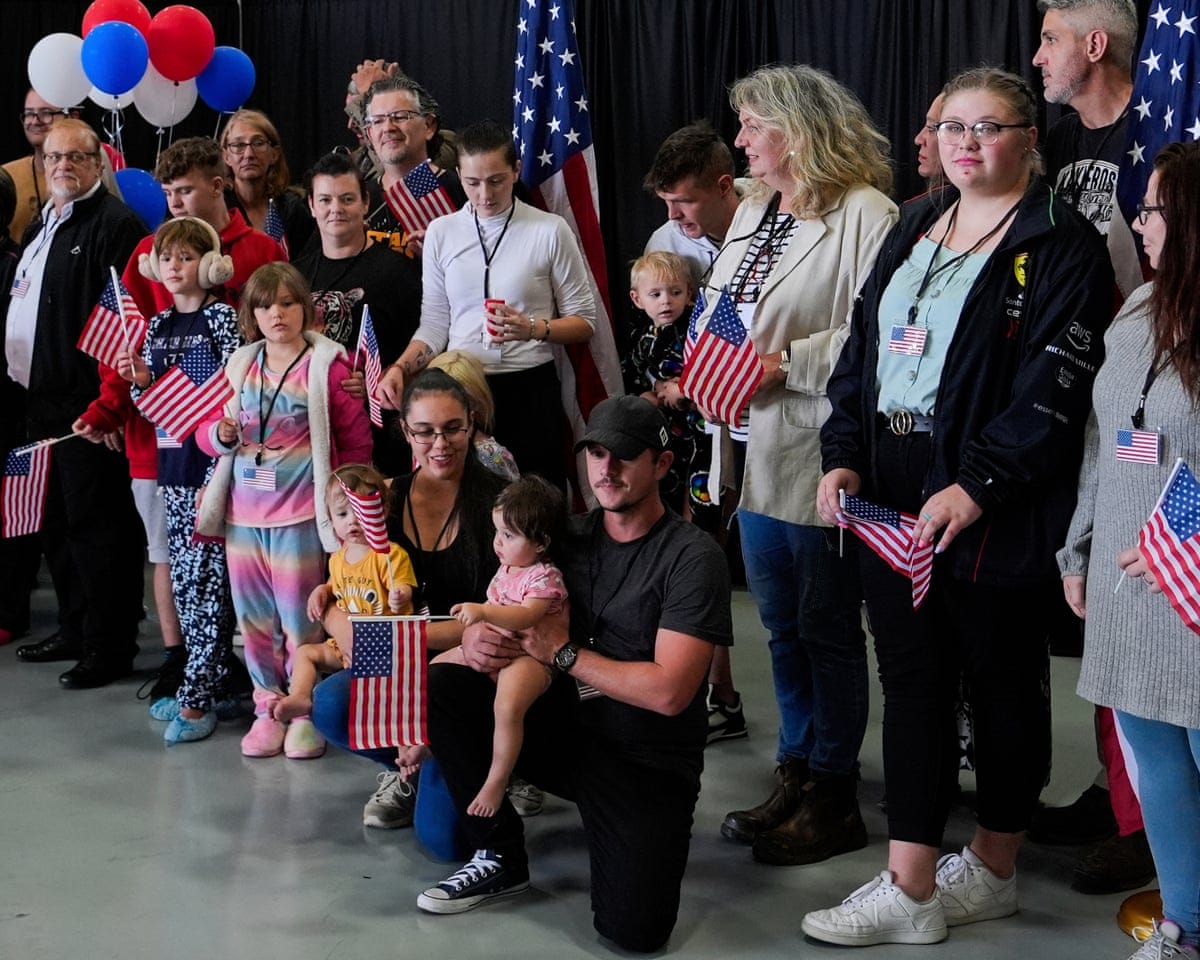
The United States admitted six thousand refugees between October and April. All but three of them were from South Africa.
This is a fact you cannot get around. It is not an interpretation. It is not a partisan analysis. It is what happened. The federal refugee program — created in 1980 with broad bipartisan support, designed to settle people fleeing war, persecution, and famine — admitted six thousand people last year, and all but three were from one ethnic group from one country.
The administration’s current proposal is to raise the refugee cap from 7,500 to 17,500. The additional ten thousand are explicitly reserved for Afrikaners under Executive Order 14204. The federal register language, in case you’re keeping a copy for posterity, says that admissions “shall primarily be allocated among Afrikaners from South Africa.” The euphemism is “victims of illegal or unjust discrimination in their respective homelands.” The math is that the policy admits one ethnic group while keeping the door shut on everyone else fleeing war, famine, or anything resembling persecution by any neutral definition.
Pause on this. Look at it directly.
This is a federal benefit allocation based on explicit racial criteria as a written, signed, and published policy. Not informal favoritism. Not deniable patterns.
Policy.
It is also not the only example.
The Justice Department created, last week, a one-point-seven-seven-six-billion-dollar fund designed to compensate “victims of weaponization” by previous administrations. The fund disburses to a categorically determined group: Trump’s political allies, January 6 pardonees, and others described as having been “prosecuted for political reasons” under Biden and Obama. The Acting Attorney General who approved the fund is Trump’s former personal attorney. Federal money. Federal infrastructure. Allocated by political alignment with the current administration. Written down. Posted on the DOJ website.
USAID has been dismantled. A study released this week links the dismantling to rising conflict in DRC, Sudan, and other African countries — the apparatus that caught outbreaks and contained conflicts at source no longer exists. The choice was ideological: the work was disliked by the President’s base. The downstream consequences — Ebola at six hundred cases and rising, conflict in regions previously stabilized — are accepted costs.
FEMA disaster declarations have followed a pattern for years now, with federal emergency assistance approvals favoring states aligned with the administration. The pattern is documented across multiple data sources. It used to be denied or attributed to coincidence. It is no longer denied.
The IRS settlement with the President’s family, which barred future examination of their tax returns “forever and precluded” — is the same move applied to enforcement. Tax obligation is now categorically different for one family.
This is a list.
It is also a pattern.
The pattern has a name.
The name is patronage.
Patronage was the rule in most of human political history. The state distributed favors and resources based on political loyalty because loyalty was the foundation on which the state rested. Roman emperors paid their legions and their clients. Medieval kings granted lands to lords who fought for them. The Ottoman millet system organized resource allocation according to religious and political affiliation. The whole concept of citizenship as something distinct from loyalty — as a status with attached rights independent of whether you supported the regime — is a relatively recent invention in human governance.
The American Republic was a particular experiment in that invention. The federal compact rested on the premise that federal resources flow by neutral criteria — by law, by need, by rule. Yes, every administration has played favorites at the margins. Yes, patronage existed before civil service reform; it exists now around the edges. But the premise held. The premise held because the formal architecture treated federal benefits as obligations under law, not gifts from a patron to clients.
That premise is ending. And what’s ending it isn’t a turn toward corruption — corruption has always existed at the edges. What’s ending it is formalization.
The refugee allocation is policy. Written, signed, published. The anti-weaponization fund is policy. Listed in the federal register. The IRS forever bar is signed by the Acting Attorney General. The dismantling of USAID is announced. The disaster funding patterns are no longer denied. Things that used to require euphemism — things that used to need a story about why this state didn’t qualify for FEMA, or why this contract went to that vendor, or why this prosecution proceeded but that one didn’t — those things now sit on official letterhead.
This matters because the asymmetry of incentive structure matters.
Informal favoritism creates pressure for restraint. Deniability is itself a resource. The official who steers federal money toward an aligned vendor has reason to be careful — explicit racism, explicit cronyism, explicit ideology can be challenged. The career cost of getting caught is high. So the favoritism stays at a level the system can absorb.
Formal favoritism removes that pressure. Once “primarily allocated among Afrikaners” is in the federal register, the incentive to restrain the next allocation falls. Once the anti-weaponization fund is announced as an official program, the next disbursement to political allies needs no euphemism. The institutional memory captures the new norm. Federal employees orient around it. State governments orient around it. Federal contractors orient around it. The Republic-era assumption — that federal funds flow by neutral criteria — becomes a museum artifact. People stop expecting it. And once people stop expecting it, restoring it is no longer a matter of policy. It is a matter of restoring the assumption, which is a generational project.
So the question of whether we are “one nation” or fifty states is not rhetorical.
Look at the map and tell me with a straight face that federal benefits flow neutrally across it. Look at the disaster declaration patterns, the federal grant allocations, the refugee allocations, the contract awards, the investigation patterns, the regulatory enforcement patterns, the tax enforcement patterns. Federal money has acquired a Voter ID. So has federal protection. So has federal regulatory enforcement, and federal benefit allocation, and federal contract distribution.
This is not corruption in the conventional sense. Corruption is transactional — someone gets paid, someone breaks a rule, someone gets caught. This is constitutional in the conventional sense. It is structural change in how the federal apparatus relates to the population it allegedly serves. The Republic-era model treated all citizens as having equivalent claim on federal benefit by virtue of citizenship. The new model treats citizens of aligned states as clients and citizens of unaligned states as adversaries. Both groups still pay federal taxes. Only one group still receives federal benefit on the previous terms.
There are historical parallels for what this becomes. Peronist Argentina ran for decades on regional patronage. The Russian Federation under Putin allocates federal resource by regional loyalty to the Kremlin. Hungary under Orbán redirects EU funds toward government-aligned regions and businesses. The pattern is not unprecedented. It is just unprecedented in modern American history, post-civil-service reform.
What ends if this continues is not “American democracy” in some abstract sense. What ends is the federal compact specifically. The agreement that all states stand equal before federal law and have equivalent claim on federal benefit. That agreement is what made fifty states a federation rather than a coalition of clients around an emperor. When the agreement is gone, the federation is gone, even if the map still shows the same borders.
Twenty-seven is the rough count of states whose population voted for the current administration in the last election. The number isn’t exact and isn’t the point. The point is that there is now a structural distinction between states whose citizens have federal protection and states whose citizens have federal punishment, and the distinction is the writing on the wall.
If you live in one of the twenty-seven, congratulations. You are inside the federation. Your refugee allocations flow. Your disaster declarations get approved. Your contracts get awarded. Your prosecutions don’t proceed if the right people don’t want them to.
If you live in one of the other twenty-three, you are in the same legal country but a different political one. The federal apparatus still taxes you. It still requires you to follow its laws. It still mandates your participation in its institutions. But the benefits run the other way.
The question worth asking — and worth asking now, because the formalization is what makes it hard to reverse — is whether this is a temporary deviation that the next administration corrects, or whether this is the new operating system. The institutional architecture being built suggests the second.
If it is the first, you have still lost ground that takes a decade to recover. If it is the second, you are already in a different country than the one you thought you were in.
Either way, the federation you assumed you lived in is not the federation you live in now. That is the diagnosis. The question that follows from it — what you do when the rules you follow are no longer the rules being applied — is the one this newsletter, and any other honest one, is going to keep returning to.
This kind of analysis doesn’t exist without readers paying for it. No ads, no foundation, no outside agenda steering the work. If you want more, the upgrade is right there.
I am an 82 year old white South African and have never experienced any violence or discrimination. This assertion of 'persecution' by these so called refugees is utter nonsense. They are racists plain and simple and are being used by Trump as political fodder. The USA will use them and spit them out in no time. They will learn that they are political pawns and have landed in a harsh uncaring country. I lived and worked in the USA so this is from direct experience, not hearsay.
This is an important point which will be discussed for years if free thought is not totally eliminated by the Ministry of Truth. How we came to this point is critical, and may have important implications. However, on an operational level, I wonder if the institutionalization of this policy by the current regime should not be one arm of the impeachment actions against this administration (for it is clearly opposed to the basis and letter of the constitution, and beyond the allotted power of the executive). The second category of impeachable offenses is the bucket full of actions the regime has done to harm the people of this country directly (anti free market, tariffs, stopping renewable energy, etc.), or indirectly, such as destruction of our soft power via ending USAID programs, and supporting enemies of democracy not our allies (Ukraine) etc.
Hopefully, the issues will be adjudicated in the public after the midterms. If not, the discussion will clearly be about how the American Experiment was murdered in our times after so much of its promise had spread throughout the world. It is doubtful the current representatives who claim allegiance to party over constitutional underpinnings will vote for the American Ideals, but an open airing of the issues may allow some education of the voting public, and maybe an awakening of the monied class to the fact that social and climate catastrophe are not good for their memory or progeny.