

Trump Fuckupometer™
We built a dashboard. It tracks oil prices, war costs, and what we're trading away. The only question it can't answer is the one you have to ask yourself.


George W. Bush — my old boss — once stood before a classroom in South Carolina and asked, with characteristic confidence, “Is our children learning?”
The line became a punchline.
It’s been twenty years since I stopped working for him, and it still follows him everywhere. What got lost in the laughter is that the question itself is structurally correct. Not grammatically — obviously not grammatically — but analytically. The right question about any policy isn’t what did we do? It’s is it working? Are we getting the outcome we were told we’d get? Is the stated theory of the case producing the stated results?
So let me apply that question to the present situation.
The President of the United States stood at the Capitol on January 20, 2025 and told America — with characteristic confidence — that energy prices were going to come down. That we were going to drill, baby, drill.
That his team had a plan.
WTI crude oil on inauguration day: $76 per barrel.
WTI crude oil today: somewhere north of $95, depending on when you’re reading this. The peak, on March 9, was $119.48.
Thus, as a policy wonk, I have to ask: Is our children learning?
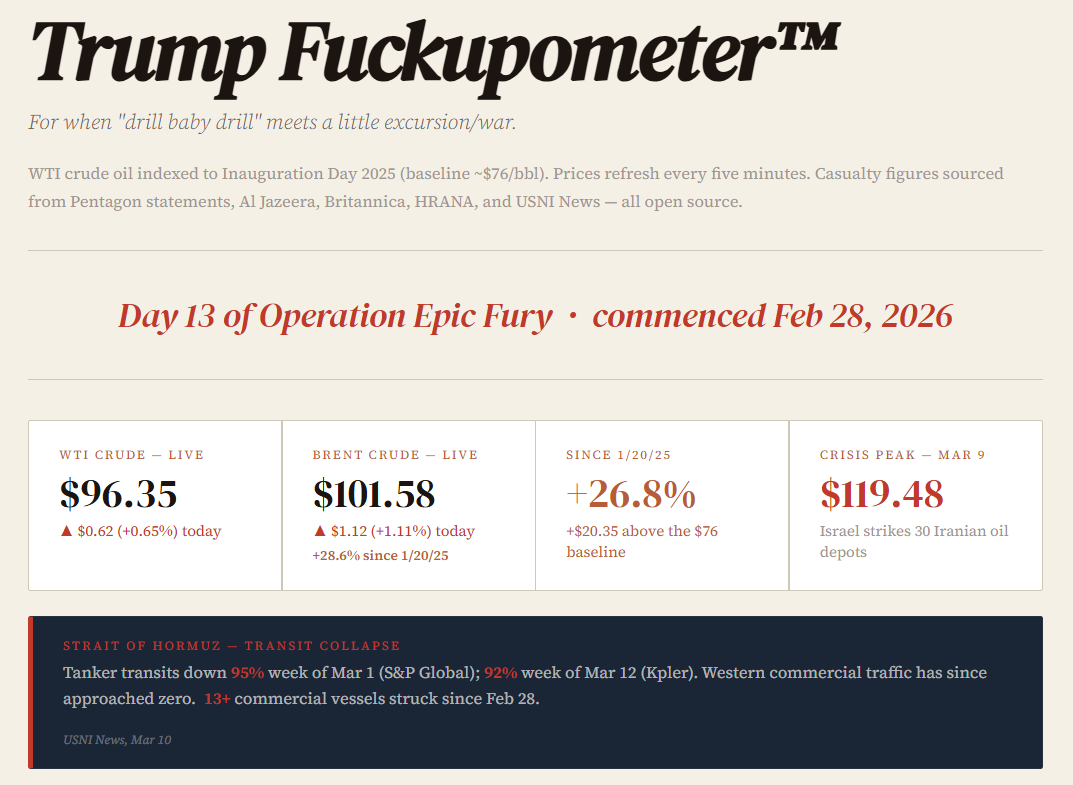
We built a tool. We’re calling it the Trump Fuckupometer™, which is not a serious name for an unserious situation. The situation is serious. The name is the appropriate response to watching an administration claim — in the same week that oil hit $100 and 13 Americans came home in body bags — that the war is “going great” and will be “over soon.”
The Fuckupometer lives at fuckupometer.thelongmemo.com. It is free. It updates every five minutes. It does not take a position on whether Operation Epic Fury was justified, necessary, or strategically wise.
It does arithmetic.
Here is what the arithmetic says.
The Strait of Hormuz handles roughly 20% of global oil flow. Since February 28, when Operation Epic Fury began, and Iran’s IRGC announced it would set on fire any ship that tried to pass, tanker transits through the Strait have collapsed by 92–95%, depending on the tracking service you use. S&P Global measured a 95% drop in the week of March 1. Kpler’s vessel intelligence platform put it at 92% as of last week. The Windward maritime AI platform reported a stretch of days in which the only vessel crossing was a single Iranian-flagged ship.
The IEA released 400 million barrels from emergency reserves — the largest such release in history. Oil held above $100 regardless.
The Trump administration granted a sanctions waiver on stranded Russian seaborne crude to ease supply. Oil held above $100 regardless.
This is what structural supply shock looks like. You cannot paper over the world’s most important energy chokepoint with reserve releases and waiver paperwork. The physics don’t care about the press release.
The Fuckupometer tracks five things simultaneously.
It tracks WTI crude and Brent crude — live, refreshed every five minutes, indexed against the January 20, 2025 baseline. It tracks the War Economy Dashboard: natural gas, gasoline, wheat, corn, and fertilizer. It tracks the Butcher’s Bill — the confirmed US and allied casualties, the Iranian dead (disputed between 1,348 and 32,000 depending on who you ask), the Lebanese civilians, the schoolgirls in Minab.
It tracks what this is costing the average American — not abstractly, but arithmetically. At the pump. On the grocery bill. On the tax bill for a war that the Pentagon told Congress cost $11.3 billion in its first six days alone, at a sustained rate of roughly $220 million per day thereafter.
And it tracks what that money would have purchased, had different decisions been made. How many people are insured? How many teachers were hired? How many Pell Grants have been written? How many families are fed?
We are not telling you what to think about those numbers. That is genuinely not our job. Our job is to put them in front of you clearly enough that you can think about them yourself.
That is the entire point of the exercise.
There is a running section of the dashboard we call “Trump Said vs. Reality.” It is not a partisan document. It is a log. The President said, on January 20, 2025, that energy prices would come down. He said, on March 1, that the operation would take “four to five weeks.” He said, on March 9, that “it will be over soon.” He said, on March 11, “We won.” He said, on March 13, that Iran will “take years to rebuild.”
On the same day he said that, Iran’s new Supreme Leader — Mojtaba Khamenei, son of the man killed in the strikes that opened the war — issued his first public statement. He vowed to maintain the Hormuz blockade. He threatened US bases throughout the region. He did not look like a man whose country was taking years to rebuild. He looked like a man who had just been handed the argument for everything he was about to do next.
Oil was above $100 that day.
I want to be precise about what the Fuckupometer is and is not.
It is not an argument against the war being fought. Unfortunately, the President never brought the case before the American People. I think our acts are foolish and have said so. Reasonable people disagree about that, and that disagreement involves classified information I don’t have, strategic calculations I can’t fully assess, and moral weights I can’t assign for you.
It is not a progressive document. The alternative-spending comparisons — what $12.8 billion would have bought in healthcare, schools, infrastructure, food assistance — are not a political argument. They are an opportunity cost. Every dollar spent on anything is a dollar not spent on something else.
We (the American people) were told we don’t have money for healthcare subsidies. We don’t have money for tax cuts for everyday Americans. We don’t have the money to hire teachers or reform education. We don’t have money for so many things.
This has always been true. The only question is whether the trade-off is visible.
This website attempts to make it visible. You will pay for this conflict in how your community and daily life function, and in how much money is available to you over the next several years.
There are tradeoffs being made every day, whether you’re aware of them or not.
For most of American history, it hasn’t been. Defense spending is complicated and slow, and happens in appropriations committees that most Americans cannot name. Energy price increases are abstract until you fill up your tank. The gap between the stated promise (”drill baby drill, prices are coming down”) and the actual outcome ($95/barrel and climbing) is legible only if someone does the work of putting it in front of you.
That is what we built.
George W. Bush asked, “Is our children learning?” and America laughed.
The funnier question — the one that turns out to matter — is what happens when the answer is no, and nobody changed the lesson plan.
Thirteen Americans are dead. Oil is above $100 per barrel. The Strait of Hormuz is 92% closed to commercial shipping. The Penn Wharton Budget Model estimates the war will cost between $40 and $95 billion in direct expenditures, and up to $210 billion in total economic impact.
Every one of those numbers is on the dashboard.
It updates every five minutes.
(Some of the things I update daily to ensure their accuracy.)
The question of whether we’re getting what we were told we’d get — that one’s yours.
If you’re watching the institutions and asking what you can do about the risk to your family — not the geopolitical risk, the personal financial and jurisdictional risk — that’s what Borderless Living is for. The people who read it aren’t pessimists. They’re doing the same arithmetic.
The Long Memo is a reader-supported, independent analysis. If this is useful to you, forward it to someone who needs to see the numbers.
13 billion in 6 days.
The Italian public healthcare budget is 136 billion for the year 2025 for 60 million people: equivalent to €7/day per inhabitant (yes, only €7/day, this is the magic of economies of scale).
If you assume the cost is the same, it means 5 days of universal healthcare for each USA citizen. Whatever the pathology, from an insulin pen to a heart transplant.
It's a dern useful & shareable tool. Thank you.