

The Next Pandemic Won't Get a Warp Speed
The hantavirus is noise. The real story is the deliberate, layer-by-layer dismantlement of the apparatus that produced Warp Speed in 2020. When the next pathogen lands, the bench will be gone.

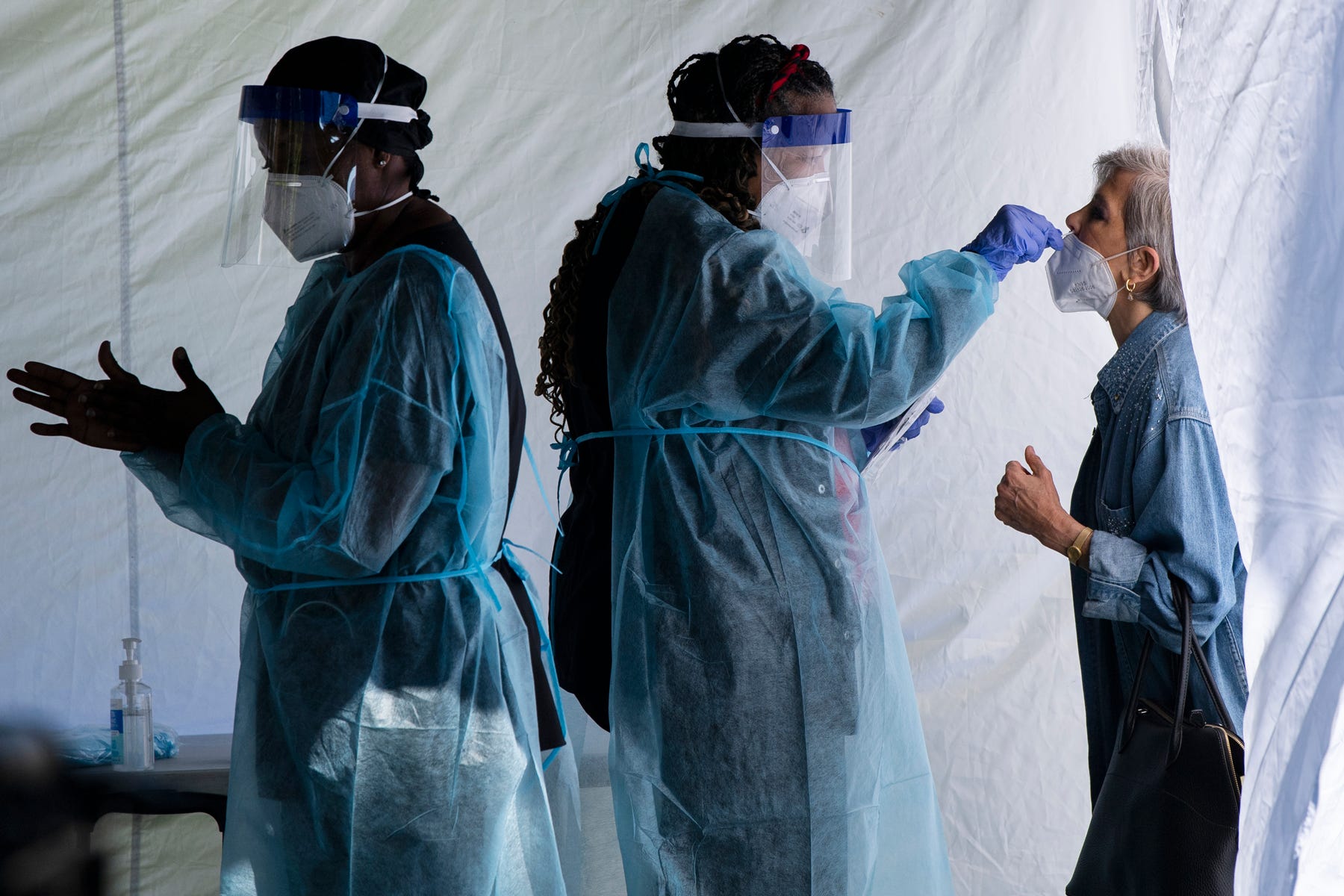
Eight people on the Hondius contracted Andes hantavirus off the coast of Cape Verde. Three died. The ship is now anchored off Tenerife, passengers being repatriated to Spain, the Netherlands, Germany, and — for the seventeen Americans aboard — to Offutt Air Force Base in Nebraska, where the National Quarantine Center will monitor them for symptoms that will almost certainly never appear. None of the Americans tested positive. The strain involved is one of the only hantaviruses with documented person-to-person spread, and that transmission requires close prolonged contact with a symptomatic individual. The CDC’s assessment of risk to the American public uses the phrase extremely low.
They are correct.
This is the test case the press is using to ask whether we are ready for the next pandemic. It is the wrong test case. A contained zoonotic outbreak with low transmissibility, clear geography, and a small case count is precisely the kind of event the present apparatus can still handle. The CDC sent a team to the Canary Islands. State coordinated the repatriation. WHO and ECDC ran the international tracking. The hollowed agency, on a low-pressure event with a known pathogen and modest scale, executed.
The question is not whether we can handle a hantavirus on a cruise ship. The question is whether we could handle a 2027 novel respiratory pathogen with R0 above 2 and an IFR above one percent — the kind of event that in 2020 killed roughly 1.2 million Americans and produced an emergency vaccine in nine months.
The answer is no.
The reason is not that the apparatus failed. The reason is that the apparatus is being deliberately taken apart.
That is the story. Not the hantavirus. The dismantlement.
Capability, not intent
I spent years in national security writing threat assessments for events that hadn’t happened yet. The discipline forces a specific habit of mind: you look at capability, not intent. Intent is opaque, contested, and lies. Capability is countable. You inventory what your adversary — or your own system — can do, you compare it to what it could do six months or two years ago, and you draw conclusions about the trajectory. Whether anyone wants to do something is a separate question. Whether they can do it is the one you can answer with arithmetic.
Apply that to American pandemic response. What could the system do in 2019? What can it do today? What will it be able to do in 2027 if the trajectory continues? Those are the questions, and the answers do not depend on partisan framing.
The 2019 apparatus had specific capabilities. A CDC with roughly thirteen thousand employees. An Advisory Committee on Immunization Practices staffed by seventeen vaccine scientists. An NIH funding forty-eight billion dollars of biomedical research, including a mature mRNA platform that had been incubating since the early 2010s. A USAID network of foreign laboratories and embedded personnel feeding early warning data from sentinel sites in Asia, Africa, and Latin America. A seat at WHO that placed Americans at the table when global outbreaks were assessed. An Administration for Strategic Preparedness and Response operating as an independent surge unit within HHS, running BARDA and the Strategic National Stockpile. An ACIP whose recommendation determined what insurance covered, what schools required, and what doctors prescribed.
The 2026 apparatus has a CDC roughly a quarter smaller. Total CDC staff losses through 2025 ran to approximately three thousand employees, between the April reduction-in-force, the October shutdown layoffs, and voluntary attrition. The proposed FY2026 budget cuts the agency by 53% relative to FY2024. The Public Health Emergency Preparedness program faces a 52% reduction. Sixty-one CDC programs are slated for elimination. The administration’s revised numbers will not all land — Congress has shown bipartisan resistance — but a final outcome around half of 2024 capacity is the realistic floor.
The ACIP that Kennedy assembled in 2025 was ruled unlawful by Judge Brian Murphy of the District of Massachusetts in March 2026. The court found that only six of fifteen members had meaningful experience in vaccines. The panel’s prior votes downgrading hepatitis B for newborns and COVID-19 broadly were invalidated. The CDC’s unilateral reduction of the routinely recommended childhood vaccinations from seventeen to eleven — cutting guidance on rotavirus, influenza, and hepatitis A — was found to exceed the agency’s authority. HHS has since rewritten the ACIP charter to broaden the membership criteria and added non-voting liaison seats for the Independent Medical Alliance, Physicians for Informed Consent, and the Association of American Physicians and Surgeons. The institutional channel through which vaccine recommendations become insurance coverage and school requirements is now contested ground.
NIH has lost $9.5 billion in canceled grants and another $2.6 billion in canceled clinical trial contracts since January 2025. The proposed FY2026 budget reduces the agency by $18 billion and consolidates twenty-seven institutes into eight. NIAID — Tony Fauci’s old institute, the lead federal agency for emerging infectious diseases — was directed to remove the words biodefense and pandemic preparedness from its website. The Office of Pandemic Preparedness and Response Policy, created in 2023 to coordinate federal pandemic readiness, was paused in June 2025. In August, HHS canceled five hundred million dollars of mRNA vaccine development funding, citing a pivot to “safer, broader” platforms that do not exist at deployable scale.
USAID is dismantled. The United States has withdrawn from WHO. The diplomatic and laboratory relationships USAID maintained — three decades of sentinel surveillance in low-income countries — are gone.
That is the inventory. It is not a story of bureaucratic inefficiency. It is not a story of incompetent leadership stumbling into bad outcomes. It is the systematic reduction of federal pandemic response capability by an administration that holds the explicit view that the response itself — vaccines, mandates, surge mobilization, federally coordinated countermeasures — was a worse outcome than the disease it addressed.
The dismantlement is the plan. The capability degradation is not a side effect.
The six-layer stack
Pandemic response is built in layers. Detection feeds characterization. Characterization feeds countermeasure development. Countermeasures feed regulatory authorization. Authorization feeds manufacturing and distribution. Distribution feeds public uptake. A failure at any layer compounds the failures below it. The 2026 stack has degradation at every layer; the question is which failures are catastrophic and which are merely costly.
Foreign detection is the first layer and the one whose degradation has been most surgical. USAID’s PREDICT program and the Global Health Security Agenda existed precisely to put eyes in the places where novel pathogens emerge — wet markets, refugee camps, zoonotic spillover zones, low-income hospital systems. Both are gone. WHO no longer has a US delegation at full strength. CDC’s foreign personnel — the people who used to be embedded at sentinel laboratories or seconded to WHO — have been pulled or reassigned. The realistic detection lag for a novel pathogen emerging outside the OECD is now one to three weeks worse than it was in 2019.
In a respiratory pathogen with R0 of 3, that is two to four doubling times of head start. Two doubling times is the difference between containment-plausible and containment-impossible. The 2019 detection layer was already weak — the Wuhan signal was suppressed for weeks before WHO learned of it, and the US response to even the early warning we did get was institutionally slow. The 2026 detection layer is substantially worse. Other countries will detect the pathogen. The US will know late.
Domestic detection is the second layer and the one whose degradation has been quieter. Once a pathogen lands on American soil, the system depends on emergency-room reporting, state laboratory confirmation, CDC Emergency Operations Center activation, and academic genomic sequencing. The ER reporting is intact. State labs are intact but financially squeezed; many depend on CDC grants for sequencing capacity, and those grants have been clawed back or paused. The CDC EOC operates but the institutional knowledge inside it has bled out. The Morbidity and Mortality Weekly Report — the agency’s flagship surveillance journal since 1952 — had its entire staff fired during the October 2025 shutdown round and partially reinstated days later. A surveillance journal that loses its publication cadence loses its function. Even after restoration, the disruption signaled to the surveillance community that the central reporting node is unreliable.
Countermeasure development is the third layer and the one whose degradation is structurally devastating. The mRNA platform retreat is the worst single decision in this entire inventory. mRNA was the only vaccine technology that produced an effective COVID vaccine within a year. The conventional alternatives — protein subunit, viral vector, inactivated virus — have known development cycles of three to seven years for a novel pathogen. Defunding mRNA research without a replacement is not a pivot. It is unilateral disarmament. The official rationale, that mRNA is being abandoned in favor of “safer, broader” platforms, is unsupported by the evidence base for those platforms at the speed and scale required.
The NIH grant cuts compound this directly. Two thousand one hundred research grants canceled. Five hundred million in mRNA work specifically zeroed. Postdocs whose grants vanished have left for industry, Europe, and Singapore. The discovery pipeline that fed Operation Warp Speed in 2020 — early-stage candidate development, animal models, preclinical immunology — was the product of two decades of NIH funding. You do not reconstitute that bench in an emergency. The factories will still exist when the next pathogen arrives. The candidate molecules to put in the factories will not.
Regulatory authorization is the fourth layer. FDA is mostly intact at the working level. The Emergency Use Authorization framework that produced the Warp Speed vaccines in record time is still on the books. EUA is an FDA process; it does not require Kennedy’s approval. But the political will to use EUA aggressively depends on HHS leadership signaling that aggression is wanted, and Kennedy has been publicly skeptical of the regulatory acceleration that made Warp Speed possible. He need not dismantle EUA. He need only slow-walk it, demand additional safety data, or publicly question authorizations after they are issued. Each of those slows real-world deployment without changing any rule.
The deeper issue is that EUA’s legitimacy depends on public trust. An emergency authorization in 2027 will arrive into an environment where the HHS Secretary is on record as a vaccine skeptic, ACIP composition is in legal limbo, CDC’s recommendation may not be trusted by half the population, and the medical establishment has already published parallel vaccine schedules independent of CDC. The product gets approved. Uptake collapses.
Manufacturing and distribution is the fifth layer and the one most resilient to the administration’s actions because it isn’t federal. The Strategic National Stockpile exists. BARDA has contracts. Pharma manufacturing capacity is private. UPS and FedEx and McKesson and Cardinal Health are private. ASPR’s reorganization into CDC creates coordination friction but does not remove a single factory, truck, or distribution center. This is the layer that survives. It is also the layer that requires federal coordination to deploy at speed and scale, and federal coordination is exactly what has been hollowed.
Public uptake is the sixth layer and the one where Kennedy’s specific damage is greatest. Uptake is the multiplier on every layer above it. A 95%-effective vaccine taken by half the population produces worse outcomes than a 70%-effective vaccine taken by 90%. Uptake depends on institutional credibility — does the public believe the vaccine is safe and effective, do schools require it, do insurance companies cover it, do doctors recommend it. ACIP is the institution that determines all four. Its capture is therefore the most consequential single damage to the response stack.
Kennedy fired all seventeen original ACIP members and replaced them with appointees the federal court called distinctly unqualified. The court invalidated the panel’s votes. HHS rewrote the charter to broaden membership and added vaccine-skeptical groups as non-voting liaisons. The American Academy of Pediatrics has issued its own parallel vaccine schedule and described the transformation of HHS as deeply troubling. The institutional channel through which vaccine recommendations become coverage decisions and school policy is now bifurcated. In a future pandemic, that bifurcation means uptake fragments along political lines. Uptake fragmenting along political lines means red-state mortality runs two to three times higher than blue-state mortality. That is not speculation. That is the COVID pattern, intensified.
What’s broken, what’s bruised, what’s resilient
The damage is uneven. Sorting it honestly matters because the recovery scenarios depend on which damages are reversible and which are not.
Hard to reverse on any reasonable timeline: the mRNA platform retreat, the NIH bench, ACIP institutional credibility, USAID’s foreign relationships, US standing at WHO. Money can be re-appropriated; the scientists who left the field, the foreign relationships built over thirty years, and the institutional credibility burned cannot be reconstituted by appropriation. The pipeline of new postdocs entering biomedical research has been signaled by eighteen months of chaos that this is a bad career bet. Reconstituting that pipeline takes a decade.
Bruised but recoverable: CDC headcount, ASPR coordination, FDA capacity, state public health infrastructure in well-prepared states. A future administration can hire three thousand people. The institutional knowledge those people carried is harder to restore, but a meaningful portion can be rebuilt over five to ten years if the political will exists.
Surprisingly resilient: Pharma mRNA manufacturing capacity. Academic medical centers in well-funded blue states absorbed grant losses with endowment money — Harvard, Stanford, UCSF, Penn, Hopkins are all functioning at near-normal research output. The federal court system has been an unexpectedly hard constraint; the Murphy ruling on ACIP, court orders pausing the 15% indirect cost cap, and the litigation over the RIFs have all prevented the worst impulses from being implemented in full. Bipartisan congressional pushback has limited the NIH cuts. Manufacturing and distribution are intact.
The shape of the damage is therefore: countermeasure development pipeline severely degraded, institutional credibility for vaccine uptake catastrophically degraded, foreign detection significantly degraded, domestic detection moderately degraded, manufacturing largely intact, regulatory mostly functional at the working level. The system retains the ability to make and ship vaccines. It has lost most of its ability to discover them, recommend them, and persuade people to take them.
The body count math
The honest range depends on three variables: pathogen lethality, vaccine timeline, and uptake. Run a few scenarios on the back of an envelope.
A COVID-equivalent pathogen, IFR 0.5–1%. Without Warp Speed, vaccines arrive twenty-four to thirty-six months after emergence instead of twelve. That is twelve to twenty-four months of additional unmitigated spread. US COVID deaths through 2024 were approximately 1.2 million with vaccines deployed on a nine-month timeline. Without vaccines for the first eighteen months, with substantially lower uptake even after, conservative projection is two to four million US deaths. The expected value is somewhere around three million.
A 1918-equivalent influenza, IFR 2–3%. This is the scenario the 2019 stack was built to handle. The 2026 stack handles it badly. Five to ten million US deaths is a reasonable range. The 1918 flu had a young-adult mortality skew, which would compound economic damage; modern influenza tends to skew elderly, which produces fewer years of life lost but still catastrophic absolute numbers.
H5N1 adapts to sustained human-to-human transmission. Current human CFR for H5N1 is over 50%, but CFR drops dramatically when pathogens adapt to human-to-human spread. Even at 5–10% sustained CFR, you are looking at deaths in the tens of millions globally and probably five to fifteen million in the US over two to three years. H5N1 has been WHO’s leading concern for twenty years. The 2019 preparedness apparatus had specific stockpiles, vaccine candidates, and surveillance infrastructure pointed at this exact threat. Most of that has been quietly defunded.
The “millions” framing is correct for a moderate-to-severe pathogen. It is somewhat overstated for a COVID-equivalent given residual private-sector capability. It is understated for anything worse.
The politics of sorting it out
The optimistic case — the one your gut might be reaching for — is that latent capability will eventually correct the system after a major event. Pharma still has factories. Academic medical centers still exist. State health departments still function. The Strategic National Stockpile is still stocked. When the political pain gets bad enough, the system will reassemble.
This is structurally correct and operationally insufficient. Latent capability is not self-activating. It requires a federal coordination layer to deploy at scale: bulk purchasing, EUA, distribution coordination, school and employer mandates. That layer is exactly the one that has been most damaged. So the recovery scenarios run through one of two routes, and neither produces a 2020-style mobilization.
The first route is a Trump pivot. The 2020 version of Trump did precisely this in March-April of that year — once he understood the political stakes, he overrode his administration’s instincts and unleashed Operation Warp Speed. Whether he does it again depends on whether he reads the next situation the same way and whether Kennedy is sidelined fast enough. The bench that ran Warp Speed in 2020 is largely gone. Even with a presidential pivot, the response is slower because the people are not there. You cannot summon Moncef Slaoui by executive order.
The second route is federalism plus pharma. Blue states coordinate among themselves, contract directly with manufacturers, run their own vaccine campaigns. This already happens for routine immunizations. In an emergency, it produces grossly unequal outcomes. Red-state mortality in COVID was meaningfully higher than blue-state mortality even with federal coordination; without federal coordination, the gap widens. The COVID politicization pattern, intensified, with the federal mediating layer absent.
Either route produces what is technically a “sorting it out” but neither route looks like 2020. The first wave is uncontrolled. The middle phase is geographically fractured. The end state has substantially more deaths, much worse economic disruption, and complete loss of US standing in global public health. The American century in public health, which dates roughly to the founding of CDC in 1946, ends sometime in 2027 or 2028.
This is the part the press coverage misses. The story is not that the system will fail. The story is that the system has been redesigned to fail in a specific way — the surge response has been removed deliberately, on the doctrine that the surge response itself was the worse outcome. Reconstruction therefore requires not just personnel but a return to a worldview that views federal pandemic response as legitimate and necessary. That coalition exists in American politics. It is not running anything right now. The next time it runs something, half the bench it would draw from is in Boston Consulting Group, AstraZeneca’s UK office, or Singapore’s A*STAR.
What it means
The honest summary is this. We have engineered ourselves into a permanent state of pandemic reactivity. We will detect novel pathogens late. We will characterize them slowly. We will not develop emergency vaccines on the timelines that 2020 demonstrated were possible. We will not authorize them aggressively. We will not deploy them coherently. We will not persuade enough of the population to take them. The first wave of any future pandemic will run unchecked for substantially longer than COVID did.
That condition is not an emergency posture. That is a steady state. We are not “between pandemics, getting ready for the next one.” We are in a redesigned regime where pandemic response capability has been permanently lowered, and where the political coalition that would raise it back has lost control of the executive branch and the federal apparatus.
The hantavirus on the Hondius will resolve in the coming weeks. Three more deaths, perhaps. A few more cases. The system will execute on this one. It is the wrong test case, but the press will not say so, because the press has trouble with structural arguments about capability degradation that don’t produce immediate body counts. The body count comes later, with the next pathogen, the one that actually has R0 above 2 and an IFR above one percent and a global airline network to ride on. When it arrives, the apparatus that delivered Operation Warp Speed in 2020 will not exist. The factories will be there. The molecules will not. The recommendation infrastructure will be contested. The Secretary of Health and Human Services will be on television explaining why mass vaccination is the wrong approach. The states will be left to coordinate on their own. People will die who would not have died in 2020.
Sovereign families have already noticed this. The medical infrastructure question is no longer theoretical for Americans with options. Healthcare systems with intact public health capability — Germany, Switzerland, Singapore, Japan, the Netherlands — have become a strategic variable in residency planning, not a footnote. The reasoning is straightforward: if your detection layer fails, your countermeasure layer fails, and your uptake layer fails, then your personal exposure to a future pathogen depends on which jurisdiction you are physically in when it arrives. Geographic optionality stops being a tax conversation and becomes a survival conversation.
The Hondius docks in Tenerife this morning. The Americans aboard will fly to Nebraska. They will be monitored. They will not get sick. The press will move on. The coverage will fade.
The dismantlement will continue. The bench will continue to leave. The mRNA program will continue to wind down. ACIP will continue to fragment. The pandemic preparedness language will continue to disappear from federal websites.
And the next pathogen, when it arrives — and it will arrive, because they always arrive — will arrive at an institution that has been deliberately engineered to fail.
That is not a failure mode.
That is the plan.
The Long Memo publishes three times a week, free. Institutional analysis written by someone who used to draft threat assessments for a living — now writing for civilians, with the freedom to say what those memos couldn’t.
The dispatch is free. The conclusions don’t get easier.
Brilliant. Im a former federal grants officer at an R1 institution. I lost my job, as did my whole office, because of the massive and criminal action in 2025 by the Trump administration. We may well find that our research-heavy institutions (R1) will lose capacity and capability to provide foundational research that would be activated for ANY population-based crisis.
I've been wondering about how the next pandemic would shake out with morons running the show. You've laid it out very clearly and it's every bit as bad as I imagined. The only bright spot is that trumpkins will die at a much higher rate just like they did during Covid.