

The Next Pandemic Was a Budget Decision
Six Hundred Cases. Last Time It Was Eleven Thousand.

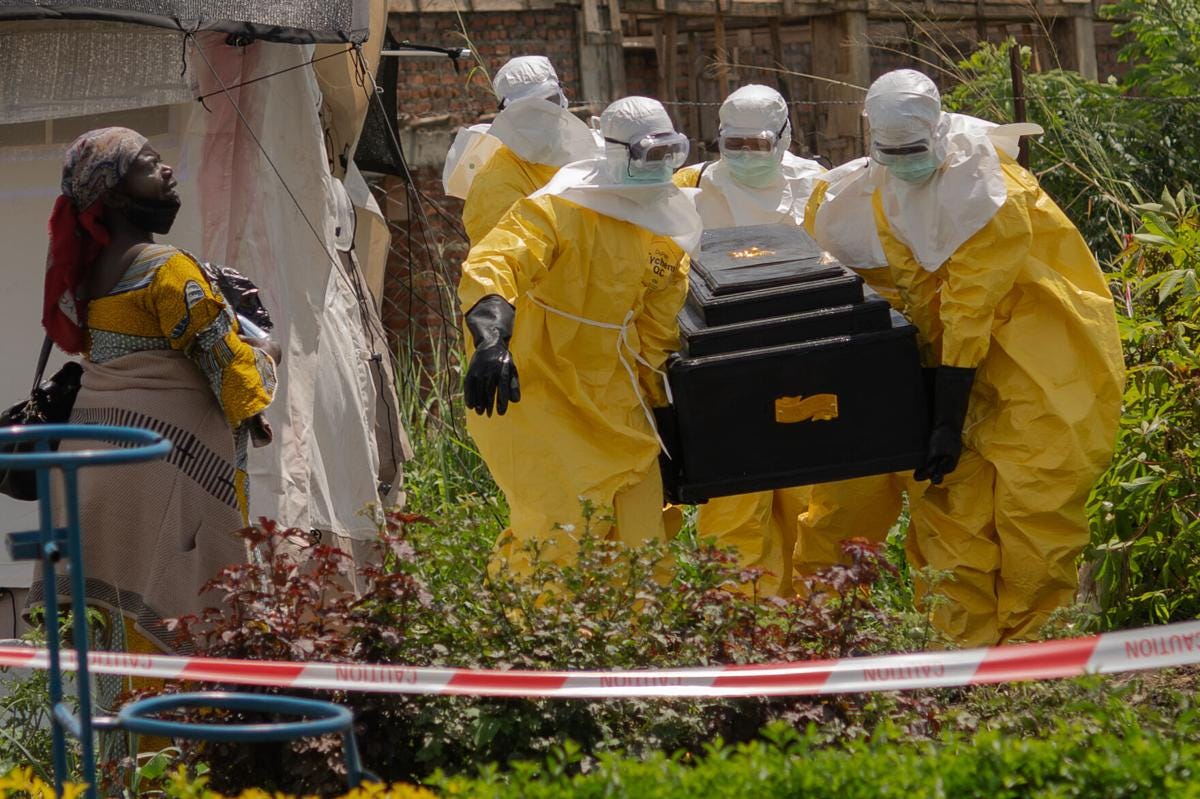
The World Health Organization declared an international public health emergency last Tuesday. Ebola in the Democratic Republic of Congo. Six hundred cases. One hundred and thirty-nine suspected deaths. Confirmed cross-border spread to Uganda. The outbreak is fewer than three months old.
The last Ebola epidemic of any significant scale killed more than eleven thousand people across West Africa over two years.
The two numbers — six hundred today, eleven thousand last time — should be looked at together. They tell you something about what is possible to contain and what is not, and what changes between epidemics that determine which outcome happens.
The 2014-2016 outbreak was eventually contained. The containment was expensive and slow, but it worked. The mechanism that worked is worth describing precisely, because the same mechanism is now gone.
In 2014, when cases crossed into Guinea, Sierra Leone, and Liberia, the United States deployed three thousand military personnel under Operation United Assistance. USAID coordinated the broader civilian response. The CDC stood up an Emergency Operations Center. The State Department coordinated diplomatic mobilization. The Department of Defense built field hospitals. The total commitment ran into the multiple billions of dollars. The pattern was: catch outbreaks at the source, mobilize the apparatus before exponential growth started, and treat the cost as cheaper than the alternative.
The alternative — letting the outbreak run — was eleven thousand dead, eight hundred million dollars in long-term economic damage in the affected countries, and serious cases imported into Spain, the UK, Germany, and the United States, with one domestic death in Dallas. That was the alternative when the apparatus worked.
The apparatus does not exist anymore.
USAID was dismantled in 2025. Not pared back. Not restructured. Dismantled. The decision was ideological — foreign aid is unpopular with the President’s base, and demolition was easier than defense. A study released this week links the dismantling to rising armed conflict in DRC, Sudan, and other countries previously stabilized by USAID-coordinated programs. The same dismantling removed the field-deployable epidemic-response infrastructure that had worked in 2014. There is no Operation United Assistance equivalent on the books. There is no civilian apparatus to coordinate one. The State Department’s relevant offices have been gutted. The CDC’s international operations have been cut. The Department of Defense will not deploy on a public health mission without civilian coordination, and the civilian coordination capacity is gone.
This is not opinion. This is operational reality. The pandemic response architecture the United States built between 1980 and 2024 was disassembled in eighteen months. The disassembly was a budget decision dressed in ideological language. The bill comes due now, with the first significant outbreak that would have triggered the old apparatus.
Stack on top of this the entry ban policy. The Trump administration’s response to the outbreak — beyond the absence of response capacity — has been to impose entry bans on travelers from the DRC, Uganda, and South Sudan. The bans look like containment, but produce the opposite incentive. Public health epidemiology has known this for decades: travel restrictions imposed on outbreak zones create incentives for case-hiding rather than case-reporting. Governments do not announce cases when doing so would trigger border closures. Sick travelers do not seek care if seeking care means deportation. The cases that get caught early — the ones the apparatus is built to catch — go underground.
The 2014 outbreak was caught at scale, in part, because the WHO and the US worked closely with affected governments to maintain trust. That trust required that countries not be punished for reporting outbreaks. The current US posture is the opposite: report an outbreak and your citizens are barred from travel. The incentive is to delay reporting. Delayed reporting means later detection. Later detection means exponential growth before the apparatus mobilizes — except the apparatus does not exist anyway.
The current outbreak is at six hundred cases. That number could stay at six hundred. It could also become six thousand, then sixty thousand, depending on how fast and how well the regional response works without American coordination. The WHO is doing what it can. Médecins Sans Frontières is on the ground. The Ugandan and Congolese health ministries are working with limited resources. The variable that decided the 2014 outcome — large-scale, well-funded, coordinated US-led international response — is not in the equation this time.
This is not bad luck.
The reason to belabor this point is that pandemics are routinely framed as natural disasters, things that happen to societies. They are not. Pandemics occur when state machinery for containing zoonotic spillover fails. The state machinery has to be built. It has to be maintained. It has to be deployed before exponential growth makes it useless. The United States built that machinery over forty years and dismantled it in eighteen months. The next outbreak that travels at scale was a budget decision.
It is worth being precise about which budget decision. The dismantling of USAID was decided in early 2025. The CDC’s international operations were cut over the following twelve months. The State Department reorganization affecting epidemic coordination capacity finalized in November of 2025. By the time Ebola crossed into Uganda this spring, the apparatus had been gone for roughly a year. The current outbreak is the first stress test of the post-apparatus regime. Whether it stays contained or does not will tell us what kind of pandemic risk environment we are now living in.
Pandemic risk has historically been treated as something governments handle on behalf of populations. That model assumed governments would maintain the capacity to handle it. When governments stop maintaining that capacity, pandemic risk shifts from collective concern to individual variable. It joins the list of things that the sovereign apparatus used to absorb and now does not: currency stability, judicial independence, regulatory enforcement, federal benefit allocation. Each of those used to be a collective good. Each of those is now a sovereign variable that varies meaningfully across jurisdictions.
The countries that maintained pandemic infrastructure — Singapore, Taiwan, South Korea, Germany, the Nordic states, parts of the Gulf — have continued to maintain it. The United States has not. The pandemic resilience of the country you live in is now something worth knowing about, in the same way that the rule of law of the country you live in is now something worth knowing about. These were not variables five years ago because the assumption held that institutional capacity was floor-level adequate across OECD countries. The assumption no longer holds.
This is the wider point, and it is worth saying directly. Sovereign variables are things you assumed were given and discover are not. Pandemic infrastructure is one of them now. The country that catches the next outbreak at 600 cases will have a meaningfully different experience from the country that catches it at 60,000. The choice of which country you are in is no longer fully decided by where you happened to be born.
Whether the current Ebola outbreak will remain at 600 is genuinely unknown. The regional response without American coordination might hold. The Ugandan health ministry has experience with previous, smaller outbreaks. The WHO and MSF will do what they can. The current strain may be less transmissible than the 2014 strain. There are several variables that could keep the number small.
There are also several that could not. The regional response is operating with a fraction of the resources the 2014 response had. The entry ban regime is creating reporting incentives that work against detection. The next time the outbreak crosses a border, there is no Operation United Assistance to deploy. If the current strain proves more transmissible than expected, or if the regional response runs out of resources before the outbreak peaks, the trajectory looks much more like 2014 than like the contained smaller outbreaks of recent years.
Either way, the next outbreak is coming. There will always be a next outbreak. Zoonotic spillover is a constant feature of human-animal interface in a world of eight billion people, billions of animal-vector contacts daily, and accelerating habitat encroachment. The question has never been whether the next pandemic will happen. The question has always been whether the apparatus catches it before it scales.
The apparatus does not exist anymore. The next pandemic was a budget decision. The decision was made. The bill is what is coming.
The Long Memo runs on subscribers. The Editorial Board is the room where the work gets steered — monthly Q&A, member-surfaced topics, a hand in what gets researched next. If this is the analysis you want more of, that is the door.
Oh, come on, when was the last pandemic? Oh, wait!
It's worth noting that at the start of Trump 45, the pandemic preparedness work that Obama had done (stockpiling of PPE, ventilators, and the creation of briefing books and contingency plans, etc) was tossed in the dumpster.
Right after Obama took office (in the summer of 2009), there was a major Flu outbreak, and Obama issued a "get ready for stuff like this" order. When Trump came in, that inventory and those plans were labeled "from Obama, so necessarily wrong" and *literally* trashed.
Successful pandemic containment looks like nothing happened. That's what made the apparatus so easy to dismantle.
Forty years of catching outbreaks at 600 cases produces a population that's never seen 60,000 and assumes it can't happen here. The better the system works, the less evidence there is that it works. So dismantling it looks free.
Your "sovereign variables" frame is the bit I'll be thinking about longest. Five years ago nobody priced pandemic infrastructure when choosing where to live. Now it sits on the same list as rule of law and currency stability. The question is how many more variables migrate from "assumed" to "priced" before people realise the list itself is the story.