

The Floor Just Gave Way
A median of 34% of those surveyed express confidence in Xi Jinping. A median of 31% express confidence in Vladimir Putin.

There is a kind of institutional damage that announces itself, and a kind that you only detect later, by reading an instrument. A currency that stops being held in reserve. A treaty that stops being cited. A number, in a survey, that crosses a line it was never supposed to cross. The loud kind makes news. The quiet kind makes history.
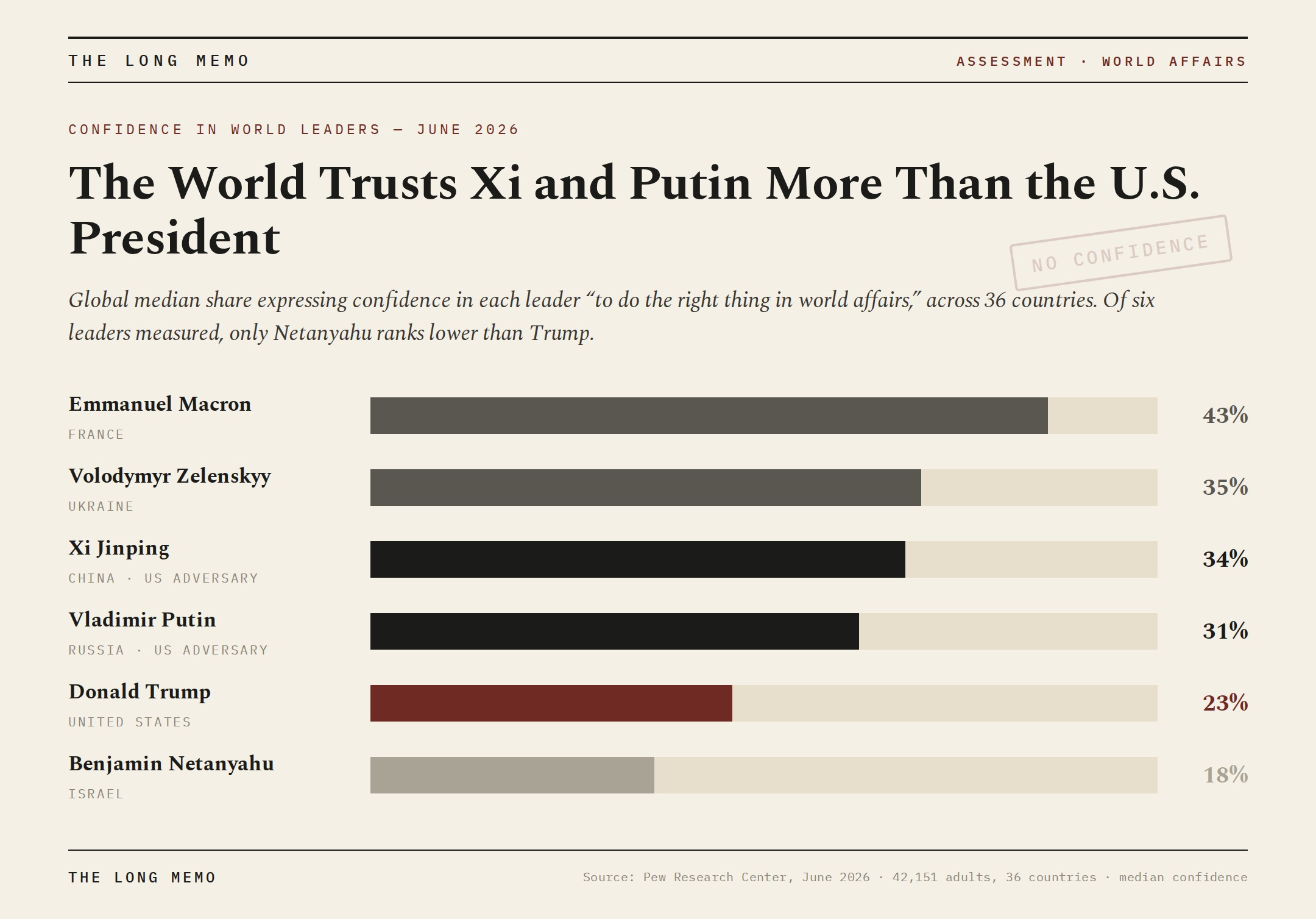
This week, the instrument gave a reading. A Pew Research Center survey of 42,000 people across 36 countries asked which world leaders they trust to do the right thing in international affairs. Global publics now place the President of the United States below both the President of China and the President of Russia. Of six leaders measured, only Benjamin Netanyahu — mid-war — scores lower than the American head of state.
That is not a story about a man. It is a reading of a structure, and that structure has underwritten American power for eighty years.
What the number is actually measuring
A median of 34% of those surveyed express confidence in Xi Jinping. A median of 31% express confidence in Vladimir Putin. The American president draws 23%. Macron sits at 43, Zelenskyy at 35. The man holding the most powerful office on earth finishes fifth of six, trailing the leaders of the two governments Washington has spent a generation naming as its principal adversaries.
The question matters more than the ranking. This is not a favorability poll. It does not ask whether foreign publics enjoy the man, admire him, or would vote for him. It asks a narrow question — whether they trust him to do the right thing in world affairs — and on that specific axis of judgment, the office built to embody the credible alternative to authoritarian rule is now judged less credible than the authoritarians.
That distinction is the whole subject of this essay. Because credibility, not capability, is the load-bearing wall of American power.
The asset nobody put on the balance sheet
For most of the postwar period, the United States ran on two kinds of power. One was material — carriers, currency, the world’s deepest capital markets. That power is still largely intact; the carriers still sail. The other was something harder to see and impossible to manufacture on demand: the assumption, held by populations and not just governments, that when Washington said a thing it meant it, and that the American side was the side that kept its word. Call it the credibility reserve. It was never voted on, never appropriated, never line-itemed. It simply accumulated, the way trust accumulates, slowly and through repeated demonstration — and like every reserve, it could be drawn down.
This is the part the material analysis misses. You can measure a navy. You cannot measure a reserve of assumed good faith until the moment someone tries to spend it and finds the account lighter than expected. A security guarantee is only as good as the belief that it will be honored. An alliance is a promise that holds because both sides assume it holds. The dollar is paper that works because the world decided to trust the institution behind it. Every one of those instruments runs on the same invisible deposit — and the deposit is exactly what this survey just measured a withdrawal against.
The Soviet Union did not collapse because it ran short of tanks. It collapsed because the cost of compelling belief in the system finally exceeded the system’s capacity to generate it — because the people inside it, and the clients outside it, stopped assuming the center would hold and began quietly arranging their affairs around its failure. Hard power was never the binding constraint. Credibility was. By the time the instruments read empty, the structure was already hollow; the reading only confirmed what the architecture had stopped being able to hide.
This is recent, and that is the alarming part
If this were a slow erosion — a decade-long drift, a gentle reversion toward some historical mean — it would be a different essay, and a calmer one. It is not. One year ago, in Pew’s 2025 survey, the American president led both autocrats: Trump at 34%, Xi at 25%, Putin at 16%. Twelve months later the order has inverted. Trump fell to 23. Xi rose to 34. Putin climbed to 31. The lines crossed inside a single year.
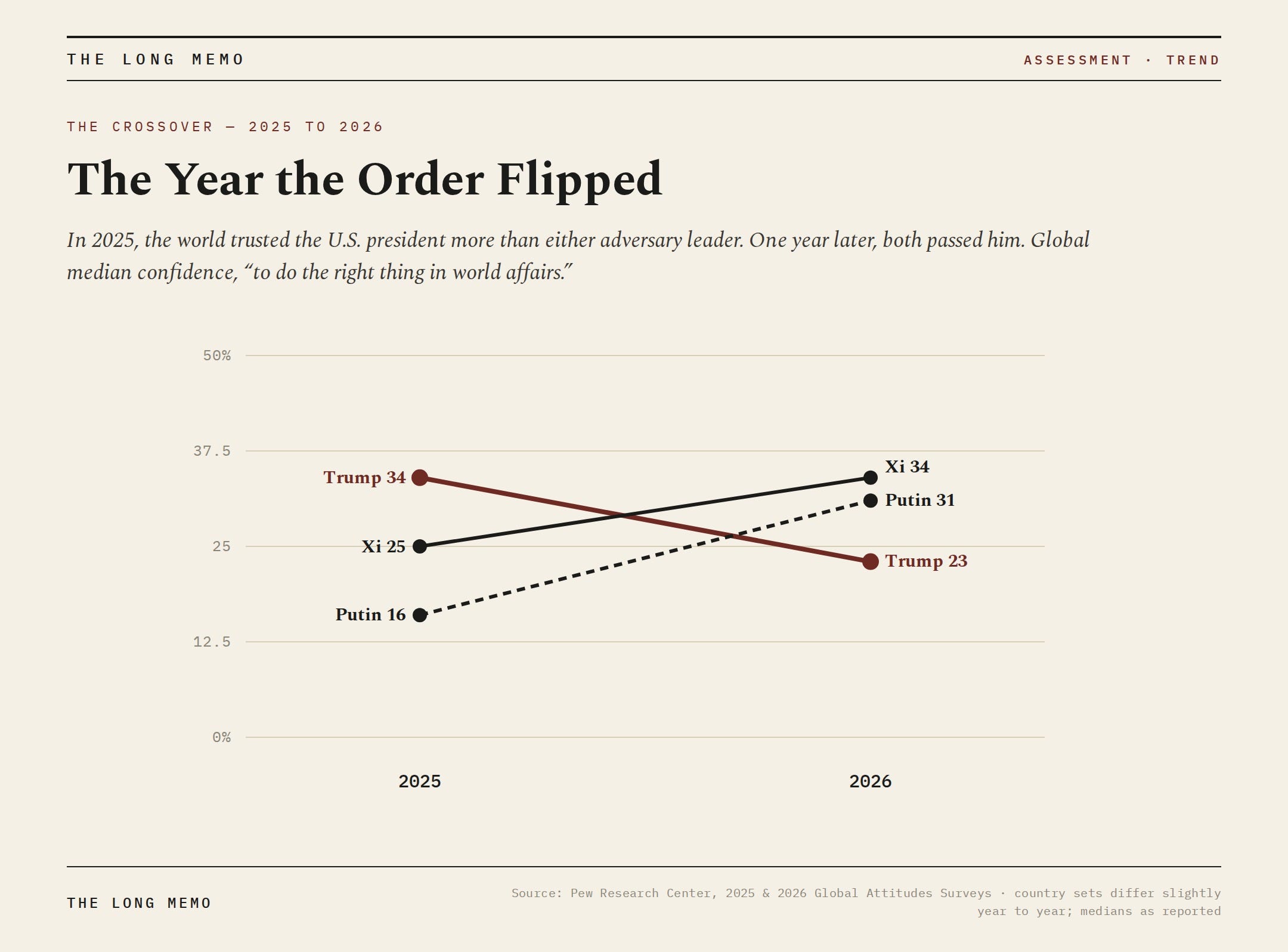
The year-over-year figures are not a perfect like-for-like — Pew’s surveyed countries shift slightly between waves, and the medians move with them, so I would not stake a claim on the precise size of any single swing. But the direction does not wobble and the magnitude is not subtle. This was not a president slipping a few points within the normal band of foreign disapproval. This was a structure failing a threshold test — falling through the floor that had always separated the democratic side from the authoritarian one, with the men on the far side of that floor rising to occupy the space he vacated.
And it is not an artifact of the global median, dragged down by publics that were never friendly. Pew names the countries in its own text. In Germany, 16% trust the American president and 15% trust Putin — the same number, inside the margin. The German figure for Macron is 72%. In Canada, the oldest neighbor and one of the closest allies the country has, Putin draws 18% and the American president draws 20%. In Mexico he draws 11%, beneath even a wartime Netanyahu. These are not the adversary capitals. These are the treaty allies — the populations whose governments share intelligence with Washington, host its forces, and buy its weapons. They have placed the American president in the same credibility tier as the man prosecuting the largest war in Europe since 1945.
What a credibility inversion sets in motion
Here is the mechanism, because the mechanism is where the damage actually lives. Credibility is not sentiment that floats free of consequence. It is the precondition for cooperation, and cooperation is the thing that converts American intentions into outcomes. A government that no longer believes Washington is a reliable actor does not announce it. It hedges. It diversifies its security relationships, quietly. It slows the negotiation. It keeps its options open against the day the guarantee is tested and found wanting. Populations move first, governments follow on the lag democracies always run between sentiment and law, and by the time the policy changes the belief has already changed underneath it.
This is what it means for a reserve to be spent rather than destroyed. Nothing dramatic happens on any single day. The carriers still sail; the treaties are still technically in force. But the assumption that made all of it function at low cost — the background belief that the American side keeps its word — is being drawn down, and the people doing the drawing have just told a pollster what they think of the institution. The system that runs on assumed good faith starts having to pay, in friction and concession, for what it used to get for free. That is not collapse. It is something quieter and harder to reverse: the slow conversion of a trusted hegemon into a merely powerful one, which is a different and weaker thing.
The individual response to a structural drawdown is the same one every rational actor reaches when it stops believing the center will hold — you stop assuming, and you start arranging your affairs around the possibility that it won’t, which is the entire premise behind building jurisdictional optionality before you need it rather than after. But the individual hedge does not touch the structural fact, and the structural fact is the point of this publication. A reserve that took eighty years to accumulate is being spent in single-year increments, by the allies it was built to reassure.
The reading
Credibility is the one form of power that cannot be reconstituted by appropriation. You cannot fund it, legislate it, or deploy it. It is earned slowly and spent quickly, and once a population has decided that your word is worth less than your rival’s, the path back is measured in decades, not news cycles — if there is a path back at all.
The instruments are not ambiguous. The floor that separated the credible side from the other side held through Vietnam, through Iraq, through a great deal of American error that was forgiven because the underlying assumption survived. It did not hold through this. The reading is on the page, in the kind of number that does not make noise when it crosses the line — and the people who took the survey are not waiting for permission to believe what they already believe.
Source: Pew Research Center, “Trump Gets Negative Reviews Internationally as Fewer Say U.S. Is a Reliable Partner,” June 2026. Survey of 42,151 adults across 36 countries, conducted February 8–May 13, 2026. Leader-confidence medians and named country figures as reported by Pew; 2025 comparison drawn from the prior year’s Global Attitudes Survey.
I guess the big question is, so what? The people of the world no longer trust the United States and its leader. Popular opinion today suggests that Trump is corrupt and possibly insane. My own, first-hand perceptions agree with that opinion. Many writers and thinkers, including you, tell us this has been coming for a long time. Again, I agree.
If you and the others who tell me what is going on are correct, then Trump is the logical outcome of a broken, corrupt system. In order for anything broken to be repaired or replaced, there needs to be an acknowledgment of the existence of the problem. Trump is that acknowledgment.
Democrats like Biden and Harris, and possibly even Obama, have been applying Band-Aids on top of the festering, pus-laden cankers that are covering our governmental system. Meanwhile, Republicans have been smoking cigarettes, drinking Bud Lites, and washing in herbicides while they tell us that nothing is amiss. Back at the ranch, the American people are being lied to as they struggle with living life in today's America.
Soooooo...... I believe Trump and his lousy approval ratings are a gift to the United States. Personally, I'd like to see him build the "Trump Arch." Then, when it collapses on a school bus full of orphans, America will once again see the foolishness of our status quo.
The Truth is, America and its leaders are not worthy of trust. We only work for our best interests, and those interests are defined by an elite who now possess an obscene amount of wealth. America doesn't care about innocent people being bombed, killed, or displaced. We really couldn't care less about starving children, especially if they're brown or black. We deny the destruction of our planet because admitting to it might hurt the profits of those who really run our country.
Yeah! Good for the people of the world for not trusting Trump.
I guess Putin’s work over the last 5? decades has paid off. I’d love to see where Mark Carney is on that list….he doesn’t have Macron’s name recognition, but he does have the gravitas. But basically the US and UK are shitshows that eclipse even the shitshow of Putin.