

The Energy Secretary Who Lied to the Oil Market — and Got Away With It
The Post He Deleted Tells You Everything About Where We Are

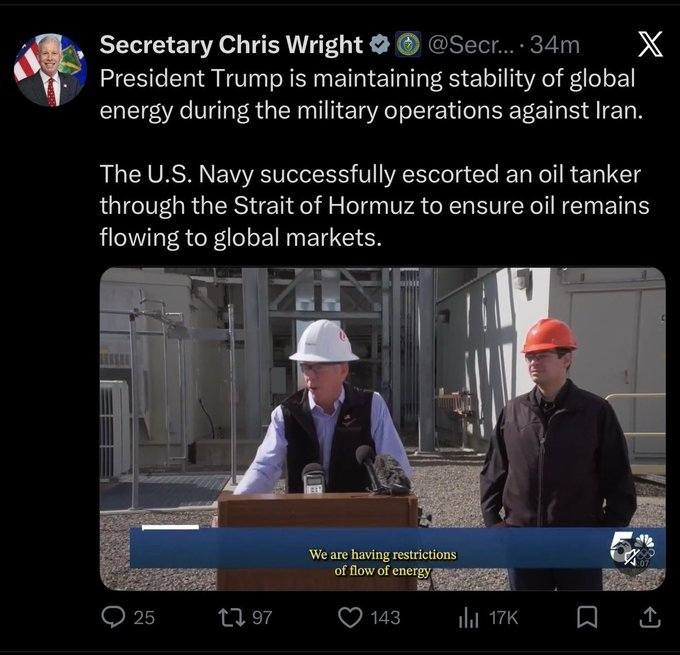
On Tuesday morning, Energy Secretary Chris Wright posted a video to his official government account. The claim was simple and significant: the U.S. Navy had successfully escorted an oil tanker through the Strait of Hormuz, ensuring oil would keep flowing to global markets.
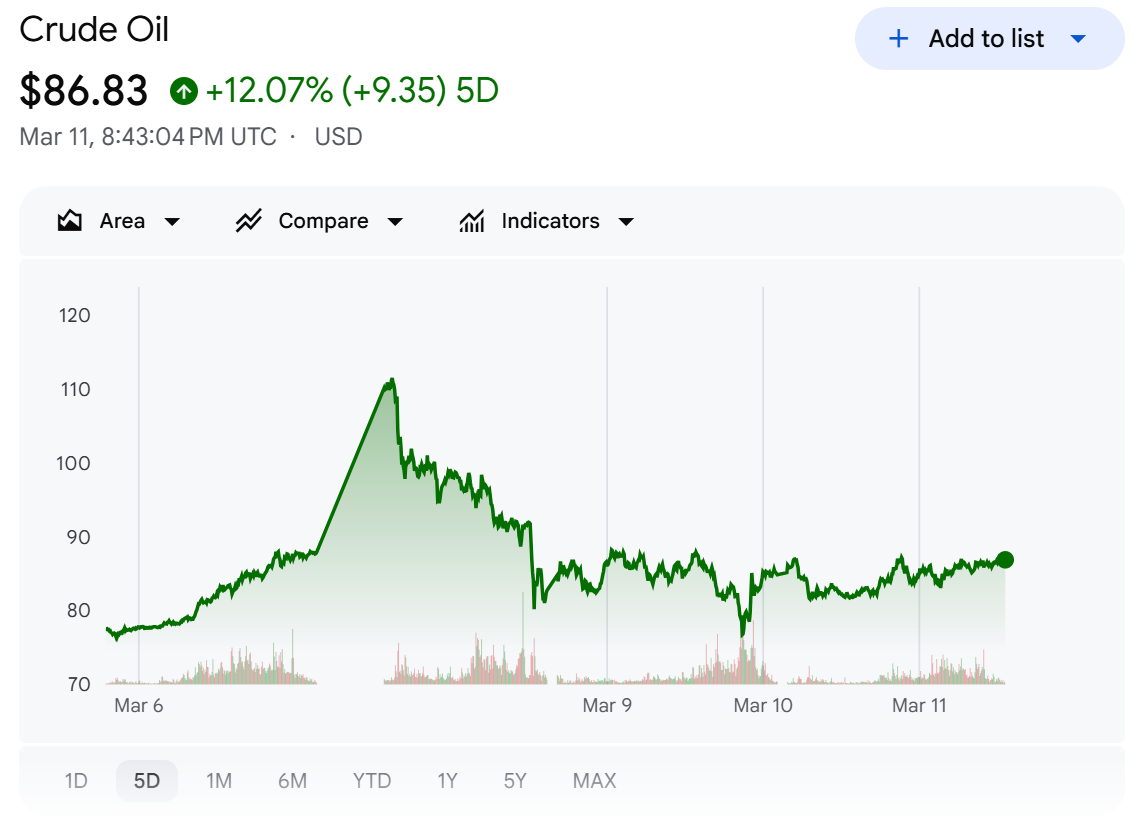
Markets responded immediately. Oil prices, which had been elevated since the conflict began February 28, plunged nearly 19% within the session. WTI briefly dipped below $77 a barrel. Hundreds of millions of dollars in market value shifted in the time it took a social media post to propagate through trading terminals.
There was one problem. It wasn’t true.1
The White House press secretary corrected the record within hours: “The U.S. Navy has not escorted a tanker or a vessel at this time.” An Energy Department spokesperson followed with a formal statement explaining that the video had been “incorrectly captioned by Department of Energy staff.” Wright deleted the post. Oil partially recovered by the end of the day — closing around $89, Brent near $91.
And then, as far as the institutional response was concerned, that was that.
No resignation.
No congressional inquiry.
No serious demand for accountability.
A Cabinet secretary of the United States government posted demonstrably false information about an active military operation — information that moved one of the world’s most systemically important commodity markets by nearly 19% in a single session, during an active armed conflict in the world’s most critical energy corridor — and the institutional response was a deleted post and three paragraphs from a press secretary.
I want you to hold that sequence for a moment, because the news cycle has buried it, and it deserves more than burial.
What the Correct Response Would Have Looked Like
Institutional credibility doesn’t operate on intent. It operates on architecture — the systems, norms, and accountability structures that exist to catch errors before they become market-moving facts, and to impose meaningful costs when they don’t.
Think about what the correct institutional response to Tuesday’s event would have looked like in a different era. Not the distant past. 2005. A Cabinet official publishes false information about an active military operation during a live armed conflict, via an official government communications channel, triggering a major commodity market movement with downstream effects on inflation, fuel costs, and global supply chains.
The sequence that follows: an immediate, formal retraction with specific attribution of accountability — not a deleted post, but a stated explanation of what failed and who bears responsibility for it. A formal inquiry, or at a minimum a public commitment to one, into how false operational claims reached an official government account without verification. Congressional attention to the communications protocols of a Cabinet department during wartime — because if an Energy Secretary can move oil markets 19% on an unchecked claim, the question of what verification procedures exist is not an academic one. And in a functioning accountability environment, a resignation or a credible public dressing down signals to every other Cabinet official what the cost of this kind of error actually is.

Instead, the sequence was: deleted post, brief press secretary comment, end of story.
The gap between those two sequences is the thing worth understanding. Not as an indictment of any individual, but as a measurement of where institutional accountability currently sits. That gap is not incidental. It is not a one-off. It is the system functioning exactly as it is currently configured.
The Decoherence Problem
I’ve been writing for several years about what I call institutional decoherence — the process by which the internal logic of institutions breaks down before any visible collapse occurs. Decoherence doesn’t look like failure from the outside. It looks like normalization. It looks like a series of events that each get absorbed, explained, and moved past, while the cumulative effect on the architecture goes untracked.
Each individual instance is explicable in isolation. Staff made a captioning error. The secretary was misinformed. Mistakes happen under wartime pressure. The correction was issued. These are all true statements that, in aggregate, are functionally useless for accountability.
What matters is not whether any single event can be explained away. What matters is how the cost structure of false official information changes when every event is explained away. When the cost of posting false military information on an official government account, during an active war, affecting global commodity markets, is a deleted social media post, you have entered a regime where the corrective mechanism has been replaced by a reset button.
Institutions do not maintain credibility through declarations of credibility. They maintain it through demonstrated willingness to pay costs when credibility is violated. Those costs are what teach every other actor in the system what the real rules are — not the written rules, the real ones.
The real rule, as of Tuesday: you can move global commodity markets 19% with a false official claim about an active military operation, and the cost is a deleted post. That rule is now in the system. Every other actor who observed Tuesday’s event updated their priors accordingly. Some of those actors are foreign governments. Some of them are energy traders. Some of them are adversaries assessing the U.S. government's credibility amid an ongoing conflict.
Why the 19% Number Is the Story
The market movement itself is the evidence that needs to stay in frame.
When a government official posts something on an official government account about an active military situation affecting a critical global trade route, the assumption built into market pricing is that there is some institutional infrastructure behind that statement. Not absolute certainty, markets don’t price things at certainty. But an adjustment. A baseline assumption that official government communications carry some verification, some cost to false signaling, and some institutional weight that distinguishes them from random rumors.
What Tuesday empirically, and in real time, established is that this assumption is no longer warranted.
The oil market ran a live experiment on the credibility of U.S. government communications during a wartime commodity crisis. The result: official statements from Cabinet secretaries are priced the same as unverified rumors. They move the market; they get corrected; they get absorbed; the market moves on.
That is a fundamental shift in the information value of official government communications in global commodity markets. Not a dramatic, announced shift. A quiet one that happened on a Tuesday afternoon when an Energy Secretary deleted a post.
Here’s why this matters beyond Tuesday specifically: markets that cannot trust official government communications in low-stakes environments solve the problem by discounting official communications and waiting for harder evidence before moving. When that same dynamic applies to communications about military operations in active conflict zones, it creates a specific kind of volatility — not the volatility of unknown information, but the volatility of uncertain credibility. Every subsequent official claim, whether true or false, will be priced with the Wright incident in the prior.
That is a real cost borne by everyone who participates in energy markets. Which is to say: everyone.
The Pattern We’re In
I don’t think this gets meaningfully better going forward. This isn’t something the normal cadre of cheerleaders saying “Vote DEMOCRAT!” can fix. Not because of any individual secretary or any single administration, but because the accountability infrastructure that would need to correct this behavior is itself compromised — and compromised architectures don’t self-repair under pressure. They tend to consolidate around their degraded state.
Congressional oversight requires committees that function as oversight bodies rather than as demonstrative partisan flanks. The committees exist. The gavels come down. The hearings get scheduled. But the function — the willingness to impose real costs on executive branch officials who mislead or misinform in ways that carry public consequences — has been so thoroughly subordinated to factional loyalty that it no longer operates as a corrective mechanism. You can observe this empirically by counting the number of consequential resignations or meaningful congressional accountability actions since the institutional degradation accelerated. The form is present. The function has been replaced with theater.
Panem et circenses.
Press accountability requires institutional journalism with both the platform and the appetite to impose reputational costs on false official claims. The coverage of Tuesday’s Wright incident was almost entirely framed as a market story. The deleted post was the lede. The commodity price movement was the story. The structural question — what does it mean that a Cabinet secretary can move global commodity markets with an unchecked claim during a live war, and pay zero cost for it — was not the story that ran. It was, at most, a paragraph near the bottom of a financial wire piece.
Panem et circenses.
Regulatory accountability would require a body with the authority and the inclination to examine the relationship between official government communications and commodity market movements. Someone (or a group of someones) likely made nearly a billion dollars by manipulating the market for those 10 minutes. That inquiry has not been opened. It probably won’t be.
Panem et circenses.
What you’re watching is paradigm consolidation in action. Not dramatic. Not announced. The new operating logic is settling in, becoming self-reinforcing, teaching every participant in the system what the real cost structure is. The old paradigm assigned real costs to false official information. Careers ended. Hearings happened. Resignations followed. Those costs didn’t exist because institutions were morally superior. They existed because the accountability architecture had enough functional teeth to impose them. The teeth are substantially dulled, and the dulling shows up most clearly in the gap between what Tuesday warranted and what Tuesday produced.
This is what permission collapse looks like in real time. Not a dramatic seizure. Not a televised moment of rupture. A deleted post. A press secretary correction. A commodity market that briefly fell 19%, shrugged, and resumed watching the next headline.
The Signal Beneath the Event
There is a version of this story in which Tuesday was an embarrassing but ultimately minor incident — a stressed staff member, a sloppy caption, a lesson learned, move on. That version is available. It is also the version that will be chosen by most of the institutions whose job it was to respond.
The version I’m asking you to hold on to is different: Tuesday was a data point in a longer series, and the series measures something specific. Not how often officials make mistakes — mistakes have always been made. It’s measuring the current cost of making those mistakes and whether that cost has any corrective function.
In a healthy institutional environment, Tuesday would have produced meaningful consequences. It didn’t. That’s not an aberration. It’s a reading.
Panem et circenses.
The families building jurisdictional optionality right now — the ones who’ve watched this series of readings accumulate over the past several years and drawn the obvious conclusion about the trajectory — are not paranoid. They’re calibrated. The argument for building a sovereign stack was never about any single event. It was about the cumulative pattern of events that each gets absorbed and normalized while the underlying architecture continues to degrade.
Tuesday is another point on that graph.
The question isn’t whether the Strait of Hormuz reopens — it will at some point, eventually, because enough powerful actors have interests in it reopening. The question is, what we saw is simply the new operating standard?
The smart bet, based on available evidence, is that it’s the new operating standard. And smart bets get acted on.
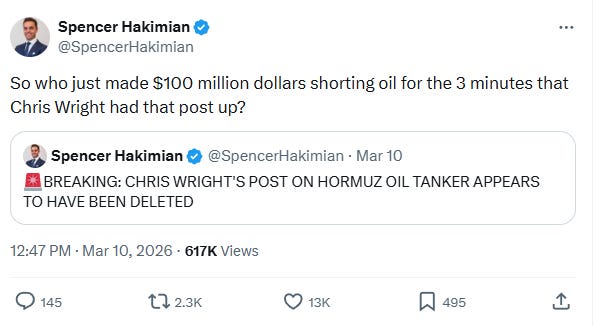
Hedge fund manager Spencer Hakimian asked the question out loud: "So who just made $100 million dollars shorting oil for the 3 minutes that Chris Wright had that post up?" In the preceding two weeks, six documented accounts made $1.2 million on Polymarket predicting the Iran strike timing — wallets funded hours before the attack, positions opened 71 minutes before news broke. Classified foreknowledge has become a revenue stream for this administration. Whether Wright knew he was the instrument is almost beside the point.
"Someone (or a group of someones) likely made nearly a billion dollars by manipulating the market for those 10 minutes. That inquiry has not been opened."
That was my first thought when I read about the post and yhe subsequent deleting of it. With this corrupt regime full of criminals and grifters they should always be presumed guilty until proven innocent. Because they're always guilty.
Spencer’s answer is Chris Wright. You are spot on. No accountability anywhere and rampant normalization of corruption. The other question? Who lost $100 million in those three minutes?