

The Category Error That Broke American Foreign Policy
Force Is Not Power. The Bill for That Confusion Is Now Due.

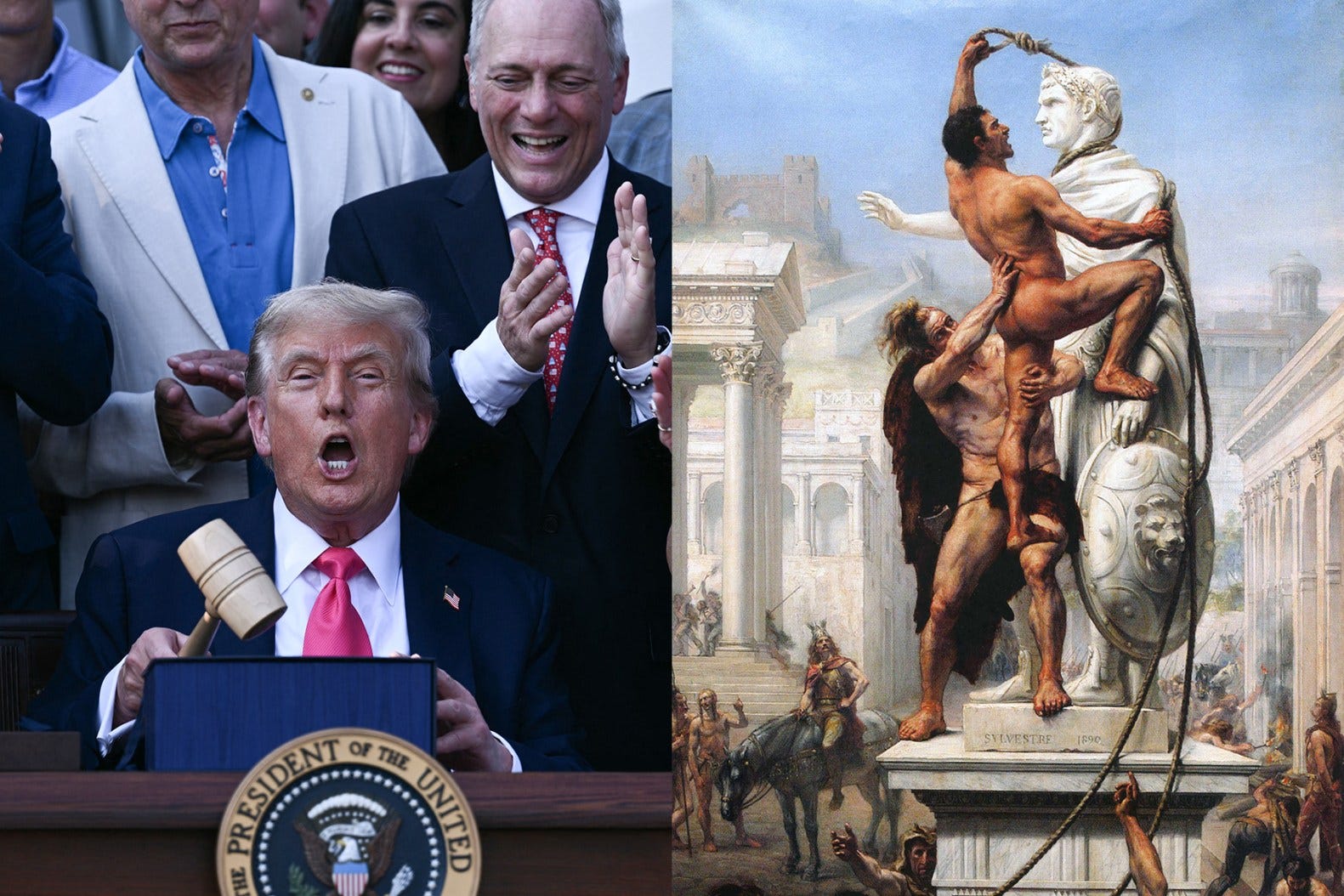
Force is not power.
I wrote that two years ago. I meant it as a provocation.
The Iran war has turned it into a description.
Strategic authority is the capacity to produce durable political outcomes that reflect your interests, in cooperation with others, over time. It derives from legitimacy — others believe your authority is appropriate. From credibility — others believe your commitments are real and your capabilities are matched to your intentions. From the coalition, others choose to align with you because of what they gain from it. And from institutional coherence, you can hold a position and enforce it consistently.
Force is one input to strategic authority. It is not a substitute for it.
The United States has the most powerful military force in the history of organized violence. It also has declining strategic authority. These two facts are not contradictory. They are causally related. The systematic substitution of force for the harder and slower work of legitimacy, credibility, coalition-building, and institutional coherence has eroded the authority that once made American power function.
You can bomb a nuclear program. The question is what you produce by bombing it, and whether that product serves your strategic interests.
Vietnam was the first demonstration of the failure of this model at scale. The US applied enormous force to a small country for a decade. The outcome was not order. It was a strategic defeat, purchased at the cost of 58,000 American lives, the destruction of an entire nation, the fracturing of domestic political consensus, and the permanent association of American military power with a specific category of failure.
The lesson was not learned.
Iraq, 2003. Enormous force. A government destroyed. A vacuum that produced the Islamic State, a collapsed state, and a regional realignment toward Iranian influence that persists today. The country we invaded to eliminate an Iranian buffer became an Iranian client. The cost: $2 trillion, 4,400 American military deaths, hundreds of thousands of Iraqi civilian deaths, and the complete exhaustion of American credibility in the region for a generation.
Afghanistan. Twenty years. $2.3 trillion. The Taliban controls Kabul. The government we built survived our departure by approximately as long as it took us to leave.
Each of these was a demonstration of what happens when force is substituted for the patient construction of strategic authority. Outcomes are produced. They are simply not the outcomes intended. The category error is consistent. So are the results.
The war in Iran is the logical endpoint of this trajectory.
Iran has been the strategic objective of American regional policy for forty-five years. The hostage crisis, the proxy conflicts, the sanctions architecture, the assassination campaigns, the covert nuclear sabotage — the entire structure of US-Iran relations is built on the premise that sufficient pressure, applied over sufficient time, will produce Iranian capitulation or internal collapse.
It produced neither. It produced a nuclear program, a hardened regime, a sophisticated proxy network across the region, and an Iranian leadership with decades of experience operating under maximum American pressure without capitulating. The sanctions regime that was supposed to bankrupt them funded their adaptation. The military pressure that was supposed to fracture their coalition solidified Iranian domestic support for the security state.
The current military engagement is the same theory extended to its kinetic conclusion. We are applying more force because the previous amounts of force didn’t work. The theory has not been reconsidered. The dosage has been increased.
This is not a strategy. It is an escalation of a failed model by people who have not updated their model.
There is an honest question buried in all of this: what would strategic authority look like for the United States in 2026? After Iraq, after Afghanistan, after four decades of demonstrated failure to convert force into a durable regional order, after the institutional decoherence that collapsed the Geneva talks before they could produce anything — what is the alternative?
That question doesn’t have an easy answer. I don’t pretend to have one. But it cannot be addressed while the category error is still functioning as doctrine, while the system still operates as if force and authority are the same thing and the only variable is magnitude.
The bill for four decades of this confusion is denominated in American lives, American fiscal capacity, American credibility, and the American ability to construct the regional and global arrangements on which American prosperity and security have depended since 1945.
It is a large bill.
It is being presented now.
P.S. — The strategic and institutional analysis above is one side of the ledger. The other — what individuals and families do in response to a country whose foreign policy has become structurally incapable of producing the outcomes it claims to pursue — is what I write about at Borderless Living. That’s where the operational thinking lives.
To mix metaphors, the definition of insanity is to invariably and repeatedly select the hammer over all other options from a fully-stocked tool chest and expect every objective to behave like a nail.
Overreliance on the military instrument has made the United States strategically lazier and lazier over time. It’s hard to disagree with you that this Iran debacle is an end point (if not necessarily the endpoint) of this longstanding, ever deepening strategic laziness. A kind of last-gasp triumph of laziness. Nicely done.