

The Arms Boom Nobody Voted For
The interesting question is not what Canada bought. The interesting question is what Canada stopped believing.

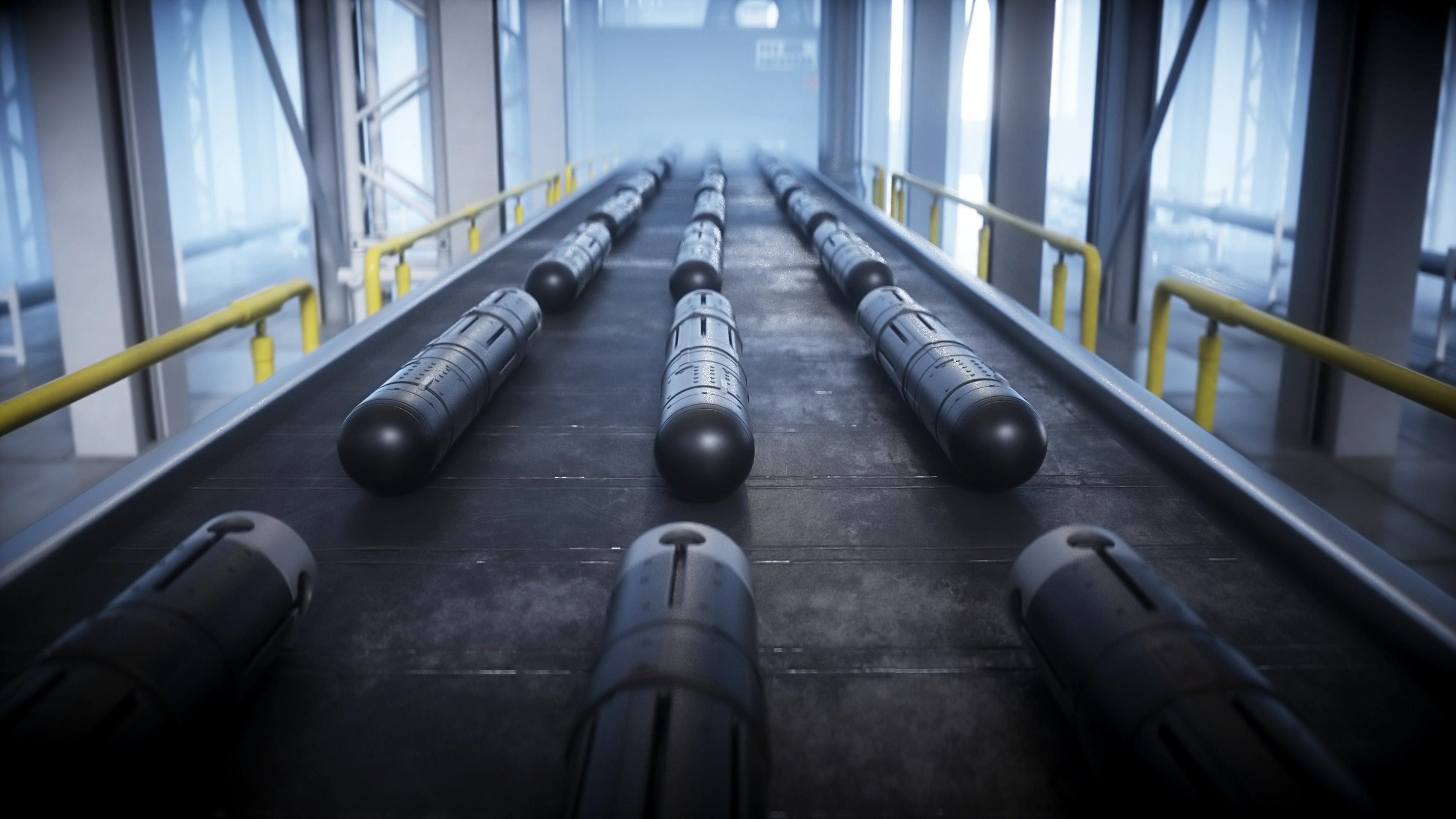
On July 6, Mark Carney stood in Halifax — on his way to a NATO summit in Ankara — and announced the largest military procurement in Canadian history: up to twelve attack submarines from Germany’s ThyssenKrupp Marine Systems, a program worth $20 to $30 billion for the boats aloneand, by Korean press estimates, as much as $100 billion over three decades once you count the lifetime of the fleet.
Canada has not bought a newly built submarine in more than sixty years. Its procurement system is a running joke in defense circles — the country that takes a decade to buy a pistol. This time, the entire competition ran in under a year, start to finish, a pace one analyst called astonishing for a project of this size. Germany and Norway offered to give up their own places in the production queue so Canada could take delivery of its first four boats by 2034 .
Stop and sit with that. A famously slow, famously cautious middle power just executed the fastest major weapons purchase in its modern history, for the largest sum it has ever spent on anything military, and two European allies rearranged their own naval production schedules to accelerate it.
The interesting question is not what Canada bought.
The interesting question is what Canada stopped believing.
The Underwriter Walks Off the Job
For eighty years, the United States sold the world’s most valuable product, and it never appeared on a customs form. The product was certainty. An American security guarantee was an insurance policy: allies paid premiums — basing rights, deference on trade, diplomatic alignment, purchases of American weapons — and in exchange they could run smaller militaries than their threat environment justified, because the underwriter of last resort was the Pentagon.
Insurance has a peculiar property. The policy is worthless the moment you doubt the insurer will pay. Not when the insurer refuses to pay — merely when you can no longer predict whether it will. A fire policy from a company that pays some claims, denies others, and decides which is which based on the owner’s mood that morning is not a discounted policy. It is not a policy at all. And every rational homeowner in that market responds the same way: they stop paying premiums and start buying their own fire trucks.
That is the mechanism now operating on the entire American alliance system, and here is the part almost nobody in Washington wants to say plainly: it does not require a doctrine. There is a cottage industry of analysts straining to find the grand strategy inside the current administration’s foreign policy — the threats to annex Canada, the ambivalence on Article 5, the tariffs on allies, a forty-day air war against Iran launched, paused, and, in mid-July, declared un-paused. I spent enough years inside the machinery of national security planning to tell you what I think is actually there: a set of beliefs about force — that it works, that it is cheap, that consequences are for other people — being acted out in real time.
Not a plan. A disposition.
But markets do not price intentions. They price behavior. And states, when it comes to survival, are the coldest-eyed market participants on earth. Whether the erratic signal coming out of Washington is four-dimensional chess or a mental disorder is analytically irrelevant to a defense planner in Ottawa, Paris, London, Berlin, or Canberra, because the planning conclusion is identical either way: the guarantee can no longer be priced, so it can no longer be relied upon.
The guarantee was never revoked. It was repriced. That distinction matters, because revocations can be reversed by the next administration. Repricings live in the counterparty’s head, and no signature can reach in there and undo them.
We have run this experiment before, and the results are on file.
In the mid-1960s, Charles de Gaulle looked at the American guarantee and asked the question no ally is supposed to ask out loud: would Washington actually trade New York for Paris? He concluded he could not know — and that not knowing was the whole answer. France pulled out of NATO’s integrated military command in 1966, evicted the alliance’s headquarters from French soil, and built its own nuclear deterrent, the force de frappe, at staggering expense for a country still rebuilding from the war.
Note the sequence carefully. Nothing had happened. No abandonment, no betrayal, no failed Article 5 invocation. The United States in 1966 was arguably at the height of its commitment to Europe (especially by present-day standards). All that changed was that a serious man in a serious capital could no longer price the promise — and that alone was sufficient to justify the most expensive hedge available.
Now note the duration. France did not rejoin NATO’s integrated command until 2009. Forty-three years. Eight American presidents came and went, several of them ardent Atlanticists, and none of it mattered, because the decision had never been about any particular president. And when France finally did come back, it came back with the arsenal. The submarines, the warheads, the independent defense industry built to serve them — none of it was dismantled because once a state pays the fixed cost of self-insurance, maintaining the capability is nearly free, and surrendering it is unthinkable. One moment of doubt, acted upon, produced a two-generation structural fact.
That was one country, reacting to a hypothetical. What is happening now is that every ally is reacting at once to behavior they can watch on television.
The Demand Map
Once you see the mechanism, the data stops looking like a collection of headlines and starts looking like a single event happening in many places at once.
Start with the aggregate. World military spending hit $2.887 trillion in 2025, the eleventh consecutive annual increase, pushing the global military burden to 2.5 percent of world GDP — the highest share since 2009. Strip out the United States, whose 2025 number fell for accounting reasons we’ll get to, and the rest of the planet increased military spending by 9.2 percent in a single year.
Now look at where the money is moving. Europe’s spending surged 14 percent to $864 billion — the fastest annual increase among NATO’s European members since 1953. Think about what 1953 means: to find a European rearmament this fast, you have to go back to the moment the continent stood up armies against Stalin. Germany raised spending 24 percent in one year, crossed 2 percent of GDP for the first time since 1990, and has pledged 3.5 percent by 2029. Spain jumped 50 percent. Poland now carries the heaviest defense burden in the entire alliance at 4.5 percent of GDP. And at this summer’s Ankara summit — the same one Carney was flying to — the alliance pressed toward the 5-percent-of-GDP target adopted in 2025, with Secretary General Mark Rutte telling members before Ankara that he expected plans that are, in his words, “clear, concrete and credible”.
Here is the detail that separates this from every previous burden-sharing cycle, and it is the one American coverage keeps missing. Europe is not just spending more. It is spending _elsewhere_ — deliberately, structurally, and now by statute. The EU’s new SAFE instrument — €150 billion in jointly backed loans, the first pillar of a plan to mobilize more than €800 billion in defense investment by 2030 — carries a legal condition: no more than 35 percent of a funded weapon system’s component cost may originate outside the EU, the EEA-EFTA states, and Ukraine. Read that again. Buy-European preference is no longer a communiqué sentiment. It is a loan covenant. The Draghi review found that nearly 80 percent of recent European procurement money flowed outside the EU, overwhelmingly to American firms. The entire architecture of European rearmament is now designed to reverse that number.
Two footnotes to the European number tell you how seriously to take it. First, the scale: NATO members collectively spent $1.581 trillion in 2025 — 55 percent of everything the entire planet spent on arms (and roughly the equivalent of the United States, something that prior had never been contemplated, let alone executed). Second, the fever: the 5-percent target is so politically load-bearing that SIPRI’s researchers are already warning about creative accounting to hit it — Italy reportedly floated counting a bridge to Sicily as defense-related expenditure. When governments start relabeling civil infrastructure to look more armed than they are, you are past a spending increase and into a status competition. Nobody gerrymanders their books to appear more militarized unless militarization has become the currency of standing.
The pattern is hemispheric, not regional. Asia and Oceania rose 8.1 percent to $681 billion, the region’s largest annual increase since 2009. Japan’s spending rose 9.7 percent to its highest share of GDP since 1958; Tokyo lifted its postwar ban on lethal weapons exports and promptly signed its first warship deal, building frigates for Australia. Taiwan posted its largest increase since at least 1988. Australia and the Philippines are climbing the same curve. And SIPRI’s own researchers, careful people not given to editorializing, attributed the allied surge in Asia not only to regional threats but to “growing uncertainty over US support.” The Commonwealth, the Eurozone, the Pacific treaty allies — different oceans, identical diagnosis.
Which brings us back to Halifax — because the submarine announcement was not a decision. It was the last step of a sequence. Last year, Canada signed a Security and Defense Partnership with the EU, the diplomatic framework that unlocks participation in European joint procurement. On June 15 of this year, Ottawa concluded the follow-on agreement admitting Canadian industry into the SAFE procurement system itself. Three weeks later, Carney picked the German boats over South Korea’s Hanwha — whose shares fell 23 percent on the news. Read the order of operations: first the treaty framework, then the industrial access, then the anchor purchase that makes Canada a customer, a supplier, and a stakeholder of the European defense bloc in one stroke. Governments do not stumble up that staircase by accident. Carney said the deal would open opportunities for Canadian firms inside European supply chains — which is the return path on the entry fee. Translate from the diplomatic: Canada, the country that shares the world’s longest border with the United States and whose military has been functionally integrated with America’s since 1940, was not shopping for submarines. It was executing an accession — wiring itself into a European defense-industrial bloc, deliberately, step by step. Not because Europe is closer. Because Europe is predictable.
One more Canadian detail deserves precision, because sloppier commentary will get it wrong. These are not nuclear submarines. The Type 212CD is a diesel-electric boat with air-independent propulsion — quiet, long-endurance, conventionally armed. Canada is not going nuclear (yet) and perhaps doesn’t need to. That is precisely the point. You do not need to break the nuclear taboo to hedge against Washington. You need hulls, missiles, shells, and supply chains that do not route through a country whose promises you can no longer price. The hedge is conventional, legal, alliance-compatible — and enormous.
The Arsenal Ran the Math Too
Now the American side of the ledger, because the same erratic behavior that is driving allied demand has simultaneously created a demand shock inside the United States.
The war with Iran — thirty-nine days of high-intensity air and missile combat this spring, more than 12,000 targets struck, a ceasefire in April, and a president who declared that ceasefire “over” in mid-July — consumed the American munitions stockpile at a rate no peacetime planner ever budgeted for. The Center for Strategic and International Studies, working from Pentagon budget documents, estimates the campaign expended at least half of the THAAD ballistic-missile interceptor inventory, nearly half of the Patriot interceptors, roughly 30 percent of the Tomahawk stock, and 45 percent of the Precision Strike Missile inventory — a system so new it had barely entered production. The Washington Post reported that the United States fired more advanced interceptors defending Israel than Israel itself did.
Against that burn rate, the refill rate is a rounding error: current delivery schedules put replenishment at roughly 15 new Tomahawks and 20 new Patriot interceptors per month, with zero THAAD deliveries forecast for all of 2026. CSIS puts the rebuild at three or more years just to return to pre-war levels — for the war we were already supposed to be equipped for, never mind a Pacific contingency. The strain is no longer theoretical enough to hide: the Navy paused $14 billion in approved weapons deliveries to Taiwan on the grounds that the munitions were needed for the Iran fight.
Follow the money that follows the shortfall. The administration has requested about $1.5+ trillion for defense in fiscal 2027 — the largest request in American history — on top of a $450 billion reconciliation package moving through Congress and a war supplemental everyone in Washington treats as inevitable (at about $70 billion). The president has personally convened defense CEOs and announced they would quadruple production of what he called “exquisite” weaponry. The Army wants 857 THAAD interceptors in a single budget year. Lockheed Martin is spending $9 billion through 2030 on more than twenty new production facilities.
So hold both halves of the picture at once. Allied demand for non-American weapons is exploding because Washington is unreliable. American demand for American weapons is exploding because Washington’s unreliability was voluntarily acted out with live ordnance over Iran, and now the magazine has to be refilled — and then expanded, because the new stated posture requires a military that can coerce without partners. If allies are freeloaders and every relationship is a shakedown, you need a force that projects power alone. That force runs on exactly the munitions we just expended with no ROI.
Either fork of American policy — restored alliances or armed unilateralism — is a defense-spending program. There is no fork where the money goes down.
Who Sells to a World That Trusts No One
A world that rearms must buy from someone, and the supplier map has a shape worth naming.
Russia will keep arming itself — $190 billion in 2025, 7.5 percent of GDP, the highest share of government spending ever recorded there — but a war economy at full draw is a customer, not a vendor. Its export book is collapsing under the weight of its own consumption and its clients’ battlefield observations.
China is the interesting case, and the place where the lazy version of this analysis goes wrong. Beijing raised spending 7.4 percent to $336 billion — the thirty-first consecutive annual increase, the longest streak on record — and Chinese firms will absolutely sell into this boom: drones, munitions, electronics, systems for the Global South and for the margins of European inventories. What China will not capture is the center. No serious state stakes its survival on the keystone systems — the submarines, the fifth-generation aircraft, the integrated air defense — of a supplier that is itself the pacing threat of half its potential customers, whose flagship platforms remain unproven in combat, and whose design lineage everyone in the business can trace. Watch what states do rather than what vendors claim: when Canada wanted boats it could bet the Atlantic approaches on, the shortlist was Germany and South Korea. Beijing was never in the room. Europe’s 35-percent foreign-component cap fences out Chinese content as surely as American. I would be shocked if China (or Russia) captured much of anything in the new “arms demand boom” from America’s former partners.
Which reveals the real structure of the coming market. It is not one arms race. It is three concentric ones. The great powers arm against each other. The equity markets have already scored it: in 2025 alone, Rheinmetall rose 154 percent, ThyssenKrupp 215 percent, Hanwha Aerospace 193 percent on top of a 154 percent gain the year before. Capital is not confused about what is happening. Capital saw the underwriter walk off the job before the foreign-policy commentariat did. Europe arms because the guarantees lapsed — and they buy from the suppliers whose reliability is their entire sales pitch: Germany, France, South Korea, Japan, Sweden, and each other. American industrial base arms to refill and then to double, selling to its own government first and to whatever allied demand it hasn’t yet alienated, along with two-bit dictatorships America suddenly realizes it might need. China and Russia continue to do “you” and sell at the margins.
Why the Boom Outlives the Man
Here is the claim that makes this an analysis rather than a news roundup: this is not a spending cycle. Cycles reverse when the stimulus fades. This has the three properties of a structural shift, and each one is a lock.
First, the demand is politically locked. NATO’s 5-percent target runs to 2035. Germany’s 3.5-percent pledge runs to 2029. SAFE loans disburse through 2030 and are repaid over forty-five years — Europe has mortgaged its rearmament on a timeline longer than its current politicians will live. Canada’s first hulls arrive in 2034; the last, sometime in the 2040s. These are not budget lines that lapse with a news cycle. They are treaty targets, loan covenants, and thirty-year industrial programs. Europe has entered the chat with a true (new) military-industrial complex. That won’t go away because a President leaves office.
Second, supply is constrained, which turns spending into a durable boom rather than a one-time purchase. Precision munitions cannot be surged like rifle cartridges. Japan needed three years to build a single Patriot factory; Germany has been standing up its own line since 2022 and has yet to produce a missile. Seventeen countries use Patriot and all of them want interceptors at once, which is why allocation decisions are already generating friction between Washington and its partners. When demand is contractually locked for a decade, and supply takes years to expand, you do not get a spike. You get a plateau at altitude.
Third — and this is the perverse one — the buildout is redundant by design. In the old system, one American production line served thirty countries, and the efficiency was the point. In the new system, every bloc builds parallel capacity precisely because depending on someone else’s factory is the vulnerability everyone just learned to fear. Europe builds European lines. Japan and Korea build Pacific lines. America rebuilds American lines. The duplication is not waste to be optimized away; the duplication is the product. Trust was the technology that made the old efficiency possible, and thanks to US actions, trust is the one component nobody can manufacture on an accelerated schedule. So, in the short and medium term, each region is going to deploy its own long-term capital. (As Keynes famously quipped, in the long term, we’re all dead. So let’s hope the long term is cheerier than that.)
All of this is why the boom survives its author. Suppose the next administration is the most alliance-devoted in American history. It flies to Brussels, reaffirms every article of every treaty, means every word. Kisses the French Prime Minister. Goes before NATO and weeps like Jerry Falwell. What changes? Ottawa does not cancel submarines arriving in 2034 because Washington sounds nice after four years of threatening to end its sovereignty — the entire lesson Canada just internalized, at the largest price in its history, is that a four-year signature cannot secure a forty-year need. The EU does not repeal a loan instrument with a 45-year tail after staring down Russia because its former guarantor went out on a bender for half a decade. Germany, Italy, Spain, and the Scandinavian countries will not unbuild factories because the new President doesn’t threaten their sovereignty daily. France needed forty-three years to walk back a hedge triggered by a hypothetical, and it kept the weapons anyway. Rearmament is a ratchet: political will opens the spending, but industrial concrete, treaty targets, and burned trust prevent it from closing. The insurance analogy holds to the end — once the homeowners have bought their own fire trucks, they do not sell them back because the insurance company hired a friendlier adjuster.
Recognizing that most people never took an international relations course, let me help you understand what this means for the ordinary American, because the costs do not stay abroad.
A tripolar world without a reliable underwriter is historically the least stable configuration the state system produces — more players, more miscalculation surfaces, fewer automatic stabilizers. The entire “cause” of the First World War is blamed on multipolarity and failures in coupling/partnering/communications (read Barbara Tuchman’s The Guns of August). Multipolarity will be a radical departure from the safe, stable, and largely prosperous world of “benign unipolarity” that followed the stability of “Cold War” bipolarity.
The Fed chairman noted this month that the Iran war has pushed inflation to a three-year high, with officials penciling in rate hikes to cool it — the guns-and-butter bill arriving on your grocery receipt and your mortgage rate. A trillion-and-a-half-dollar defense budget is a claim on the same treasury that funds everything else you were promised. And the deeper cost is the one Canada just priced: the discovery that guarantees you organized your life around can be repriced overnight, without your consent, by temperament. States are answering that discovery by building options that don’t depend on anyone’s mood in Washington. It is the same math sovereign families have started running on their own lives — which is exactly why the ones paying attention are building jurisdictional optionality now, while it is still a choice rather than a scramble.
For now, hold the image from Halifax. A prime minister announcing the largest weapons purchase his country has ever made, boats that will not touch water until the mid-2030s, bought from Germany, financed for a generation — then boarding a plane to a NATO summit hosted in Ankara. Nothing about that scene was aimed at the current occupant of the White House. Canada is not arming against this administration. It is arming for the world this administration made possible.
That is the tell. Every capital on earth watched the same behavior you did. They stopped arguing about whether it’s a doctrine.
They started buying fire trucks.
Follow the money. Fundamental restructuring away from USA defense firms. Move to regional and country sovereignty. Inefficient from a capital POV but no one can trust the USA after Trump so this is what you get. And the USA is a loser in this realignment.