

The Architecture of the Next Economic Apocalypse
Warsh Sworn In. The Architecture Is Complete.

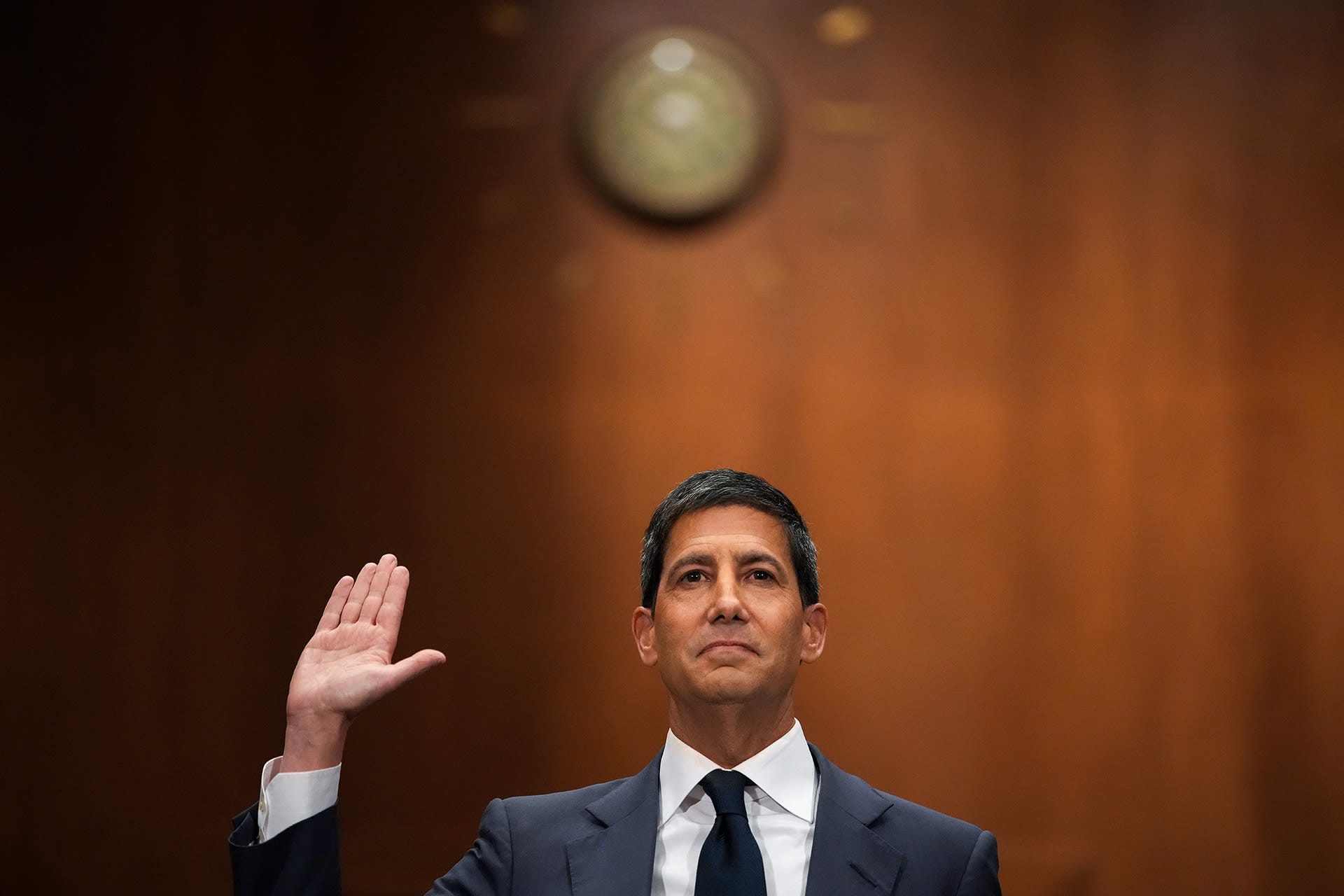
Kevin Warsh was sworn in as Chair of the Federal Reserve last Friday.
His confirmation, 54-45 in the Senate, was the most divisive vote for a Fed Chair in the modern banking era. The vote followed a months-long pressure campaign that included a Justice Department criminal investigation into the Federal Reserve itself — a probe that was dropped only after the Senator who had been blocking Warsh’s committee vote in protest released his hold. The investigation went away. The hold went away. The nomination advanced.
This is how the architecture was completed.
The architecture has three legs, and they have been installed in sequence. Hold all three in view at once.
The first leg, already in motion, is the reduction of capital requirements. In March of this year, the Federal Reserve voted six-to-one to reduce the capital requirements imposed on the largest banks in the United States. The vote received roughly a tenth of the press coverage that the President’s social media posts got that day. This is inverted from its significance.
What was voted on, in concrete terms, was the re-proposal of the Basel III Endgame rule — the regulatory framework that determines how much capital large banks must hold against their lending and trading activities. The original 2023 proposal would have raised the required capital for the largest US banks by about 19%. The 2026 re-proposal, led by Vice Chair for Supervision Michelle Bowman, instead cuts that requirement. Capital requirements for the largest banks fall by 4.8 percent. For mid-sized banks, by 5.2 percent. For smaller banks, by 7.8 percent. Stack on top of this the November 2025 final rule that already cut the Enhanced Supplementary Leverage Ratio for globally systemically important institutions, capping the eSLR for depository subsidiaries at four percent.
Alvarez & Marsal, the consulting firm, estimates that the changes unlock $2.6 trillion in new lending capacity for the US banking system.
A quick aside? People talk about “printing money,” and inflation. The US Government does not “print money” into existence. Capital operations bring money into existence. Specifically, banks loan money into existence. Thus, we’re talking about trillions of dollars in new money becoming available for lending.
The KBW Bank Index is at an all-time high, unsurprisingly. They all see themselves as about to get very rich. (And they’re probably right.)
These are the facts of the first leg.
The second leg is the leadership change. Jerome Powell’s term as Chair expired May 15. Powell was, by the standards of the Trump administration, insufficiently compliant on rate policy. The President spent the better part of two years complaining that rates were too high. The pressure campaign against the Fed escalated through 2025 and into early 2026, culminating in the DOJ probe and a months-long Senate stall before Warsh’s confirmation.
The result: Kevin Warsh, age fifty-six, sworn in as the eleventh Fed Chair of the modern banking era. Trump’s handpicked successor. Confirmed almost entirely on party lines. The institution that was historically defended as politically independent now has a Chair whose nomination was advanced through DOJ pressure on the institution itself.
Warsh’s biographical signals are worth noting precisely.
He served previously on the Federal Reserve from 2006 through 2011. The Fed on which he served, in 2007 and 2008, was the body that the historical record now describes as having initially dismissed the dangers of the subprime mortgage meltdown that led to the global financial crisis.
Warsh was one of the dismissers.
He was the Wall Street liaison during the crisis itself. He has been, for fifteen years since leaving the Fed, an inflation hawk in his public commentary — though his recent statements have signaled openness to lower rates, which appears to be the price of the chairmanship.
He has also been an adviser to Electric Capital, a crypto-focused investment firm. This is the third leg.
The Basel III re-proposal contains a provision that has received almost no political attention. The current Basel framework applies a 1,250 percent risk weight to unbacked crypto assets, which effectively means banks must hold one dollar of capital for each dollar of crypto exposure. This treatment was deliberate. It reflected the assessment by international regulators that crypto assets, lacking productive cash flow and subject to extreme price volatility, were unsuitable balance-sheet items for systemically important banks. The 2026 re-proposal substantially relaxes this treatment. Major US banks are now positioned to offer custody, lending against, and trading services for digital assets at risk weights that make the business profitable. JPMorgan, Goldman Sachs, and Bank of America are publicly positioning for this expansion.
So: capital requirements being cut by the Vice Chair for Supervision. Rate policy now in the hands of a Chair selected for compliance. Crypto integration into the banking system now economically viable, championed by a Chair with crypto-industry ties. All three moves the work of the same institution, in the same calendar year, with the same beneficiary class.
This is what is meant by Fed-led.
The argument from here is structural.
Capital requirements were not invented to harass banks. They were the institutional response to 2008. The reason 2008 happened the way it happened was that the largest banks had insufficient capital to absorb the losses that materialized on their books when the housing market reversed. The losses were not the surprise. The losses were always going to happen — that is what credit cycles do. What was surprising was that institutions whose stated business was absorbing financial risk turned out to have so little capital that they could not absorb the financial risk they had taken. They were, by the time the cycle turned, leveraged at a ratio that left no room for ordinary credit losses.
The Basel III framework was the response. Basel III required banks to hold more capital. The capital was specifically calibrated against the failure modes that materialized in 2008. The framework said: you will hold enough capital to absorb a 2008-scale shock without becoming insolvent. The framework was conservative in some respects, less so in others, but its core logic was sound. If you require capital, you prevent the failure mode in which a credit cycle reverses, and the institutional absorbers cannot absorb.
The framework worked for about fifteen years. It has just been substantially undone by the same institution that previously served as its custodian, now led by the same person who was on the Fed when the subprime crisis was initially dismissed.
This matters because credit theory is not optional.
Banks are leveraged institutions. They borrow short and lend long. When their capital position is strong, they can absorb losses without affecting their ability to lend or meet obligations. When their capital position is weak, even ordinary credit losses force them to deleverage, which means calling loans, refusing new lending, and selling assets into falling markets. The deleveraging cycle is what makes credit crises systemic rather than localized. The reason 2008 became a global financial crisis rather than a contained housing correction was that the institutional absorbers turned out to be amplifiers.
When you reduce capital requirements, you do two things. You increase the banking system's lending capacity during good times. And you reduce the banking system's absorption capacity during bad times. These are not separate effects. They are the same effect viewed from two different positions in the credit cycle. The same regulatory change that produces the boom produces the bust.
When you combine reduced capital requirements with a Fed Chair committed to lower rates and the integration of a volatile asset class onto bank balance sheets, you produce more of both. The boom phase will be more pronounced because the policy mix is more accommodative. The bust phase will be more severe because the absorption capacity is lower, and the new asset class brings volatility that the prior framework was designed to keep off the books.
The timing question is when, not whether.
Historical data on this is consistent. The Gramm-Leach-Bliley Act in 1999 removed the structural separations between commercial and investment banking. Eight years later, the system blew up. The 1980s deregulation of the savings and loan industry was followed by the S&L crisis. The Glass-Steagall reforms of the 1930s lasted for 60 years and were dismantled in stages over the 1990s, with the final removal in 1999, followed by the 2008 crisis. The pattern is consistent: rule relaxation, credit expansion, asset bubble, cycle reversal, systemic crisis. The lag between relaxation and crisis is typically four to seven years, sometimes longer.
The current capital relaxation began in late 2025 under Powell. The Warsh chairmanship begins now. The crisis the combined architecture sets up, on historical pattern, lands somewhere between 2029 and 2033.
It will not look like 2008. Financial crises never look like the previous one. The institutional adaptations and regulatory adjustments since 2008 will route the next crisis through different channels. The most likely candidates are: commercial real estate, where significant losses have been deferred and disguised through loan extensions and restructurings; private credit, which has grown from roughly $300 billion to nearly $2 trillion since 2008 with substantially less regulatory oversight than bank lending; and digital asset exposure, which the Basel re-proposal now makes economically viable for major banks to hold on balance sheet.
The implication is that the next crisis will have compounding factors that were not present in 2008. The deregulated capital position. The accommodative rate stance of a Trump-installed Fed Chair. The new institutional exposure to crypto, championed by a Chair who previously advised a crypto fund. And the loss of Fed independence as an institutional check — the DOJ used as a pressure tool against the central bank is the single most institutionally degrading move in modern American monetary policy. Crisis economists studying this period in twenty years will likely treat these moves as a single architectural decision rather than four separate ones.
In the near term, none of this looks like a crisis. In the near term, this looks like a boom.
Banks with reduced capital requirements lend more. Rate cuts add fuel. Asset prices rise as new credit chases existing assets. Wealth concentrated in equities and real estate compounds at accelerated rates. The KBW Bank Index at all-time highs is the first move of a sequence that will likely include the S&P at all-time highs, real estate at all-time highs, crypto at all-time highs, and a generalized sense in the financial commentary that the post-COVID environment has finally normalized into a sustained expansion. The expansion will be real. It will also be funded by leverage that the banking system is no longer required to absorb if the cycle reverses, in an institutional environment where the Fed’s traditional role as countercyclical check has been politically neutralized.
There is a particular kind of person who reads regulatory news like this and quietly moves a percentage of their assets out of bank deposits and equity-correlated holdings. These people are not panicked. They are not making predictions about the timing of the next crisis. They are simply observing that the regulatory architecture that prevented the last crisis has been undone, and that the absence of that architecture means the next credit cycle will play out differently from the last.
They are adjusting their exposure to that fact.
You do not have to be that kind of person to take the structural point. The structural point is just that capital requirements are crisis prevention. Reducing them in good times is the institutional decision that produces the next crisis. The Fed Chair installed to ratify and extend that reduction was on the same Fed that dismissed the warnings before the last crisis. The institution that is meant to prevent these cycles has just been politically captured by the cycle’s beneficiaries.
The bank index is at all-time highs. The expansion is real. The next four to seven years will likely feature substantial asset price growth, particularly in financial sector equities, real estate, and digital assets. After that, the architecture of the apocalypse, which is the title of this piece, will do what it was just built to do.
The decision was made. The bill is what is coming.
Reader-funded analysis. No advertisers, no foundations, no editorial board outside this one. If you want it sustained, the door is open.
Oof, it's hard to imagine the AI bubble continuing for 5+ years, and with the conflict wildcards..
And you tell me…
Over and over and over again my friend…
You don’t believe we’re on the eve of destruction…