


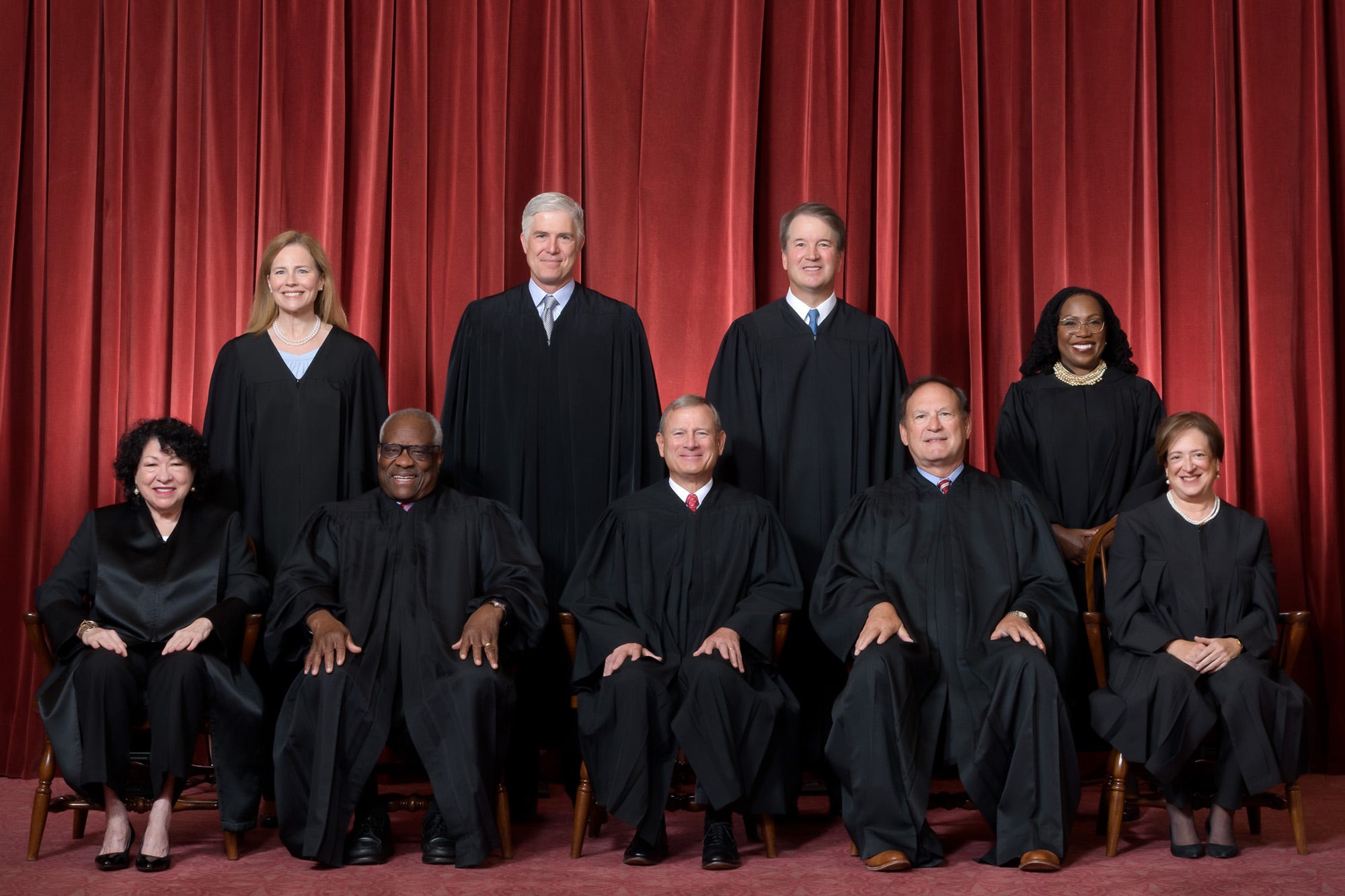
Most Americans assume the rights they grew up with — the right to an abortion or to contraception, the right to attend an integrated school, the right to marry someone of a different race, the right to a lawyer if they cannot afford one, the right to vote without their map being gerrymandered to neutralize them, the right to expect that a federal agency knows more about industrial pollution than a federal judge — were established by the Constitution itself or by an act of Congress.
They were not.
They were established by two specific Supreme Courts between 1954 and 1986, and they were never put into statute.
That distinction did not matter for two generations because the Supreme Court continued to enforce the architecture.
It matters now because the Supreme Court has stopped.
What is happening in American jurisprudence right now is not a series of bad decisions about race or gender or abortion. It is the methodical demolition of a constitutional architecture that was always, on inspection, much more fragile than its defenders ever acknowledged. The demolition is happening in plain view. It is being carried out by a Court that has been overseeing this project since 1982. And it is being permitted by a Congress that, given multiple opportunities to write the architecture into actual law, declined.
You have probably heard part of this story. The part you have heard goes like this: a conservative Court is rolling back civil rights, particularly racial protections. Activists call this “deciding at the speed of white” — a clever play on the Warren Court’s 1955 instruction that schools be desegregated “with all deliberate speed.” The clever frame captures something real. The Court is, in fact, rolling back racial protections. The frame is also partial and analytically inadequate. The race rollback is the most morally vivid part of a larger project.
The full project is the restoration of a much older constitutional order — one that predates the New Deal, predates the modern administrative state, and predates the assumption that federal law is the natural protector of individual rights. The full project also requires the cooperation of Congress, which it has received, and the political opposition, which has provided that cooperation through inaction.
This piece walks through what was built, what is being demolished, and why the demolition is happening. The story is long because the architecture is large. The cleverness of the surface story has obscured the depth of what is happening underneath.
The Architecture
In 1953, the Supreme Court was an institution most Americans rarely thought about. It decided cases. It refereed disputes between branches and between states. It did not, by any common understanding, write the substantive content of American liberty. In 1953, Liberty was understood as what Congress and the states said it was, within the procedural limits imposed by the Constitution.
That changed when Earl Warren became Chief Justice. Warren had been a Republican governor of California and a vice-presidential nominee. He was not, by background, a transformative jurist. He became one. Under his leadership, the Court issued a sequence of decisions that, over sixteen years, fundamentally rewrote the relationship between the federal government and the individual American — and between the federal government and the states.
The foundational case was Brown v. Board of Education (1954). Brown held, unanimously, that racial segregation in public schools violated the Equal Protection Clause of the Fourteenth Amendment. The decision overturned Plessy v. Ferguson (1896), which had established the “separate but equal” doctrine that had governed Southern public life for fifty-eight years. Brown did not, by itself, integrate any school. The follow-up decision in 1955 — Brown II — instructed that desegregation be carried out “with all deliberate speed,” a phrase that in practice meant nearly nothing for over a decade. But Brown established the principle, and the principle established the Court as the federal protector of substantive racial equality.
Brown was followed by an arc of decisions that, in the aggregate, produced what we now think of as the modern civil rights architecture: Mapp v. Ohio (1961), which applied the Fourth Amendment’s exclusionary rule against the states; Gideon v. Wainwright (1963), which established the right to appointed counsel; Reynolds v. Sims (1964), which established one-person-one-vote; Griswold v. Connecticut (1965), which found a constitutional right to privacy protecting contraception; Miranda v. Arizona (1966), which required police to inform suspects of their rights; Loving v. Virginia (1967), which struck down laws against interracial marriage; and Katz v. United States (1967), which extended Fourth Amendment privacy protections beyond physical trespass.
When Warren retired in 1969, his replacement was Warren Burger, appointed by Richard Nixon specifically to slow the Court down. Burger did not slow it down — or, more accurately, he slowed it less than Nixon had hoped. The Burger Court (1969-1986) produced several of the architectural decisions Americans most associate with the modern constitutional order: Reed v. Reed (1971), the first sex-discrimination case under the Fourteenth Amendment; Roe v. Wade (1973), the abortion decision built on the privacy doctrine of Griswold; United States v. Nixon (1974), which held that the president was not above the law; Regents v. Bakke (1978), which upheld race as one factor in college admissions; Plyler v. Doe (1982), which guaranteed public education to undocumented children; and Chevron v. NRDC (1984), which established judicial deference to federal agencies’ reasonable interpretations of ambiguous statutes.
These decisions, and the dozens of supporting cases that elaborated them, were not separate items. They were a single architecture. Together they established that the federal government — and specifically the federal judiciary — was the substantive protector of individual rights against state legislative majorities and against the executive branch. The architecture had a particular philosophical posture: rights were substantive, not merely procedural; the federal government’s protective reach was broad; state legislatures had narrow latitude to override federal rights guarantees; the executive was not above the law; and administrative agencies, operating with technical expertise, were entitled to interpret ambiguous statutes within reason.
Each of these architectural elements has been demolished in the last twelve years.
The Demolition
What follows is not, strictly speaking, a list. It is the same architecture, examined surface by surface, with the demolition timestamped against the building.
Equal Protection.
Brown established that state racial classifications were presumptively unconstitutional and that federal courts would enforce that presumption. Loving extended the principle to private life. Reed v. Reed, Frontiero v. Richardson (1973), and Craig v. Boren (1976) extended it to sex. Bakke accepted that the principle permitted, within limits, the affirmative use of race to remedy historical exclusion.
The demolition begins with Students for Fair Admissions v. Harvard (June 2023). Chief Justice Roberts, writing for a 6-3 majority, held that race-conscious admissions at Harvard and the University of North Carolina violated the Equal Protection Clause. The decision overturned Bakke, then Grutter v. Bollinger (2003), then the elaborate institutional framework that had developed around affirmative action over forty-five years.
This was the architecturally clean reversal. Two further decisions extend the project beyond admissions.
Trump v. Anderson (March 2024) addressed Section 3 of the Fourteenth Amendment — the post-Civil War provision that disqualifies from federal office anyone who has previously taken an oath to support the Constitution and subsequently engaged in insurrection. The Colorado Supreme Court had held that this provision applied to Donald Trump after January 6, 2021. The U.S. Supreme Court reversed per curiam, holding that states lack authority to enforce Section 3 against federal officeholders, including the president. Only Congress, under Section 5 of the Fourteenth Amendment, may enforce the provision. Congress has not done so. Congress will not do so. The disqualification clause, in operation, is now a dead letter.
Louisiana v. Callais (April 29, 2026) finished what Shelby County v. Holder (2013) and Brnovich v. DNC (2021) had started: the operational dismantling of Section 2 of the Voting Rights Act. The 6-3 decision, written by Justice Alito, held that compliance with Section 2 generally cannot justify the use of race in drawing electoral districts. Justice Alito’s reasoning was supported in part by his observation that Black and white voter turnout had reached parity in two of the last five presidential elections — those happening to be 2008 and 2012, the years Barack Obama ran for president. The cherry-picking was not subtle. The decision’s practical effect was to open the door for the wave of mid-decade Southern redistricting underway across Alabama, Tennessee, Louisiana, Missouri, and South Carolina.
The Equal Protection architecture is not yet gone entirely. Brown still stands, formally. Loving still stands. But the substantive content has been progressively narrowed to the point that the Court's operative posture is that race-conscious remediation is itself a constitutional violation. The clause that was supposed to require remediation has been read to forbid it.
Substantive Due Process and Privacy
Griswold established that the Fourteenth Amendment’s due process clause protected a substantive right to privacy. Roe extended this to abortion. Lawrence v. Texas (2003) extended it to consenting same-sex sexual conduct. Obergefell v. Hodges (2015) extended it to same-sex marriage.
Dobbs v. Jackson Women’s Health Organization (June 2022), written by Justice Alito, overturned Roe and Casey v. Planned Parenthood (1992). The majority opinion found no constitutional right to abortion in the text, history, or tradition of the Constitution. The opinion was also explicit that the methodology it used — looking only at rights “deeply rooted in this Nation’s history and tradition” — should be applied to the rest of the substantive due process doctrine. Justice Thomas, concurring, named Griswold, Lawrence, and Obergefell as the next candidates for reconsideration.
United States v. Skrmetti (June 2025) upheld Tennessee’s ban on gender-affirming medical care for minors. The 6-3 decision framed the law not as discriminating against transgender Americans but as classifying by age and medical use — a framing that allowed the Court to apply rational-basis review and uphold the statute. The methodological move is the important one. Skrmetti establishes a template for upholding state laws that target disfavored groups by re-describing them as classifications by some other variable. The Equal Protection doctrine that was supposed to protect minorities against majoritarian targeting has, in operation, been retooled to permit the targeting if the legislature is careful in its language.
The substantive due process architecture is currently held together, in formal terms, by Griswold, Lawrence, and Obergefell. None of the three is secure. Each has been signaled, in print, by sitting justices, as eligible for reconsideration.
Voting Rights
The Voting Rights Act of 1965 was the closest thing to statutory codification the civil rights movement achieved. It was an act of Congress, not a judicial improvisation. But it depended, in operation, on federal judicial enforcement of two key provisions: Section 5, the preclearance requirement that obligated states with histories of voter discrimination to obtain federal approval before changing voting rules; and Section 2, the catchall provision that prohibited voting practices producing racial vote dilution.
Shelby County v. Holder (2013) gutted Section 5. Chief Justice Roberts, writing for a 5-4 majority, held that the formula determining which states required preclearance was based on outdated data — citing the same 2008 and 2012 turnout figures Justice Alito would cite again thirteen years later in Callais. Within forty-eight hours of Shelby, Texas had enacted new voter ID requirements that had previously been blocked under preclearance. Other Southern states followed.
Rucho v. Common Cause (2019) held that federal courts could not hear claims of partisan gerrymandering at all — the question was “non-justiciable.” The decision did not address racial gerrymandering directly, but it removed the parallel federal mechanism that might have constrained partisan-coded racial gerrymandering.
Brnovich v. DNC (2021) narrowed Section 2 further by establishing standards for evaluating voting restrictions that, in practice, made successful Section 2 challenges almost impossible.
Louisiana v. Callais (2026) completed the demolition. The remaining mechanism by which voters of color could challenge racially discriminatory maps in federal court has been narrowed to the point of operational irrelevance. The architecture that had been the operative federal guarantee of fair representation since 1965 is now structurally inoperative. The mid-decade redistricting wave underway across the South is the operational consequence.
Criminal Procedure
The Warren Court’s criminal procedure decisions — Mapp, Gideon, Miranda, Katz — are formally intact. They have not been overturned. The dismantling here is slower, less visible, and operates through narrowing rather than reversal.
Vega v. Tekoh (2022) held that a Miranda violation cannot be the basis for a civil rights lawsuit against a police officer. The decision did not overturn Miranda; it removed one of the principal mechanisms for enforcing it. Officers who fail to give Miranda warnings still face the exclusion of the resulting statements at trial — sometimes — but they no longer face personal liability. The deterrent has been removed; the formal right remains.
The exclusionary rule of Mapp has been narrowed over decades by good-faith exceptions, inevitable-discovery doctrines, and standing limitations that have, in the aggregate, made the rule less restrictive than it was when announced in 1961. The right to counsel of Gideon still exists, but the operational quality of public defense in most American jurisdictions is so degraded — under-resourced, overworked, structurally incapable of mounting effective representation — that the formal right does not produce the substantive result the Warren Court intended.
This is the section of the architecture where the demolition is least visible. The decisions still exist. The rights still nominally apply. The mechanisms by which they used to be enforced have been hollowed out from below, decision by decision, without a single dramatic reversal.
The Administrative State
Chevron v. NRDC (1984) — a Burger Court decision near the end of the architectural era — established that federal courts should defer to federal agencies’ reasonable interpretations of ambiguous statutes. The principle had a practical justification: agencies have technical expertise (the EPA understands air quality science; the FDA understands drug efficacy; the FCC understands spectrum allocation) that federal judges do not. The principle also had a constitutional justification: agencies are part of the executive branch, the executive branch is politically accountable, and deference to agency interpretations respects the separation of powers.
Loper Bright Enterprises v. Raimondo (June 2024) overturned Chevron. Chief Justice Roberts, writing for a 6-3 majority, held that courts must exercise their own independent judgment in interpreting ambiguous statutes. Agency expertise may be “informative” but is not entitled to deference. The 40-year precedent that had underwritten the operation of the modern regulatory state — environmental, financial, occupational safety, drug approval, communications, immigration — was removed.
The practical effect is that every agency interpretation of every ambiguous statute is now subject to de novo review by a federal judge. Since taking office in January 2025, the Trump administration has explicitly invoked Loper Bright to justify deregulation across multiple agencies. The deregulatory pressure does not require new legislation. It requires only that a federal judge agree that an agency’s prior interpretation was wrong.
This is the part of the demolition that has received the least public attention and that will, in the long run, have the greatest material consequences. The administrative state that operates American life — clean water rules, drug safety standards, financial system stability, workplace safety, environmental protection, telecommunications — was built on the architecture that Loper Bright destroyed.
Executive Accountability
United States v. Nixon (1974) was the Burger Court’s other structural contribution. The decision was unanimous. It held that the president was not above the law, that executive privilege could not shield criminal evidence, and that the rule of law applied to the executive branch as it applied to every other citizen. The decision led directly to Nixon’s resignation.
Trump v. United States (July 2024) substantially modified this principle. The 6-3 majority, written by Chief Justice Roberts, held that a former president enjoys absolute immunity from criminal prosecution for actions within “core constitutional powers,” presumptive immunity for “official acts” outside the core, and no immunity for “unofficial acts.” The lines between these categories were left to lower courts to work out — in litigation that will outlast any given administration.
The Burger Court's structural contribution to executive accountability has been substantially undone. The Nixon principle — no president above the law — has been narrowed to no president above the law for some unofficial acts, the categorization of which is now itself contested.
The Part Nobody is Willing to Say
The conventional story about what I have just walked through is that a conservative Court, captured by a long-term right-wing legal project, is rolling back civil rights against the will of the American electorate. This story has the comfort of partisan clarity. It also has the disadvantage of being incomplete.
The complication is that the Warren and Burger architecture was, with the partial exception of the Voting Rights Act and the Civil Rights Act, judicial. It was not statutory. Brown, Loving, Griswold, Roe, Bakke, Miranda, Nixon, Chevron, Reed, Reynolds — all of these were Supreme Court decisions interpreting constitutional provisions. They were not acts of Congress. Congress could have, in any of the multiple windows when Democrats held both chambers and the presidency, written the architecture into statute. Congress did not.
Consider the windows. Democratic trifectas with at least a working majority existed in 1977-1980 (Carter), 1993-1994 (Clinton, briefly), 2009-2010 (Obama), and 2021-2022 (Biden). Each offered an opportunity to write the underlying rights into federal statute. Each closed without the legislation being written.
Roe was not codified in 1977. Not in 1993. Not in 2009. The Women’s Health Protection Act, which would have codified Roe, passed the House in 2022 in the wake of the leaked Dobbs draft. It died in the Senate due to the filibuster. Senate Democrats declined to break the filibuster to pass it. The filibuster was, throughout, a choice — a choice Democrats made not to make.
The Voting Rights Advancement Act (later renamed the John Lewis Voting Rights Advancement Act) failed to pass after Shelby County in 2013. It failed again in 2014, 2019, and 2021. The Freedom to Vote Act, paired with it, failed in 2022. Each failure was attributed to the filibuster. Each failure was, in operational reality, a refusal to do whatever was procedurally necessary to pass the bills.
Affirmative action was never codified federally. Same-sex marriage was codified only after Dobbs raised the question of whether Obergefell was next — the Respect for Marriage Act passed in 2022 reactively, not proactively. Contraceptive rights were never codified. Privacy rights were never codified.
The pattern is consistent. The Court was doing the legislative work, and Democrats found this arrangement politically useful. The rights remained mobilizing precisely because they remained unlegislated — every election cycle could be sold as the one in which they might be lost if the wrong party won the presidency. The unlegislated status was not a bug. For the party that benefited politically from the issue, it was a feature.
The Republican legal project, by contrast, has been organized around the long reversal of this architecture since 1982 — the founding of the Federalist Society. The Federalist Society’s project was explicit, methodical, and patient. It identified jurists, supported their advancement, and produced the intellectual infrastructure that the current Court majority deploys. The project has now succeeded.
The Democratic legal project has been ambient and reactive. There is no Federalist Society equivalent on the left. There is no comparable institutional pipeline. The Democratic Party’s response to the demolition has been to express alarm at each decision while, when in power, declining to do the structural work that would have made the demolition harder.
I am not drawing false equivalence between the parties. The Republican Party engineered the rollback. The Democratic Party did not engineer it. But the engineering took forty years. During those forty years, the architecture was demolishable specifically because no party had ever bothered to convert it into statute. The Democratic failure was not the cause of the demolition. It was the precondition for the demolition's success.
You cannot vote your way out of this. You could, in any of four trifectas, have voted your way into permanent codification of the architecture. The party you elected to do this did not do it. The next trifecta — if one materializes — will face a substantially harder task, because the Court that interpreted Brown, Loving, Roe, and Bakke into existence will now interpret the codification statutes against the rights those decisions sought to protect. The legislative escape hatch was open for forty years. It is, for practical purposes, closed.
The Larger Project
Race is the most morally vivid casualty of this demolition.
It is not the largest target.
The larger target is the constitutional order that emerged from the New Deal — an order in which the federal government had broad protective reach over individual rights, federal agencies had substantial discretion to regulate economic activity in the public interest, federal courts were the principal protectors of individual liberty against state legislative majorities, and the president was, like every other American, subject to the rule of law.
That order was assembled between 1937 and 1986. It is being disassembled now.
What is being restored, by inspection, is the constitutional order that preceded it. The pre-New Deal order has a name in legal history: the Lochner era, after the 1905 Supreme Court decision Lochner v. New York. That decision struck down a state law limiting bakers’ working hours on the ground that it interfered with “freedom of contract.” The Lochner Court — operating roughly from 1897 to 1937 — read the Constitution as forbidding most economic regulation, narrowing federal power, protecting property rights, and treating state legislative judgments with deference except where they impinged on the economic rights of capital.
The Lochner Court was not particularly interested in racial equality. It permitted Plessy v. Ferguson to stand and produced no decision restricting Jim Crow. It was interested in protecting capital from regulation. The civil rights project — to the extent it existed at all in that era — operated outside the Court, through the social and political mechanisms that the Court permitted to function unimpeded.
What is being assembled now, surface by surface, is something close to the Lochner Court’s substantive posture, modernized for the political conditions of 2026.
Read three of the recent decisions together. Loper Bright removes federal agency interpretive authority — Congress must legislate with specificity it cannot achieve, which means deregulation by judicial default. Trump v. United States establishes presidential immunity for “official acts” — the executive is, for the first time since Nixon, substantially insulated from criminal accountability. Callais removes the federal mechanism by which voters of color could challenge state legislative caprice in drawing electoral districts.
What replaces the New Deal order is: a regulatory state hollowed out from above, an executive branch insulated from accountability from beside, and electoral accountability delegated to state legislatures that no longer face federal preclearance or Section 2 enforcement. The beneficiaries are capital, the executive, and state legislative majorities — in roughly that order.
This is not Jim Crow restoration, although it permits it. This is Lochner restoration with a presidential coda. The constitutional order being assembled in real time looks much more like 1925 than 1955.
The race rollback is real. It is not the substance. The substance is class restoration, executive consolidation, and the systematic removal of federal protections against the economic and political prerogatives of capital and incumbent state power.
That is what the architecture was holding back. That is what its demolition lets through.
Where this leaves you
I will not pretend the situation is simple to respond to. The architecture cannot be voted back into existence on the timetable that matters for most American families. The legislation that could have stabilized it was not written when it could have been. The party that might have written it has demonstrated, across four trifectas spanning forty-five years, that it would not.
Voting was supposed to fix this through congressional codification. The codification did not happen. No subsequent election rebuilds an architecture that was always judicial — not within the time horizons that matter to someone who is sixty-three, or someone whose daughter has a chronic condition that requires reliable access to healthcare, or someone whose career depends on regulatory predictability. The political timetable for restoration is, at minimum, multiple presidential cycles. The personal timetable for many readers of this is much shorter.
What feels like a sudden and shocking civil rights regression is not sudden. It is the planned, methodical removal of a legal architecture that was always more fragile than the press depicted. You were not crazy to assume the architecture was load-bearing. You were misinformed about how the architecture was attached to anything underneath. The architecture was attached to the willingness of five members of the Supreme Court to keep it standing. Five members no longer agree. There is, structurally, no Plan B.
When the rights architecture you assumed was permanent has been demonstrated to be conditional on judicial composition, and when the legislative branch that was supposed to be the backup has structurally failed to be the backup, the only durable protection is membership in a polity that has codified its rights into a constitution that actually works. By “actually works” I mean: a constitution where rights are statutory or constitutional in the formal sense, where the legislative branch has the institutional capacity and historical pattern of using its authority to defend the architecture, and where the political culture has not normalized the gradual hollowing-out of rights through judicial reinterpretation.
What you thought was a constitution turned out to be a courtesy.
As always, mahalo.
To paraphrase what Hemingway wrote, it's happened gradually, then all at once.
"Justice Thomas, concurring, named Griswold, Lawrence, and Obergefell as the next candidates for reconsideration."
Interesting how Oreo Clarence (Black outside, white inside), didn't mention Loving vs Virginia. I certainly don't remember the Constitution addressing interracial marriage. And if it had I'm pretty sure it wouldn't have been in favor of it. It would be karma if one of the other republicans on the court came out in favor of overturning it.