

Reserve Status Is Not an Identity. It Is a Trade. The Trade Is Closing.
The dollar's reserve role is the most consequential economic asset the United States has owned since 1944. It was always a counterparty trade conditional on specific institutional terms.

The American conversation about the dollar treats reserve status as an identity. The dollar is the world’s reserve currency in the way the United States is a continental power, or in the way English is the global lingua franca — a fact about the world, structurally durable, available as a premise of all subsequent reasoning. The conversation assumes the status. The status is the background against which questions about American monetary policy, federal borrowing, and economic primacy are debated. The status is rarely itself the question.
The assumption is wrong.
Reserve status is not an identity. It is a trade. The trade is being made every day, at desks where no one is sentimental about the United States, by reserve managers at foreign central banks who have specific mandates, specific risk models, and specific quarterly review cycles. The trade is the holding of dollar-denominated assets — Treasuries, agency debt, dollar deposits — in exchange for confidence that those assets will retain value and remain accessible on the terms that defined the asset class at the moment of purchase. The trade has a price. The price is the dollar’s value, the yield on Treasuries, and the implicit cost the United States pays for the privilege of having its currency held abroad in scale.
What the counterparties are buying, when they hold dollars, is not the dollar itself. It is the institutional architecture that backs the dollar. The components of that architecture are specific. They are independent monetary policy, free of political instruction. They are deep, liquid, transparently regulated capital markets. They are a predictable legal regime in which contract enforcement does not bend to executive preference. They are restraint in the use of the currency as a coercive instrument, so that holding dollars does not become a hostage condition. They are fiscal credibility, in the sense that the issuing state demonstrably maintains its capacity to service its obligations on the original terms. These are the conditions. The trade is conditional on all of them. When any of them moves past tolerance, the allocation moves.
The dollar’s “strength” — the surface phenomenon that the conventional commentary treats as the substance — is the output of the trade, not the cause. When the trade is being made in size, the dollar is strong, yields are low, and the United States enjoys what the French call exorbitant privilege. When the trade slows, the strength fades, yields rise, and the privilege is repriced. The strength has been the dollar’s most visible feature for so long that most American observers mistake it for an attribute of the dollar rather than a consequence of the trade. The mistake is consequential. It produces a conversation in which the dollar is assumed strong because it has been strong, and in which the institutional conditions that produced the strength are not themselves treated as variables.
The conditions are variables. The conditions are what is being repriced.
The Counterparty Trade
The reserve managers at the People’s Bank of China, the Saudi Arabian Monetary Authority, the National Bank of Switzerland, the Banco Central do Brasil, and the central banks of perhaps two dozen other countries with material reserve holdings do not make their allocation decisions on sentiment. They make them on mandate. The mandate, in most cases, is the preservation of purchasing power against a basket of trade-weighted obligations, the minimization of credit risk in the reserve portfolio, and the maintenance of liquidity sufficient to meet operational needs across plausible stress scenarios. The mandate is implemented through portfolio models that have been refined over decades and that are reviewed on cycles ranging from quarterly to annual.
The models have inputs. The inputs are the conditions named above. When the inputs change, the model outputs change. When the model outputs change, the allocation shifts. The shifts are typically incremental — central banks do not announce rotations and do not move at speeds that would themselves disrupt the markets they are operating in. The shifts compound, however. A central bank that reduces its dollar allocation by one percent per quarter will, over five years, have reduced its dollar allocation by twenty percent. The same central bank that maintains the original allocation across five years has decided, every quarter, against the reduction. Both decisions are decisions. Neither is automatic.
The aggregate of these decisions is what dedollarization actually is. It is not a collapse. It is not a crisis. It is a reallocation, conducted in size across the global central-bank reserve community, on the basis of models whose inputs have been moving steadily in one direction since approximately 2014, faster since 2022, and substantially faster since the beginning of 2025. The reallocation has been visible in the public data the central banks themselves publish. Central bank gold purchases since 2022 have run at the highest sustained pace in modern history — over a thousand tons per year, more than triple the average of the preceding decade. The renminbi’s share in international payments has risen from approximately two percent in 2022 to approximately five percent in early 2026, low in absolute terms but the trajectory matters more than the level. The SDR-basket composition has been under review on accelerated terms. The BRICS-plus payment infrastructure — including the mBridge multi-CBDC platform that several major central banks have piloted with the Bank for International Settlements — has moved from concept to operational test to actual transaction processing in less than four years.
These are the visible artifacts of the trade closing.
The American economic commentary has tended to dismiss each artifact in isolation. Gold buying is a marginal phenomenon. The renminbi’s share remains small. The BRICS payment infrastructure is incomplete. Each dismissal is, in isolation, defensible. None of the artifacts taken alone constitutes the unwinding. The unwinding is the pattern. The pattern is the central banks of the world progressively reducing their conditional commitment to a trade whose conditions are no longer being maintained by the issuing state.
What the counterparties are doing is not a forecast. It is the trade. The trade is being made now, at prices that have not yet repriced. The reader who assumes the trade will continue indefinitely is operating under the prior terms.
The terms are no longer current.
The Capture
The most consequential of the institutional conditions backing the reserve trade is the Federal Reserve’s independence from political instruction. The independence is operationally specific. It is the proposition that monetary policy is set by the Federal Open Market Committee on the basis of its statutory mandate — maximum employment, price stability, moderate long-term interest rates — and not on the basis of the political needs of the sitting administration. The proposition has never been absolute. There has always been pressure. The pressure has always been resisted. The resistance has, for seventy-five years, been the operative condition.
The resistance is what is being dismantled.
The dismantling has a recent history. The first Trump administration of 2017–2021 broke a long-standing convention by repeatedly criticizing the Fed publicly, attacking the Chairman by name, and calling for specific rate decisions in service of specific political objectives. The breaking of the convention was treated, at the time, as an anomaly — a feature of an unconventional presidency rather than a structural change. The Biden administration of 2021–2025 restored the convention. The Fed operated, during that interval, without sustained public political pressure. The convention’s restoration was treated as confirmation that the underlying institutional norm had survived the prior administration’s pressure.
The reading was wrong. The convention had not survived. It had been suspended. The suspension permitted its restoration by a successor administration that chose to restore it. The choice was the choice of a single administration. Once a convention has been demonstrated to be a matter of choice, the next administration’s choice becomes a live question. The next administration arrived in January 2025 and made the opposite choice.
Since January 2025, the executive’s public posture toward the Federal Reserve has been continuous and explicit. The Chairman has been criticized publicly. Specific rate decisions have been demanded. The legal question of whether the President has the authority to remove the Chairman before the expiration of his term — a question that the Federal Reserve Act’s silence has rendered legally ambiguous — has been raised repeatedly in administration statements. Personnel pressure has been applied at the level of Board appointments, at the level of the regional Federal Reserve Bank presidents, and at the level of the supporting staff. The pattern of pressure is not analogous to the 2017–2021 pattern. It is the same pattern at a different scale, conducted by an administration that has been institutionally prepared for the pressure in a way the first iteration was not.
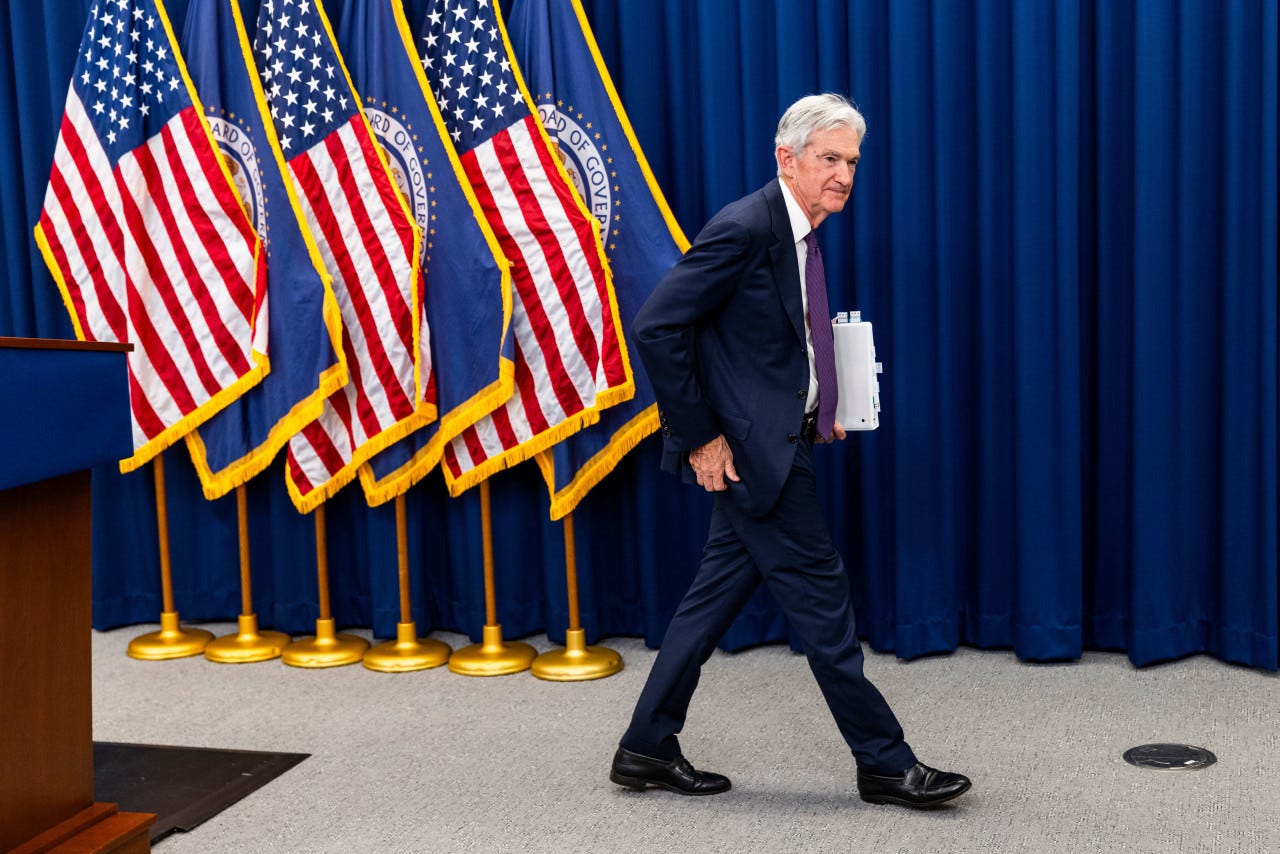
The Chairman’s term as Chair expires on May 15, 2026. The succession is the institutional inflection point.
The successor will be chosen by the executive. The successor’s confirmation will be conducted by a Senate whose institutional discipline on Fed independence has been substantially weakened over the past eighteen months. The successor’s tenure will define the next four years of American monetary policy and, more consequentially, will define whether the institutional architecture of Fed independence remains operational or is replaced by an architecture in which monetary policy is functionally a political instrument. The reserve managers at foreign central banks are not making this decision. The reserve managers are watching the decision being made, processing it through their models, and adjusting their allocations against the range of plausible outcomes. Every plausible outcome that involves a substantially compromised independence regime is being priced in now, before the outcome is known, because the option value of the unbiased outcome is rationally being discounted as the unbiased outcome becomes less probable.
FDR captured the Fed into a constructive monetary regime. The current capture is the reverse.
The historical comparison most often invoked for current Fed pressure is the Burns-Nixon period of 1971–1974, when Arthur Burns accommodated Richard Nixon’s political demands and produced the inflationary acceleration that defined the subsequent decade. The comparison is informative but inadequate. Burns accommodated Nixon by easing monetary policy below the level his judgment would have set; the accommodation produced inflation; the inflation was then defeated by Paul Volcker beginning in 1979 at substantial economic cost. The episode demonstrated that political pressure on the Fed produces specific kinds of damage and that the damage is correctable through subsequent independent action. The institutional architecture survived.
The 1933 Roosevelt comparison is more uncomfortable but more relevant. Roosevelt’s relationship with the Fed during his first term was substantively coercive. He moved the gold standard. He restructured the Federal Reserve Act through the Banking Acts of 1933 and 1935. He installed Marriner Eccles as Chairman with a mandate to coordinate monetary policy with fiscal expansion. The Fed under Eccles was an instrument of administration policy in a way it had not been before and would not be again until the 1951 Treasury Accord restored its operational independence. The 1933 capture was real.
The 1933 capture was also constructive. Roosevelt’s monetary regime was coordinated with a specific economic theory and a specific institutional reform program. The Fed was captured into a coherent monetary architecture, even if the architecture was politically directed. The reserve role of the dollar, which was emerging during this period and would be codified at Bretton Woods in 1944, was being underwritten by an administration that had a substantive monetary policy. The capture was reformist.
The current capture is the reverse. It is the extraction of monetary policy from the institutional architecture rather than its coordination with one. The executive’s interest in lower rates is not coupled to a substantive monetary theory or a coherent fiscal program. It is the interest of an administration in the political utility of lower rates against the institutional cost of producing them. The Fed is being captured out of its institutional architecture, not into a replacement one. There is no Eccles. There is no Banking Act. There is no Bretton Woods waiting at the end. There is the extraction.
The reserve managers know the difference. The reserve managers price the difference.
What the Central Banks Have Been Doing
The visible evidence of the reserve reallocation is the public data. Central bank gold purchases through 2022, 2023, 2024, and 2025 have set successive records. The People’s Bank of China, the Reserve Bank of India, the central banks of Turkey, Poland, Singapore, and several Gulf states have been the largest net purchasers. The aggregate central-bank gold position has reached its highest sustained level since the breakdown of Bretton Woods. The purchases are not speculative. They are reserve-portfolio reallocation away from credit instruments — Treasuries, dollar deposits, agency debt — toward an asset whose value is not conditional on the issuing state’s institutional architecture.
The renminbi’s invoicing share in commodities has continued to rise. Russia and China settled the substantial majority of their bilateral trade in non-dollar currencies by mid-2024. Saudi Arabia accepted renminbi for some oil shipments to China beginning in 2023, and the share of yuan-denominated invoicing among Gulf-China trade has continued to expand. Brazil and Argentina have piloted yuan-denominated trade arrangements. The aggregate effect on the dollar’s invoicing share has been incremental, but the trajectory is consistent and the network effects are nonlinear. Each new commodity-trade pair invoiced in non-dollar currency lowers the marginal cost of subsequent non-dollar invoicing.
The BRICS-plus payment infrastructure has moved through three generations in five years. The first generation — RCEP-adjacent settlement arrangements, BRICS Pay concept — was largely aspirational through 2023. The second generation — Project mBridge, conducted under the Bank for International Settlements with the central banks of China, the United Arab Emirates, Hong Kong, Thailand, and Saudi Arabia — moved through pilots in 2023 and 2024 and entered full operational deployment in 2024. The third generation is the integration of these settlement rails with the broader CBDC infrastructure being built across the major reserve-holding economies. The architecture is not yet a dollar replacement. It is a dollar bypass. For specific commodity flows, specific bilateral trade relationships, and specific sanctioned-state circumventions, the bypass is now operational.
The financial sanctions infrastructure that has been the dollar’s most consequential geopolitical use — the threat of secondary sanctions against any foreign entity that transacts with sanctioned counterparties — is being repriced as the bypass matures. The threat depends on the dollar being the only credible settlement currency for international trade. As the alternatives mature, the threat’s marginal credibility declines. The decline is not symmetric across all use cases — sanctions against Iran, Russia, North Korea, Venezuela remain costly to evade — but the marginal cost of evasion has been falling, and the falling cost compounds. The 2022 sanctions response to the Russian invasion of Ukraine was the inflection point. The unprecedented mobilization of dollar-system instruments against a major economy taught the world’s reserve managers that the conditions backing the trade now included a use-of-currency-as-coercion that had not been priced into the pre-2022 model. The model was updated. The allocations were adjusted.
What the central banks have been doing, in aggregate, is what the analytical reader of this publication is being asked to consider doing at the level of personal arrangement. They have been doing it faster, because they are paid to. They have been doing it at scale, because their mandates require it. They have been doing it quietly, because their institutional discipline requires that. They are not waiting for a crisis. They are pricing the conditions as the conditions move.
Slow Then Fast
The conventional analogy for dollar dedollarization is the British pound. The pound was the global reserve currency through the nineteenth century and into the first half of the twentieth. Its loss of reserve status played out across the 1944 Bretton Woods agreement, the 1956 Suez Crisis, the 1967 devaluation, the 1976 IMF rescue, and the gradual completion of the transition through the 1980s. The transition took roughly four decades. It was driven by the relative economic decline of the United Kingdom against the United States and the institutional consolidation of the dollar as the system’s central currency. The pace was generational. The implications for British policy were substantial but were absorbed gradually over the period.
The British analogy is the wrong analogy for the current American case.
The British pound lost reserve status as the British economy lost its weight in the world economy. The institutional architecture backing the pound — the Bank of England, the City of London, British contract law, British fiscal discipline — remained substantially intact throughout the transition. What was lost was the economic substrate. The institutional architecture survived the transition and continues to support the pound’s secondary international role.
The American case is the opposite configuration. The American economy retains its weight. The economic substrate of the dollar — the size and depth of the American economy, the relative productivity of American capital, the dominance of American firms in specific high-value sectors, the demographic structure — is not what is currently moving. What is moving is the institutional architecture. The Federal Reserve’s independence. The legal regime’s predictability. The fiscal trajectory’s credibility. The restraint in use of the currency as coercion. These are the variables changing. The economic substrate is the constant.
The historical analogy that matches this configuration is not Britain in the twentieth century. It is Spain in the seventeenth.
The Spanish peso was the world’s reserve currency from roughly the mid-sixteenth century into the mid-seventeenth. The peso’s status was underwritten by Spanish silver production from the Potosí and Zacatecas mines, by the Habsburg monarchy’s institutional reach across Europe and the Americas, and by the network of Genoese and Portuguese bankers who intermediated Spanish trade across the system. At its height, the peso was held by every major commercial center in Europe, was the unit of account for most international transactions, and was the asset against which other currencies were priced.
The peso lost reserve status in approximately two generations. The Habsburg monarchy defaulted on its debts in 1557, 1560, 1575, 1596, 1607, 1627, and 1647. Each default was technically resolved. Each default was, in cumulative effect, a demonstration that the institutional architecture backing the peso was not as reliable as the counterparty trade had priced. The Dutch and English commercial capital that had been intermediating the Spanish system progressively redirected itself toward the emerging institutional alternatives — the Bank of Amsterdam, founded in 1609, and later the Bank of England, founded in 1694. The redirection was incremental for the first generation. It was substantial by the second. By the late seventeenth century, the peso had been replaced as the system’s reserve currency by the Dutch guilder, and shortly thereafter by the English pound.
The Spanish economic substrate did not collapse during this period. The silver continued to be mined. The empire continued to be vast. The transatlantic trade continued to be substantial. What collapsed was the institutional credibility of the issuing state. The trade closed because the conditions backing it had been demonstrated to be unreliable, not because the economic underpinnings had failed.
Slow until it is fast. The trade closes when the conditions move past tolerance, not when the economy fails.
The Spanish case is informative because it demonstrates the speed at which a reserve role can be lost when the loss is institutional rather than economic. Two generations is a long time in personal terms and a short time in structural terms. The peso’s loss of reserve status was not visible in 1620. It was visible in 1670. The transition was substantially complete by 1700. A Spanish merchant of 1620 operating on the assumption that the peso’s status was a permanent fact of the world was making arrangements on the conditions that the next two generations would dismantle. The arrangements were valid at the moment they were made. They were obsolete by the time they had to be honored.
The American case is in approximately the 1620 position. The economic substrate is intact. The institutional architecture is being demonstrated to be less reliable than the counterparty trade had priced. The reallocation is in motion, incremental in the near term, compounding over the relevant horizon. The implications for arrangements being made now, on current assumptions, will be visible on a horizon that is shorter than most personal-planning horizons can ignore.
The Old Terms
What does dollar repricing actually cost, at the level of the country and the individual?
At the country level, the costs are direct. Treasury yields rise as the marginal demand for Treasuries declines. The federal government’s interest expense, already over fifteen percent of federal outlays and rising on the current trajectory, will compound faster as yields rise. The fiscal arithmetic becomes more constraining: less discretionary room, harder choices on programmatic spending, increased pressure on the entitlements baseline. The dollar’s trade-weighted value declines, raising import prices and pressuring inflation in a way the Fed will be less institutionally positioned to resist. The sanctions architecture loses marginal credibility as the bypass matures, reducing American geopolitical leverage in the specific use cases where sanctions have been the operative instrument. The exorbitant privilege ends, slowly and then suddenly, as the privilege is repriced.
At the individual level, the costs are distributed. The arrangements that depended on continued dollar primacy — the assumption that dollar-denominated savings would maintain purchasing power against international goods and services, the assumption that American real estate and equities would be the default for foreign capital, the assumption that dollar-denominated debt was the cheapest debt available — these arrangements are being repriced. The repricing is not catastrophic in the near term. It is constant.
The personal-arrangement implications track the country-level repricing on a lag. Currency diversification, which was a sophisticated preoccupation a decade ago, has become an obvious one. Real-asset exposure — particularly productive real estate in jurisdictions with stable property regimes — has been the rational hedge across most of the post-2022 period and remains so. Banking jurisdiction matters in a way it did not when the dollar was the unambiguous default. The institutional resilience of specific foreign jurisdictions — Switzerland, Singapore, the major European Union members, Canada — has become a relevant variable in personal financial planning, where for two generations it was a footnote.
The window in which arrangements can be made on the pre-repricing terms is the window between the trade’s progressive closing and the moment the closing is fully reflected in the asset prices the arrangements would use. The window has been open. It is narrowing. The reserve managers are not waiting for it to close.
The Chair’s term expires this week. The successor will be named, confirmed, and seated on a schedule the news cycle will cover one decision at a time. The cumulative meaning of the decisions will be available retrospectively, in the same way that the cumulative meaning of last week’s twelve events became available only when several of them clustered. The cumulative meaning of the next eighteen months of Fed decisions will be available retrospectively as well. The reserve managers will have made their adjustments by then.
The dollar bought the United States the right to write checks against tomorrow. Tomorrow has arrived.
The terms are no longer current.
The Long Memo is what I write when the architecture moves faster than the commentary moves. If this piece named something you had not yet seen named, the rest of the work runs in the same register.
Just WOW! Bryan. I was in Davos in 2008 when the subject of the dollar’s role in the world came up as a question…will it continue? Everyone scoffed at the idea. Not anymore…
And then there is the Seneca Effect shown throughout history... https://senecaeffect.substack.com/p/50-years-of-world-models-collapse