


Editorial Note: Some of my “notes” on Substack wind up reaching hundreds of thousands of readers. They catch fire (for whatever reason). If they’re going to get that much distribution, I figure, might as well also make it clear we have this publication called “The Long Memo.” So please do like, share, restack, as you normally would, but these posts are going to be “notes” - not analytically rigorous, but more likely than not, very irreverent.
“‘If you stay here much longer you’ll all be slitty-eyed.’”
Now, naturally, you assume Trump said that.
Reasonable guess.
Wrong decade.
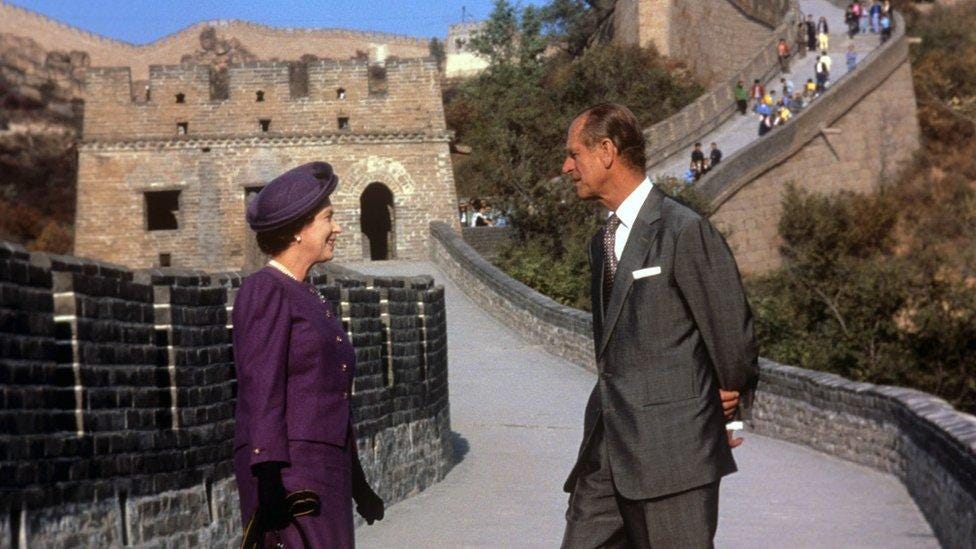
That was Prince Phillip in 1986, speaking to British students in China — back when the Royal Family still believed diplomacy meant showing up drunk, insulting the locals, and hoping the Commonwealth didn’t notice.
Phillip, to be fair, was the undisputed heavyweight champion of public gaffes. The man made Joe Biden look like Cicero with a teleprompter. Somewhere in Buckingham Palace there was probably an emergency room reserved exclusively for his press secretaries.
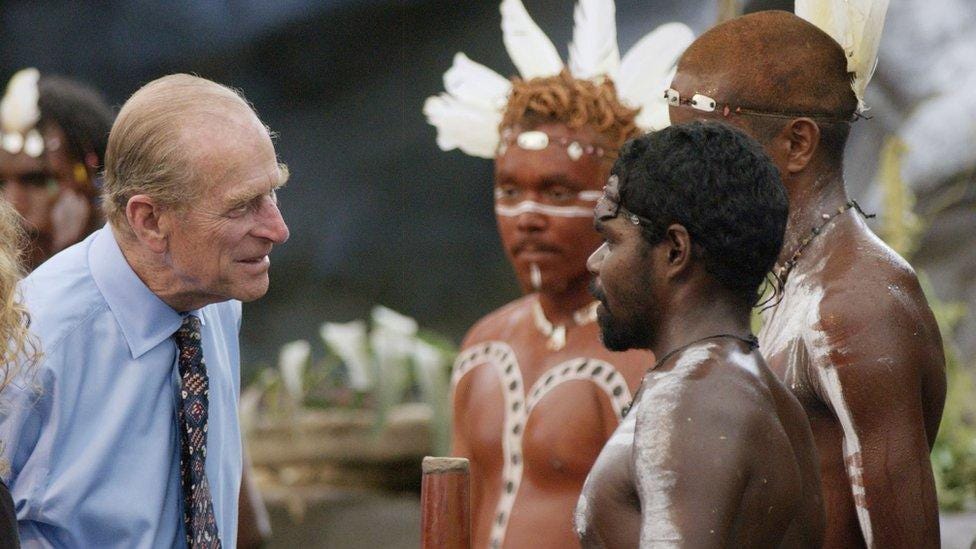
My personal favorite remains: “Still throwing spears?” — asked to an Australian Aboriginal during a royal visit. (That picture below is from that visit, I went and found it.)
Now, if Trump said that, Americans would collectively perform their standard ritual: clutch pearls, faint theatrically, and then immediately continue voting for him anyway.
But no. Prince Phillip.
The amusing part is that you instantly believed Trump could say it.
Which tells us something important.
So on the flight back from China, my friend Aaron is feeding me clips from what I can only describe as Reich Home Shopping Network Television — OAN, Fox, NewsNation, and the rest of the patriotic gelatin. While every normal newsroom is screaming “Jesus Christ, what now!?” these people are airing hard-hitting strategic analysis like:
“37 Velveeta recipes to celebrate Donald Trump!”
“Gasoline prices are down? Does this mean masculinity is back?”
“Is owning a leaf blower now an act of national sovereignty?”
Now, while they may not literally say “slitty-eyed” or “spearchucker,” spiritually we are absolutely operating in that neighborhood.
And from all this nonsense, one thing becomes perfectly clear:
Donald Trump could not possibly care less about Taiwan.
Frankly, if I put a revolver to his temple and demanded he locate Taiwan on a map, there’s at least a 40% chance he’d point at Aruba and ask for credit.
I remain unconvinced he could reliably locate Iran either, despite spending the last two months threatening to bomb it back into the Bronze Age every nine minutes on television.
So apparently, the grand “Art of the Deal” with Beijing now works like this:
“Hey Xi — don’t embarrass me over Iran, and you can rough up Taiwan a little. What do I care? You all look the same anyway.”
That, more or less, is the level of strategic sophistication currently emanating from Washington.
And remember:
roughly eighty million Americans examined this man and concluded:
“Yes. That is clearly a stable billionaire genius.”
No.
He isn’t.
And neither are they.
Now here’s where things actually become serious.
Taiwan is not Iraq.
It is not Afghanistan.
It is not some exhausted desert state held together with duct tape, AK-47s, and Toyota Hiluxes with Soviet plumbing welded to the back.
Taiwan is a real country.
It has real infrastructure.
Real engineers.
Real command-and-control systems.
Real industrial capacity.
Real anti-ship missiles.
Real cyber capabilities.
Real manufacturing.
Real education.
This is not a bunch of sandal-wearing insurgents firing homemade rockets while CNN explains tribal politics to suburban wine moms.
Pre-Ukraine, I would’ve said Taiwan was probably doomed in a direct confrontation.
Post-Ukraine?
Post-Iran?
Post-America sticking its national penis directly into an electrical socket and screaming “DETERRENCE!” while the lights flicker?
I’m no longer so certain.
Because modern warfare has revealed something Washington’s professional war-porn addicts still struggle to process:
Defense is often easier than offense.
Russia did not roll over Ukraine.
The United States has spent staggering quantities of money and munitions in the Middle East and still cannot reliably secure shipping lanes from dudes launching drones assembled with the equivalent budget of a suburban Applebee’s franchise.
Turns out conquering populations who prefer not to be conquered is surprisingly complicated.
Who knew?
Now let me clarify something before the internet’s strategic illiterates begin hyperventilating:
I do not think China is omniscient. Xi Jinping is not playing twelve-dimensional underwater Mahjong while America drools into the carpet.
China has enormous problems:
debt,
demographic collapse,
property bubbles,
capital flight,
internal corruption,
a political system structurally incapable of admitting major mistakes.
The People’s Republic is not the Galactic Empire.
But there is a profound difference between:
“China is unstoppable”
and
“China may have concluded the United States is increasingly incapable of coherent strategic discipline.”
Those are radically different propositions.
And right now, the second one matters far more.
Because Beijing is watching the United States behave like a wealthy alcoholic stumbling shirtless through a casino, yelling about freedom while setting its own wallet on fire.
China likely looked at America voluntarily stumbling into a regional war with Iran and thought:
“Surely they aren’t actually this strategically self-destructive.”
Then Washington answered:
“Oh, but we absolutely are.”
And Beijing kept watching.
Now understand:
China is a serious intelligence power.
Signals intelligence.
Cyber operations.
Industrial espionage.
Satellite reconnaissance.
Human penetration.
Economic analysis.
Diplomatic collection.
They do not require omniscience.
They only require pattern recognition.
And the pattern America is currently emitting looks something like this:
Extraordinarily powerful.
Increasingly erratic.
Politically fragmented.
Emotionally reactive.
Governed by a narcissistic game-show host who appears to make geopolitical decisions the way a drunk uncle chooses barbecue sauce.
That distinction matters.
The danger is not that China believes America is weak.
The danger is that China may believe America is inducible.
That is much worse.
Because once an adversary concludes you are reactive, impatient, distracted, and vulnerable to prestige traps, they stop trying to confront you directly.
Instead, they encourage you to exhaust yourself.
They widen distractions.
They deepen dependencies.
They let you consume your own bandwidth.
And this brings us to Taiwan.
Western commentary still treats Taiwan like a simple algebra equation:
China attacks → Taiwan falls.
But amphibious warfare against a fortified island defended by advanced surveillance, anti-ship systems, hardened infrastructure, drones, cyber capabilities, and a technologically sophisticated population is among the hardest military operations on Earth.
Taiwan is not Normandy in reverse.
It is not a Risk board.
It is not a cable-news animation narrated by retired generals who haven’t updated their mental software since Desert Storm.
To invade Taiwan, China would need to mass ships, logistics, transports, aircraft, fuel depots, staging areas, and command nodes across one of the most surveilled maritime corridors on Earth.
Those become targets.
And Beijing almost certainly understands something Washington is rediscovering in Iran:
Escalation ladders are easy to climb.
Controlling them is another matter entirely.
The United States can devastate Iran militarily.
That does not mean it can produce clean political outcomes.
Likewise, China may possess the capability to inflict catastrophic damage on Taiwan.
That does not necessarily mean Beijing can achieve a rapid, sustainable, economically survivable victory.
And that uncertainty is likely shaping Chinese behavior.
Because China historically prefers erosion to collision.
Pressure over spectacle.
Normalization over dramatic rupture.
Which means the greatest danger may not be an immediate invasion.
The greater danger is slower.
More corrosive.
A gradual conclusion spreading quietly through Asia that the United States no longer possesses the political coherence, industrial stamina, or strategic discipline required for sustained great-power competition.
And once allies begin privately wondering whether America can stay focused long enough to finish what it starts?
Deterrence begins collapsing all by itself.
No invasion necessary.
Really interesting analysis! Got a couple of chuckles but China doesn’t think or analyze like we do so you may have nailed this one! Great article!
«Turns out conquering populations who prefer not to be conquered is surprisingly complicated.»
Really? You just figured that out? What about Gallipoli? What about Dien Bien Phu?
OK, there's Normandy and the Marines Island hopping at about the same time, but I don't see the modern US having the kind of commitments the Allies had in Europe or the US in Asia these days