

If the 14th Turns to Ash...
Everyone wants to believe the Justices will do the right thing. What if they don't?

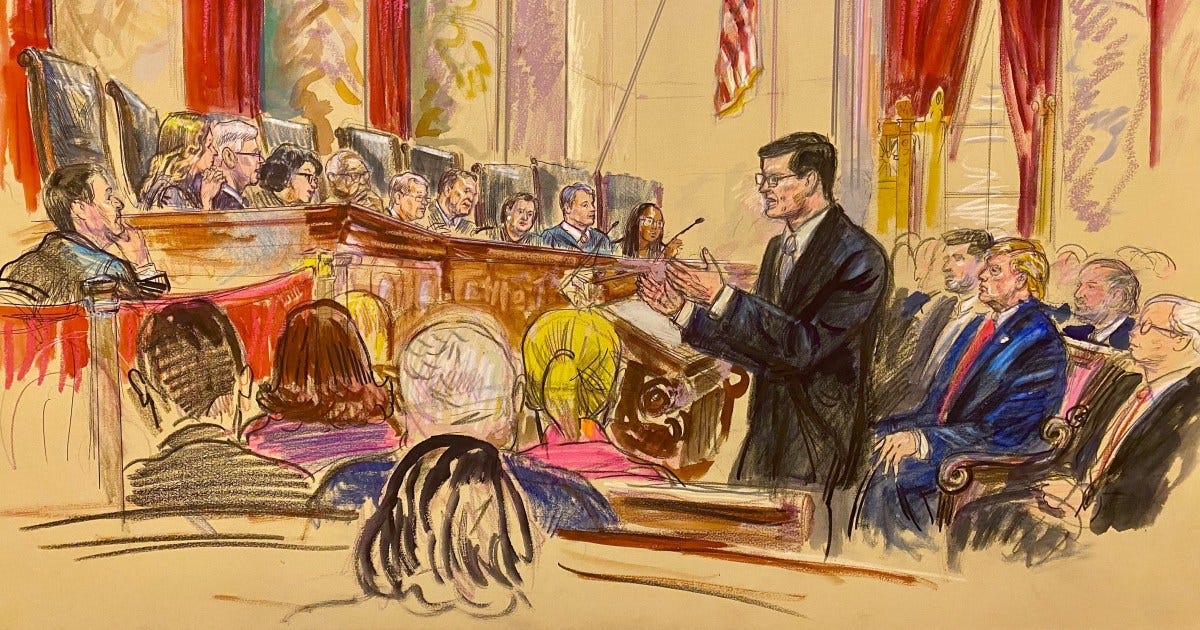
If the Court turns the Fourteenth Amendment to ash—and given its recent habit of treating precedent like kindling, that is no wild speculation—then millions of Americans will discover their citizenship is not a birthright, but a status subject to review.
Ask yourself a simple question:
If tomorrow the only test is whether you are “subject to the jurisdiction thereof,” do you actually know where you stand?
Not what you assume. Not what you were told in civics class. What you can prove.
Because if the Amendment is gutted, the fallback is blood. Lineage. Paper. A bureaucrat with a checklist asking you to reconstruct your ancestry—on their timeline, to their standard, with consequences for getting it wrong.
Can you do it?
Can you produce the documents that show someone in your chain naturalized—cleanly, properly, in a way the government will accept?
No?
Then your birthplace—“I was born in New York!”—becomes a sentimental detail. The government’s answer will be brisk and unpoetic: irrelevant.
The entire purpose of United States v. Wong Kim Ark was to remove precisely this uncertainty—to establish that birth on American soil, coupled with allegiance, settled the question. Full stop.
For more than a century, that wasn’t debated. It was assumed—like gravity.
Until it wasn’t.
Now people comfort themselves with courtroom theater—who sounded sharp, who asked tough questions, who seemed skeptical.
This is a category error.
This Court does not decide cases based on how oral argument “felt.” It decides based on what it believes the law should produce.
We have seen this movie before.
Roe was “settled law”—until it wasn’t. Every justice nodded solemnly at confirmation, then promptly set fire to it in Dobbs v. Jackson Women’s Health Organization.
Not because of abortion politics—that’s the distraction—but because the reasoning was a wreck. A decision that reads less like law and more like a brief written after the verdict was already chosen.
The pattern holds.
Take Chevron U.S.A., Inc. v. Natural Resources Defense Council, Inc.—forty years of doctrine built on a simple premise: Congress writes vague laws, agencies interpret them, courts defer within reason.
Functional. Boring. Necessary.
Then comes Loper Bright Enterprises v. Raimondo, and the Court decides—on its own authority—that it would prefer to be the policymaker. Doctrine gone. Not refined. Not limited. Erased.
No new coherent framework replaces it. Just the quiet assertion: we will decide now.
Or take the presidential immunity case—where two centuries of “no one is above the law” dissolves into a haze of exceptions so broad they swallow the rule. Even if you could defend the outcome, the Court’s decision to say it out loud—at that scale, in that way—betrays a deeper indifference to consequence.
That is the throughline: when the destination matters, the map becomes optional.
Which brings us back to the Fourteenth Amendment.
If the Court wanted to preserve the existing order, it had an elegant tool: decline to hear the case.
It could have simply said, “Certiorari Denied.” Let Wong stand. Let the executive order die quietly.
Two words. Status quo preserved.
It did not.
And when a Court goes out of its way to pick up a loaded question it could have ignored, it is rarely because it intends to holster the gun.
Do I think Kagan, Sotomayor, and Jackson buy the attack on birthright citizenship? No.
Do I think Alito, Roberts, Kavanaugh, Barrett, Thomas, and Gorsuch are persuaded by the arguments defending it? Also no.
This is where, I believe, all this commentary on what people saw yesterday is terribly misguided.
The outcome will not hinge on persuasion. It will hinge on preference.
And the preferences here are not subtle.
For decades, there has been a persistent irritation—sometimes whispered, sometimes shouted—about automatic citizenship for the children of non-citizens. Since the Immigration and Nationality Act of 1965, that irritation has matured into an ideology.
The legal question—“subject to the jurisdiction thereof”—is merely the lever.
What I expect is not an outright incineration of the Amendment. That would be too crude, too obvious, too easy to recognize as madness.
Instead, you will get something worse: a narrowing. A qualification. A “clarification” that introduces contingencies where none existed before.
A doctrine that sounds technical and restrained, but functions like a trapdoor.
Citizenship will become conditional—not in theory, but in administration. In edge cases first. Then in broader categories. Then, inevitably, in practice.
And once that door is open, it will not close.
Because the same Court that reimagined administrative law, rewrote privacy doctrine, and flirted with executive impunity is not suddenly going to rediscover judicial modesty when the stakes are higher.
If I’m wrong, I’ll say so gladly.
But if I’m right, the shift will be quiet at first. No mass denaturalizations. No dramatic announcements.
Just a new question, asked more often, in more places—
at airports, at banks, at borders, in courtrooms:
Prove it.
E. Pluribus fuck ‘em
Fuck. Always a brain bomb from you. Thanks for being forthright and frighteningly frank. I'm always a little scared reading the Long Memo, but always glad I did. Greatly appreciated, Mr. Del Monte.