


I was talking with one of my closest friends yesterday — a man who probably would have become a general were it not for his Army MOS. Vietnam veteran. Multiple tours. Eventually, a colonel.
He was also the man who hired me at the Pentagon.
I said to him, “Why do we say ‘Happy Memorial Day?’ It’s odd, isn’t it? We wouldn’t walk into a funeral and say, ‘Hey! Happy he’s dead! Happy funeral!’ But that’s essentially what we’re doing.”
He replied that prior to Iraq and Afghanistan, most Americans simply didn’t know the military the way they do now. Before the Global War on Terror, the overwhelming majority of Americans had little direct connection to war. Then, over twenty years, roughly 2.3 million Americans served in Iraq and Afghanistan across more than three million deployments. Nearly everyone in uniform knew someone who had been killed or wounded.
And that changes things.
In Iraq, 4,418 American service members were killed and nearly 32,000 wounded. In Afghanistan, another 2,350 were killed and more than 20,000 wounded.
No, those are not the catastrophic casualty levels of the Civil War or the Second World War. Not even close.
But what was different was the repetition.
I knew people at the Pentagon twenty years ago who had done six deployments. Before the GWOT, that would have been almost unimaginable outside of World War II. More than half the soldiers I met had done at least two tours. Many had spent years of their lives deployed overseas.
So perhaps Memorial Day once was mostly hot dogs, beer, and the unofficial start of summer. Maybe it really was just summer dresses, parades, and Nat King Cole singing about those “lazy, hazy, crazy days of summer.”
And honestly, it should be that.
It should be the peace paid for in blood.
Years ago, I visited Normandy.
Places I had studied for decades, I finally stood in myself: Omaha. Utah. Sword. Caen. Vierville. Pointe du Hoc.
We visited the German batteries overlooking the coast. Rusting artillery still sat there facing the English Channel.
The guns silent.
We have all seen the movies. Saving Private Ryan. Band of Brothers. The Longest Day. We think we understand what war looked like from those films.
I realized almost immediately that we do not.
Point du Hoc shattered every cinematic illusion I had ever carried about war.
The cliffs are not dramatic in the Hollywood sense. They are worse. Roughly 120 feet high, unstable, jagged, and unforgiving. From the top, you can see nearly the entire landing area below — which means the Germans could too.
Two hundred and twenty-five Rangers landed there on D-Day. By the time they were relieved, fewer than ninety remained combat effective.
Standing there, it became obvious that this was not Robert Wagner and Paul Anka heroically scaling cliffs in a war movie.
It had to have been terror.
Chaos. Confusion. Men drowning, slipping, screaming, climbing through mud and blood while machine guns fired down from above.
The films suddenly felt less like depictions of war than faint echoes of it.
But Omaha Beach was what truly overwhelmed me.
And I say this sincerely: even Saving Private Ryan understates what Omaha must have been like.
You cannot understand that landing until you stand there yourself.
The beach is enormous.
An immense killing field overlooked by bluffs, bunkers, artillery positions, and machine-gun nests with commanding fields of fire. The sand itself is soft and exhausting underfoot even in peace and sunlight. The day I stood there, families were walking the beach while children played near the water.
Broad, sunlit uplands.
That phrase from Churchill suddenly became real to me there.
I walked from the waterline toward the bluffs, trying to imagine what the men of the 1st and 29th Infantry Divisions faced that morning.
The Higgins boats approached through rough seas under artillery, mortar, and machine-gun fire. If you survived long enough for the ramp to drop, you then had to cross what felt like seven football fields of open beach carrying nearly eighty pounds of gear while being shot at from elevated positions in multiple directions.
The only meaningful cover was the shingle — little more than a slight rise in the sand followed by a shallow trench at the base of the bluff.
That was it.
That tiny depression in the beach became the difference between life and death.
And beyond it still stood the bluffs, the bunkers, the machine guns, and the artillery.
Standing there, you realize the sheer physical improbability of the assault. Not in the abstract. Not as arrows on a map. As human beings.
Young men.
Ordinary men.
That realization stays with you.
But what struck me most was the contrast between what happened there and what exists there now.
People laughing. Windsurfers crossing the Channel. Families enjoying summer along the French coast. Peaceful towns full of cafés, flowers, churches, and ordinary life.
Churchill once said:
“If we can stand up to him, all Europe may be freed and the life of the world may move forward into broad, sunlit uplands.”
That was what I saw at Normandy.
The bunkers still exist. Craters from bombs still scar the countryside. The remnants of the Atlantic Wall still sit facing the sea.
But the life of Europe moved forward.
Broad, sunlit uplands.
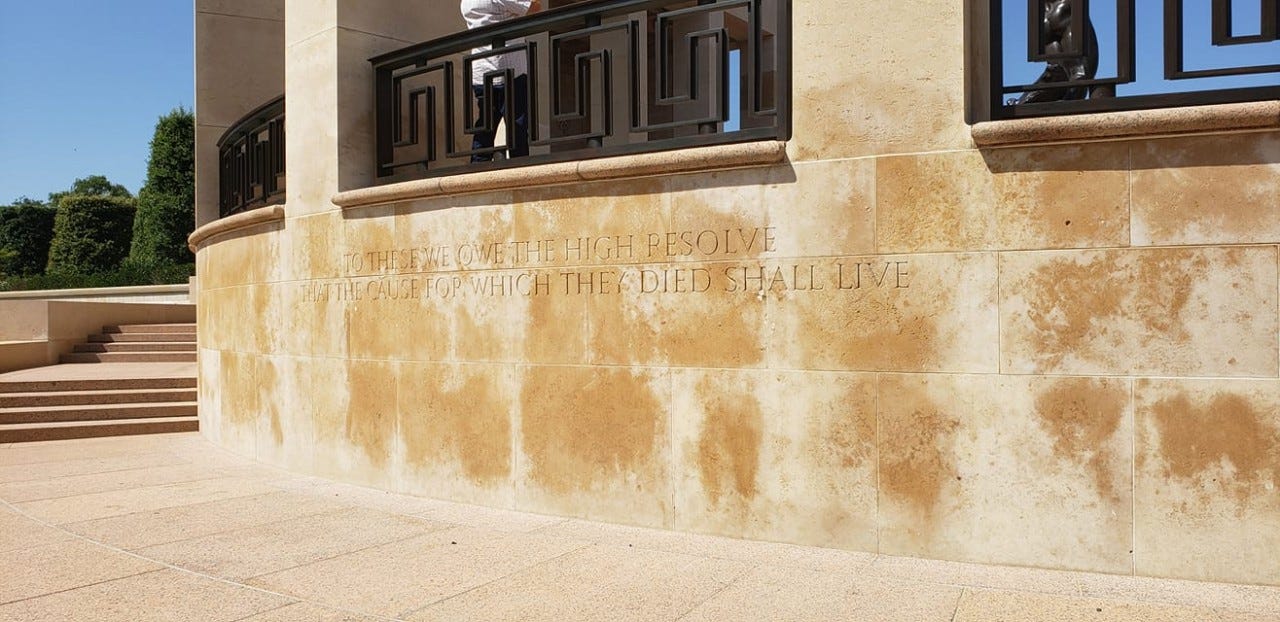
Then you arrive at Colleville-sur-Mer.
Arlington is solemn and moving. I have been there multiple times, including for military funerals.
But the American cemetery above Omaha Beach is something else entirely.
The entire cemetery feels American. Virginia bluegrass. Trees native to the United States. Perfectly maintained grounds overlooking the coastline where so many died.
It is as if those soldiers remain home, even in France.
Row after row of crosses and Stars of David.
Every one of them someone’s son.
Someone’s husband.
Someone’s brother.
General Mark Clark once said:
“If ever proof were needed that we fought for a cause and not for conquest it could be found in these cemeteries. Here was our only conquest: all we asked was enough soil in which to bury our gallant dead.”
France granted that land to America in perpetuity.
One comment from our Parisian tour guide has stayed with me ever since. He said Paris is beautiful — but that beauty carries shame, because the city was largely spared the destruction that consumed so much of Europe through surrender, collaboration, and capitulation.
He pointed out that unlike Poland, Italy, or much of Normandy, Paris bears few scars of war.
Then he said something I have never forgotten:
“The Americans had no reason to liberate France except that they believed freedom was worth fighting for.”
Standing there, I believed him.
I have seen extraordinary Americans in uniform. I had the honor of working beside many of them at the Pentagon.
But never have I been prouder to be an American than standing on those beaches.
The Big Red One.
The Rangers at Pointe du Hoc.
The 101st Airborne at Sainte-Mère-Église.
The stories are all there. Not as movies. Not as mythology.
As reality.
And what overwhelms you when standing there is not simply the scale of the courage, but the humanity of it.
They were not superheroes.
They were ordinary men trying to survive, protect one another, and come home.
That is what made them heroes.
That is why they deserve remembrance.
Not because they were born different from us.
But because, when history demanded it, ordinary men carried unbearable burdens and endured unimaginable terror so that future generations could live ordinary peaceful lives.
That is Memorial Day.
The peace paid for in blood.
Stephen Ambrose wrote in Band of Brothers that Lieutenant Harry Welsh remembered looking at the sleeping men around him before D-Day and realizing that, despite death surrounding them, none of them truly believed it would happen to them.
“They hadn’t come here to fear. They hadn’t come to die. They had come to win.”
For those remembering loved ones who never came home, perhaps no words say it better than Abraham Lincoln:
“I feel how weak and fruitless must be any word of mine which should attempt to beguile you from the grief of a loss so overwhelming. But I cannot refrain from tendering you the consolation that may be found in the thanks of the Republic they died to save.
I pray that our Heavenly Father may assuage the anguish of your bereavement, and leave you only the cherished memory of the loved and lost, and the solemn pride that must be yours to have laid so costly a sacrifice upon the altar of freedom.”
Ever since I visited Normandy 20 years ago, I've thought that every American needs to go there at least once. It should be our version of the American Hajj -- an essential pilgrimage that every citizen makes once in their lifetime, because it teaches you in a way nothing else ever can exactly what it means to be American in this world. You will never understand yourself or your country -- who we are, and what our existence makes possible -- in the same way again.
We visited Versailles a few days later. Our guide -- an elderly Frenchman with flowing silver locks, an extremely gay affect, a cravat, watery blue eyes, and a mouth that seemed to be stuck in a permanently disapproving pucker, led us into the King's study and started talking about the reasons that the monarchy failed. (I'd been walking around the palace for 45 minutes at this point, marvelling at the opulence and muttering to myself: Holy Christ on a baguette, did these people ever need a revolution....) Our guide made it clear that in his opinion, the thing that undid the French king was his support of the American Revolution -- a commitment that France, as it turned out, could ill afford (well, no, not while you're spending the substance of the nation on...gestures wildly...ALL THIS....), and which ultimately broke the country.
He went on like this for a long minute or two, his mostly American and Brit crowd listening uncomfortably, absorbing the shame he was clearly intending to inflict. But I wasn't having it. With such recent images of Colville-sur-Mer still filling my head, I couldn't control my mouth. Before I could catch the thought, my voice raised itself, solid and clear, and out it flew....
"I'd like to think that we paid that debt back, with interest, on June 6, 1944."
The words hung in the air. The group sharply, audibly inhaled with a single breath. My husband, standing beside me, winced, and then stared at me with an odd combo of embarrassment, pride, and glee. (Hoookay, so, that's my girl...) The guide's azure eyes widened like I'd just peed in the spittoon, and his mouth puckered so hard it looked like I'd shoved a lemon into it. (And I kind of had.) And thus ended his commentary. We moved on to discussing the vases on the mantle.
We've got this bond, us and France. They paid for our existence with treasure -- and, ultimately, blood, if the guide is to be believed. But we did not forget. When history gave us the chance to pay it back, we came, and climbed those beaches, and died for their existence, too. And they have not forgotten: two-thirds of the visitors to Colville-sur-Mer --some 650,000 per year -- are French. They bring their children, and they remember our sacrifice. Their memory hasn't died, either.
Our family had no members at D-Day -- my grandfathers were all in the Pacific -- but my kids' paternal great-grandfather sat out the invasion in a German POW camp. He was a B-17 tailgunner with the 90th Bomb Group, and had been shot down in February during the Big Week air assault on German industrial facilities that softened the ground for D-Day. By August, he'd escaped the camp, gotten over the Pyrenees, been returned to the UK, and was headed home.
Thank you for this! I too have been to Normandy, Omaha, the bunkers , Point de Hoc and the American cemetery. As a former Soldier in the 29th Division, Normandy is a special place. I found many 29ners graves at the Normandy Cemetery. It's incredible what they did on 6 June 1944, punching through the bluffs to get off the beach, as I stood on Omaha Beach and looked inland. The same at Point de Hoc!
As we remember those who served our country, I am reflecting on the service of my father (US Navy, WWII, South Pacific) and my father-in-law (US Army, WWII, 95th Infantry Division), as well as the Soldiers from my own service who have passed.
I also want to express what a privilege it was to serve with many great Soldiers. I truly value their service following their retirement. I learned a great serving with them and continue to do so.