


Canadians did something over the past fourteen months that Americans still do not fully understand.
They replaced us.
Not militarily.
Not diplomatically.
Commercially.
Socially.
Habitually.
And they did it bottle by bottle.
The story begins, improbably enough, with bourbon.
When Donald Trump imposed tariffs on Canadian goods in early 2025, the Canadian provincial liquor monopolies responded by pulling American alcohol from shelves. Ontario’s LCBO removed thousands of American products. Quebec followed. British Columbia followed. Most of the country followed.
At first glance, this looked like the sort of thing Americans are accustomed to seeing in trade disputes: governments retaliating against governments. Tariffs. Counter-tariffs. Press conferences. Officials pretend they are playing three-dimensional chess while everyone else waits for the next communiqué.
That was the official story.
It was not the important story.
The important story was what happened next.
The bottles disappeared.
Canadians substituted.
And then the substitution stuck.
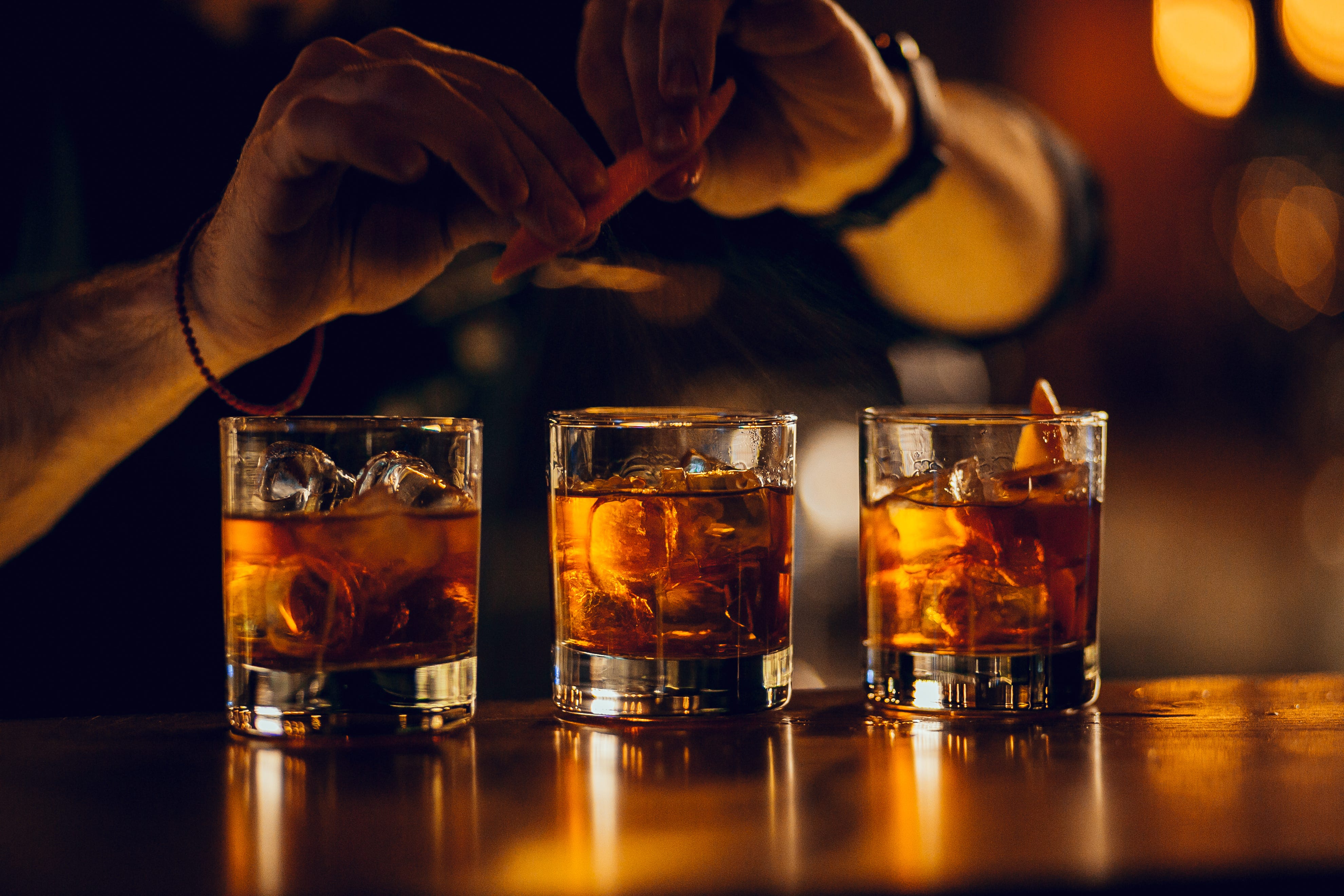
Bars in Toronto rebuilt their cocktail programs around Canadian rye. Restaurants in Montreal rewrote drink menus. Consumers who had spent decades buying Buffalo Trace, Maker’s Mark, Jim Beam, and Jack Daniel’s picked up Forty Creek, J.P. Wiser’s, Lot No. 40, Alberta Premium, and Caribou Crossing instead.
At first because they had to.
Then because they realized they could.
Then because they realized they preferred to.
That sequence matters.
The institutional move — pulling American liquor from shelves — created the interruption. But governments cannot force populations to internalize preferences. Governments can remove products. They cannot manufacture attachment.
The attachment came from the Canadian public itself.
That is the part Americans still do not understand, because the American political press is structurally incapable of describing it accurately.
The American press understands elite conflict. It understands presidents, ministers, trade representatives, polling memos, campaign messaging, diplomatic signaling, and procedural maneuvering between states.
It does not understand populations reevaluating another population.
That is what happened here.
The bourbon story was never fundamentally about tariffs.
It was about reputation.
At some point over the past several years — accelerated dramatically over the past eighteen months — millions of Canadians quietly concluded that association with the American brand no longer carried the prestige value it once did.
That is an extraordinary thing to say about the United States. It is also increasingly difficult to deny.
For roughly eighty years, “American” served as a premium marker globally. American products did not merely represent products. They represented affiliation with a civilization that much of the world associated with modernity, competence, optimism, stability, power, wealth, openness, and momentum.
American jeans.
American universities.
American technology.
American films.
American passports.
American financial markets.
American whiskey.
To consume the American thing was, in some sense, to participate in the American project itself.
That was the real export.
The bourbon mattered less than what the bourbon signified.
And what Canadians discovered over the past year was not merely that they could survive without American bourbon.
They discovered they no longer needed the American association attached to it.
This is where the story becomes larger than whiskey.
The mistake Americans are making is assuming this is still about Donald Trump.
It is not.
Trump may have accelerated the process. He may have exposed it. He may have crystallized latent sentiment into visible action. But the underlying mechanism is now operating independently of any one administration, because foreign populations increasingly do not evaluate the United States on a president-by-president basis.
They evaluate the system.
What much of the world sees now when it looks at America is not an aberration.
It sees volatility.
Political volatility.
Institutional volatility.
Cultural volatility.
Strategic volatility.
Social volatility.
It sees a country that appears unable to maintain continuity from one administration to the next, one election to the next, one constitutional interpretation to the next, or even one shared reality to the next.
And once populations perceive a hegemonic power as volatile, they diversify their exposure to it.
Not dramatically.
Not ideologically.
Gradually.
That is how hegemonic repositioning actually occurs in the real world.
Not with declarations.
With substitutions.
The bourbon story matters because the substitution became visible quickly enough for people to notice.
But the same mechanism is increasingly visible elsewhere.
European governments openly discussing reduced dependence on American weapons systems are not merely debating procurement efficiency. They are pricing strategic uncertainty into long-term planning.
Foreign technology firms reducing concentration around American cloud providers are not conducting ideological protests. They are managing geopolitical dependency risk.
Universities broadening recruitment and research partnerships away from American concentration are not signaling anti-Americanism. They are hedging against instability.
Agricultural importers diversifying supply chains away from the United States are not making moral statements. They are reducing exposure to unpredictability.
Even artificial intelligence — the field Americans assume guarantees indefinite dominance — depends fundamentally upon trust:
trust in legal continuity,
trust in stable capital markets,
trust in visa systems,
trust in research openness,
trust in alliance structures,
trust that dependency on American systems will not later become coercive leverage.
Once trust begins to erode, substitution pressure appears everywhere simultaneously.
This is the part Americans consistently misunderstand about decline.
Decline rarely begins with military defeat.
Decline begins with preference drift.
The world does not wake up one morning and formally announce:
“We reject the empire.”
Instead, over time, it quietly reorganizes itself to rely less on the empire.
Different suppliers.
Different schools.
Different software stacks.
Different financial rails.
Different logistics networks.
Different security assumptions.
Different cultural aspirations.
The process is gradual enough that the population within the declining hegemon often cannot perceive it as it happens.
Until suddenly, entire industries discover that markets they once assumed were permanent are no longer emotionally attached to them.
That is what bourbon represents.
Not the destruction of whiskey.
The discovery that the American premium is no longer guaranteed.
And once the premium disappears, every industry whose valuation depended partly upon American association begins repricing simultaneously.
Not because the world suddenly hates America.
Hatred is unstable.
Hatred fades.
What is happening now is colder than hatred.
The world is beginning to perceive America as a volatility source.
And rational systems reduce concentrated exposure to volatility sources.
That process is extraordinarily difficult to reverse because it is not fundamentally political anymore. It is behavioral.
Once populations normalize substitutes, they stop experiencing the old dependency as necessary.
The Canadian who spent fourteen months drinking domestic rye instead of bourbon does not automatically return to Jack Daniel’s because a tariff was removed.
The bartender who rebuilt his menu around Canadian whiskey does not suddenly reverse course because Washington changed administrations.
The substitution stops being political.
It becomes normal.
That is the point of no return every hegemonic system eventually reaches: the moment when alternatives become psychologically sufficient.
The terrifying thing for declining powers is not when the world fears them.
It is when the world discovers it can live without them.
That is what the bourbon story revealed.
Not that Canada hated Trump.
Not that tariffs hurt exports.
Something much larger.
A neighboring population — one historically among the most culturally integrated and psychologically aligned with the United States on earth — quietly demonstrated how quickly American centrality can erode once populations begin reassessing the value of association itself.
And they did it the way all large geopolitical transitions eventually happen.
From the bottom up.
Cheers.
As a Generation X Canadian, I believe you have captured brilliantly what is happening not just between Canada and the US, but globally. However, I would add one thing that is also simultaneously at play here, in a very
important grass roots way. For over 80 years, Canada's relationship with the US was rather like two young best friends growing up together. However, along the way the US became increasingly more powerful and wealthy, and gradually became drunk in it's own love of self. It started bragging about itself constantly, using phrases like "American exceptionalism", began beating it's chest loudly everwhere it went, yelling at the top of it's lungs how it was better than everyone. It started acting like the schoolyard bully in many ways. And over time it started taking it's much quieter friend, Canada, for granted. It began treating it's loyal and longtime friend as "less than", began referring to it's other friends, like the UK, as it's closest friend, not Canada. When the World would step up to help the US in wars, during 911, etc. it was other countries the US always made sure it thanked, often leaving Canada's name out. Canadians became increasingly and painfully aware that the US took them for granted, that the US didn't even bother to know it's old friend. When Canadian Rick Mercer traveled the US filming the show "Talking to Americans", it became alarmingly clear the average American knew very little to nothing about Canada, some even remarkably unaware Canada had it's own Navy! This was a slap in the face and a wake up call to Canadians that while we educated ourselves about our old friend, the US, while we took the time to know who they were, that same effort felt unnecessary to Americans. We slowly woke up to the reality that our old friend didn't really value our friendship, that they felt in some ways our friendship was a "sure thing" they didn't need to nurture or work on maintaining. Canadians quietly watched while Americans bragged about themselves, acted like the World would be nothing without it, and slowly, over time, that friendship eroded to the point that Canadians felt betrayed, taken for granted, unappreciated, and disrespected. You are right when you said that Americans aren't understanding what is happening today isn't merely about Trump. Trump was the proverbial "straw that broke the camel's back". He said the quiet part out loud. The utter disrespect and lack of appreciation for the longtime friendship between Canada and the US that Canadians had been feeling for decades was made official, loudly and with verbal violence. This was the breaking point for Canadians as individuals. This was the moment WE no longer valued the friendship but turned our backs and moved on from it. We boycot not only US alcohol, but in our everyday grocery shopping we left US products on the shelves to slowly rot like the US did our friendship. That is how Canadians sent the message to our old friend that we had had enough. We would no longer be taken for granted, be mocked, be ignored and dismissed as unimportant. We would invest instead in relationships with other Countries who knew our value, who took the time to know us, see us, appreciate us and respect us. Your decades of bragadocious tirades, of drinking your own Koolaide about how the US was superior, untouchable, the years of disrespect shown to others, have ended in a painful reality check for every American. Your house of cards has tumbled and you are mired in shock that no one is coming to help you rebuild. Canadians don't hate Americans. We are hurt, disappointed and frankly angry. We know you were drunk on your own Koolaide. But here's your reality check......it's time to sober up. Your Government doesn't define who you are, the American people do. So if you don't like how you are being portrayed around the World, get off your asses, stop waiting for someone to save you, and save yourselves. Home of the brave? Prove it......to the World, but most importantly to yourselves.
I for one, am so proud of Canada and Canadians for kicking my country, the U.S. to the curb.
We most definitely deserved their walking away from us and showing this awful elitist group of Americans running this country now, that we are not needed nor wanted.